
By Mason Carter | Technology & Future-of-Work Writer
Summarize this blog post with: ChatGPT | Perplexity | Claude | Grok
You already know AI is changing how work gets done — you’ve probably used it yourself, or at least seen your colleagues start to. But here’s the thing most articles keep getting wrong: AI isn’t coming for your job title. It’s coming for the specific skills inside your job — and honestly, for a lot of professionals, that process isn’t coming. It’s already happened. In this guide, I’ll walk you through exactly which skills AI has absorbed in 2026, name the tools doing the replacing, and give you a practical way to figure out where you actually stand before your employer does it for you.
Key Takeaways
- AI is replacing individual skills faster than entire job titles — most displacement in 2026 is happening at the task level, which means you can stay relevant by letting go of automatable sub-skills and building up the ones machines still can’t touch.
- Basic copywriting, data entry, Tier-1 support, translation, and boilerplate coding are already being handled by AI at enterprise scale — these aren’t future risks anymore. They’re current realities.
- AI adoption timelines compressed dramatically between 2023 and 2025, turning what analysts thought would take a decade into a three-year disruption cycle for many white-collar skill categories.
- Contextual judgment, emotionally intelligent leadership, creative strategy, and physical coordination remain genuinely hard to automate — these are your highest-value differentiators right now.
- A personal skill vulnerability audit is the most actionable thing you can do today — map your daily tasks against what AI tools already do, and the picture becomes very clear very fast.
- Microsoft, Google, Salesforce, Adobe, and a wave of specialized startups are leading the displacement — knowing what they’re building next gives you an early warning system.
- Learning to direct AI tools is now more valuable than the skills those tools have replaced — the workers being hired aren’t competing with AI; they’re managing it.
What Does “AI Replacing Skills” Actually Mean Right Now?
AI skill replacement is the process by which artificial intelligence tools automate specific tasks within a job role, reducing or eliminating the need for human performance of those tasks — without necessarily eliminating the job title itself. I know that sounds like a careful distinction, but it matters a lot in practice.
Think about a marketing manager. That role isn’t disappearing. But the first-draft copy, the keyword research report, the social media asset resized for six different platforms? ChatGPT handles the copy in 45 seconds. SEMrush AI generates the keyword report. Canva’s Magic Resize does the six formats before you’ve finished your coffee. The job title survived. A chunk of the work that used to justify a full-time hire did not.
From what I’ve seen across industries, this is almost always how it starts — not with a mass layoff announcement, but with a quiet realization that a task someone used to spend three hours on now takes three minutes. Then two people are doing the work of four. Then the next hiring cycle just… doesn’t happen.
Skills becoming obsolete due to AI tend to share one trait: they’re built around information retrieval, pattern-based generation, or rule-following execution. Those are exactly the things large language models and robotic process automation were designed for. If you can write down what you do as a step-by-step checklist — and that checklist doesn’t change much week to week — AI can almost certainly do it faster and cheaper than you can.
Why Is AI Replacing Jobs and Skills Faster Than Anyone Expected?
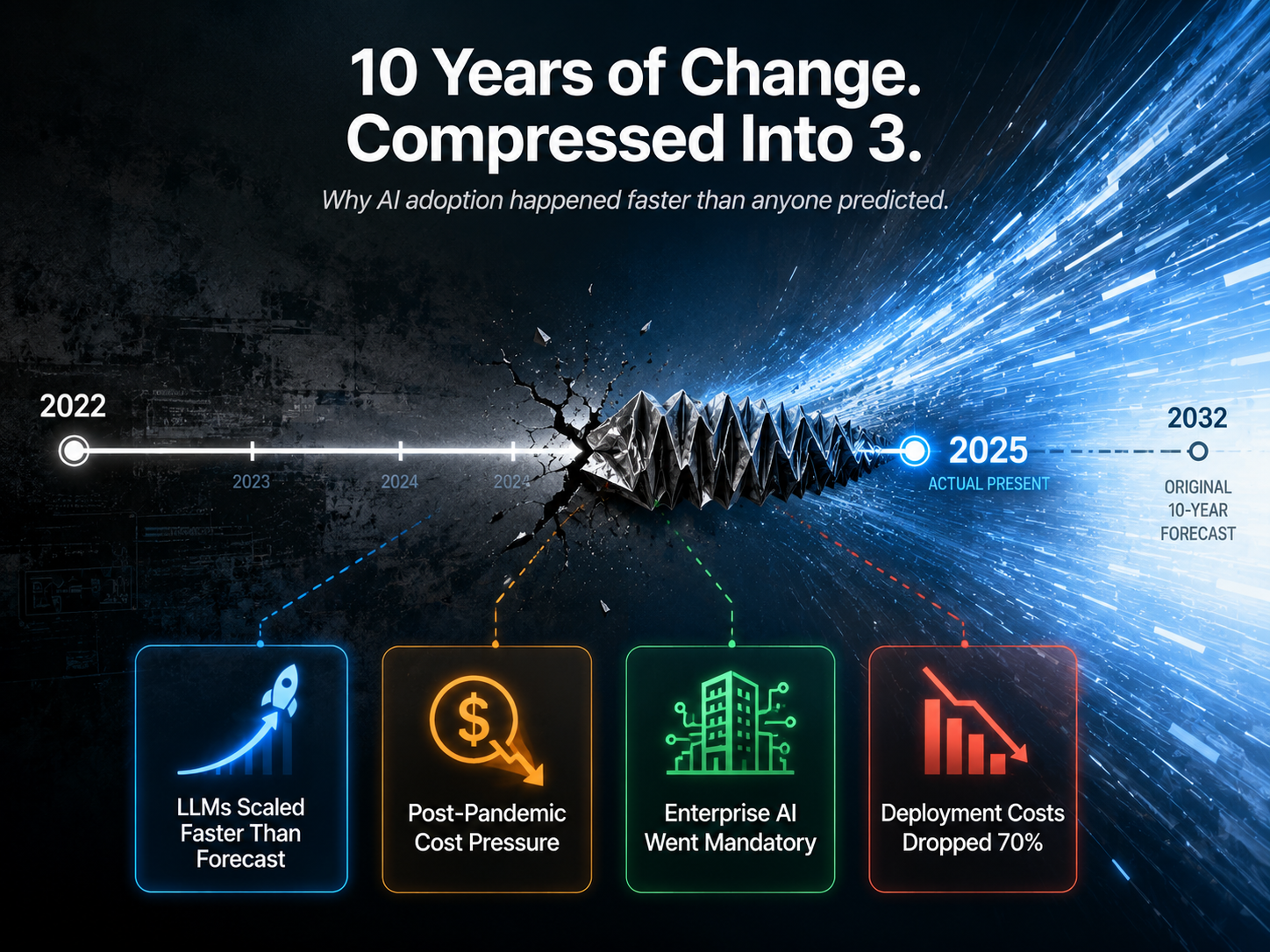
Honestly, even the researchers who study this got caught off guard by the pace. The acceleration of AI-driven skill displacement came from four things hitting at the same time between 2022 and 2025, and they compounded in ways nobody quite modeled correctly.
Large language models scaled faster than projected. GPT-4, Claude 3, Gemini 1.5 — these weren’t incremental updates. They represented capability jumps that analysts had penciled in for several years later. At the same time, post-pandemic cost pressure gave executives permission to pursue automation investments they’d have been more cautious about in a growth environment. Then how enterprises adopted AI in 2026 shifted from “we’re running a pilot” to “this is now part of the operating system” — Microsoft Copilot is embedded in the Office 365 suite used by over 400 million people. And the cost of deploying these tools dropped roughly 70% between 2022 and 2024 — Source: Stanford AI Index, 2025 — which made automation economically rational even for companies that aren’t Fortune 500.
One useful signal of how seriously the financial world views this shift: the scale of institutional capital flowing into AI infrastructure — even Warren Buffett’s Berkshire Hathaway now holds meaningful indirect AI exposure through Apple, Alphabet, and energy holdings tied to data center power demand.
According to McKinsey’s 2025 workforce analysis, approximately 30% of tasks across knowledge worker roles are now technically automatable using currently deployed AI systems — a figure that doubled since 2022 — Source: McKinsey Global Institute, 2025. Meanwhile, the World Economic Forum projects 85 million jobs displaced by automation globally through 2025, offset by 97 million new roles — Source: WEF Future of Jobs Report, 2023 — but that net-positive story depends heavily on workers being able to transition, and transition timelines are compressing faster than reskilling infrastructure can keep up.
Separately, Goldman Sachs research on AI and global employment estimates that generative AI could expose 300 million full-time jobs globally to automation — with two-thirds of occupations partially affected rather than fully eliminated — Source: Goldman Sachs, 2023.
Here’s what most people miss: it’s not that companies suddenly decided to fire everyone and replace them with robots. It’s that productivity per worker went up so dramatically that hiring slowed, junior roles stopped backfilling, and the skills that used to justify entry-level positions quietly became the job of a software subscription.
Which Specific Skills Is AI Already Replacing in 2026?
AI is actively replacing at least 10 distinct skill categories in 2026, each with specific tools doing the work at enterprise scale. Some of these will be obvious. A few might surprise you.
1. Basic Copywriting and Content Drafting
AI replacing copywriters is no longer a conversation about the future — it’s a line item in agency budget reviews. ChatGPT, Claude, and Jasper produce serviceable first drafts of blog posts, email sequences, and product descriptions in under a minute. Are they brilliant? Not usually. But “not brilliant” clears a pretty high bar when the alternative is paying a junior writer for several hours of work. Agencies report reducing junior writing headcount by 30–50% after integrating AI drafting tools — Source: Content Marketing Institute, 2024.
The human writer’s value now lives almost entirely in editing, voice, strategic framing, and the kind of nuanced judgment that comes from actually understanding an audience. If your writing work was mostly execution — filling templates, hitting word counts, turning briefs into deliverables — that part is largely automated.
2. Data Entry and Spreadsheet Manipulation
This one was probably inevitable, but the speed is still striking. Microsoft Copilot, Zapier AI, and UiPath now handle data extraction, validation, transformation, and spreadsheet population with near-zero error rates. Invoice processing that used to take 10 minutes per document runs in seconds. Tasks that once justified a dedicated data analyst now run as automated workflows triggered by a single prompt.
A 2026 automation analysis estimates data entry roles face up to 95% task automation risk in structured environments — Source: Industry Automation Analysis, 2026. That’s not “some tasks are automatable.” That’s nearly the whole job.
3. Tier-1 Customer Service and Support Scripting
The automation impact on customer service jobs is already showing up in company headcount numbers. Intercom’s Fin AI and Zendesk AI now resolve over 60% of inbound support queries without any human involvement — Source: Zendesk CX Trends Report, 2025. Sierra handles complex escalations that previously required trained agents. The scripts, the FAQ responses, the ticket routing — all of it runs on AI now in most mid-to-large enterprises.
Human support agents are increasingly handling exceptions, escalations, and situations that genuinely require empathy and contextual judgment. The rest of the queue? Automated.
4. Basic Graphic Design and Visual Asset Creation
AI image generation is reshaping creative teams in ways that felt theoretical just two years ago. Midjourney, Adobe Firefly, and Canva AI generate production-ready visuals in minutes. Junior design roles built around asset resizing, template population, stock-image sourcing, and social media variant creation have been effectively automated. These weren’t the glamorous parts of design work anyway — but they were the parts that justified entry-level hiring.
The designers still thriving are the ones doing brand strategy, art direction, and creative concepting — work that requires taste, cultural literacy, and a point of view, not just technical execution.
5. Document Translation and Localization
DeepL, Google Translate’s neural engine, and GPT-4o now produce translation quality that genuinely matches human professionals for standard business content. Meeting transcripts are generated with speaker identification in real time. Localization of product copy, marketing materials, and customer communications is largely automated. The human translator’s real edge now exists only in literary work, legal nuance, and culturally sensitive contexts where a mistranslation carries serious consequences.
For general business translation? The economics shifted decisively toward AI in 2024 and haven’t looked back.
6. Boilerplate Coding and Routine Development Work
GitHub Copilot, Cursor, and Replit AI complete repetitive code blocks, write unit tests, generate documentation, and handle boilerplate functions automatically. Devin tackles end-to-end feature implementation for well-defined tasks. From what I’ve seen in developer communities, the shift has been less about junior developers disappearing and more about senior developers no longer needing junior developers to do the work that GitHub Copilot and AI coding tools now handle. Output per developer went up; teams got smaller.
This doesn’t mean coding as a career is over — far from it. But if your value was writing the same patterns over and over, that specific skill is largely commoditized now.
7. Market Research Synthesis and Competitive Analysis
Perplexity and Crayon AI aggregate, synthesize, and deliver competitive intelligence reports in minutes — tasks that previously occupied analysts for days. AI tools for market research and competitive analysis now generate structured summaries with source citations on demand. The human analyst’s value has shifted to interpretation, strategic implication, and judgment calls that require business context the tool doesn’t have.
8. Scheduling, Calendar Management, and Administrative Coordination
Reclaim.ai and Motion autonomously optimize calendars, schedule meetings across time zones, handle conflict resolution, and prioritize tasks by deadline weighting. Executive assistants whose primary value was logistics coordination face direct displacement from these tools. The EAs who are doing well now are the ones managing relationships, handling sensitive communications, and exercising judgment — not the ones booking conference rooms.
9. Basic Legal Document Drafting
Harvey AI and Ironclad generate standard NDAs, contracts, and compliance templates that once required paralegal hours. Law firms using Harvey report 60–70% reductions in document drafting time — Source: Harvey AI Case Studies, 2024. This doesn’t mean lawyers are obsolete — it means the billing model for routine document work is fundamentally broken. The value in legal work is now even more concentrated in strategic judgment, courtroom performance, and complex negotiation.
10. Junior Financial Analysis and Report Generation
Runway, Planful, and Mosaic generate variance analyses, financial narratives, and forecast reports automatically. AI replacing human jobs in entry-level finance roles has shown up in multiple Fortune 500 earnings calls in the past 18 months, with CFOs explicitly citing AI tooling as the driver of reduced analyst headcount. The finance professional who just ran reports is in a much harder position than the one who knows how to use those tools to build better models and tell better stories with data.
The OECD Employment Outlook on automation risk identifies that 27% of jobs in OECD countries are in occupations highly exposed to automation — concentrated almost entirely in roles built around information processing and routine cognitive tasks — Source: OECD, 2023.
What AI Tools Are Actually Doing the Replacing?
Here’s a quick reference of the tools driving the most skill displacement right now:
| Skill Category | Leading AI Tools | What They’ve Replaced |
|---|---|---|
| Writing & Content | ChatGPT, Claude, Jasper | First-draft copy, email writing, ad creative |
| Data & Operations | Microsoft Copilot, UiPath, Zapier AI | Data entry, reporting, workflow administration |
| Design & Creative | Midjourney, Adobe Firefly, Canva AI | Asset creation, resizing, design templates |
| Customer Support | Intercom Fin, Zendesk AI, Sierra | Tier-1 support queries, scripting, ticket routing |
| Development | GitHub Copilot, Cursor, Devin | Boilerplate code, tests, documentation |
| Legal | Harvey AI, Ironclad | Document drafting, contract review |
| Finance | Runway, Planful, Mosaic | Report generation, variance analysis |
| Research | Perplexity, Crayon AI | Competitive intelligence, synthesis |
These AI tools replacing workers in 2026 aren’t in beta. They’re embedded in enterprise workflows, listed on company balance sheets as productivity investments, and actively factoring into headcount decisions. That’s the part that makes this different from previous technology waves — adoption happened at the operating layer, not just the tooling layer.
If you want a hands-on breakdown of how each category actually works in practice, our guide to AI productivity tools already transforming daily workflows covers the real-world setup — not just the theory.
Are White-Collar Jobs More Vulnerable to AI Than Blue-Collar Jobs?
This is a question I get asked a lot, and the honest answer is: yes, at least for now. White-collar knowledge work is automating faster than physical labor roles — Source: ReplacedByAI Report, 2026. That’s a reversal of what most people expected.
Previous waves of automation hit factory floors and physical logistics. AI is hitting offices. The reason is that language models and automation platforms are fundamentally tools for processing information, generating text, and following rule-based logic — all of which describes a significant portion of what office workers do. A robot still can’t wire your house, perform surgery with the finesse of an experienced surgeon, or manage a classroom full of eight-year-olds. But it can write a contract, generate a financial report, and answer a customer service email with reasonable competence.
Boston Consulting Group’s research on AI at work found that over 50% of workers are already using generative AI tools in their roles — but fewer than 20% have received any formal training on how to use them strategically, Source: BCG, 2023.
That said, no physical role is completely insulated. AI tools are enhancing capabilities in healthcare, construction, and agriculture — the exposure is just different in character.
Which Skills and Careers Will Stay Secure as AI Advances?
Skills AI cannot replace share a defining characteristic: they require human judgment applied under genuine ambiguity, emotional stakes, or in the physical world. Let’s be specific about what that actually looks like in practice.
Contextual ethical decision-making is genuinely hard to automate. Not because AI can’t generate an ethical-sounding answer, but because it can’t be held accountable for one. Emotionally intelligent leadership — the kind where you read a room, navigate a difficult team dynamic, or deliver feedback that actually lands — requires a kind of social intelligence that current models can simulate but can’t execute with real-world reliability.
Original creative strategy, as opposed to creative execution, is another area where humans still have a clear edge. AI can write a blog post. It can generate a hundred ad variations. But developing the brand positioning that makes one direction clearly right over another? That requires synthesis of business context, cultural insight, and taste that goes well beyond pattern matching.
Complex physical work — surgery, skilled trades, crisis response — remains genuinely hard to automate for a different reason: the physical world is messier than training data. An electrician encountering a 1960s wiring system in a flood-damaged building is dealing with a situation that has no clean precedent. Same with a surgeon handling unexpected anatomy during a procedure.
AI replacing human jobs typically follows a three-stage pattern: first, AI handles repetitive sub-tasks; second, headcount is reduced as productivity-per-worker rises; third, the role is redefined around tasks AI cannot perform. Knowing which stage your role is currently in tells you a lot about your timeline.
For a granular look at projected growth and decline by specific occupation, the Bureau of Labor Statistics Occupational Outlook Handbook remains the most reliable public resource — and its 2024–2034 projections show a clear pattern of growth concentrated in roles requiring judgment, care, and technical oversight.
How Do You Identify Which of Your Skills Are Most Vulnerable to Automation?
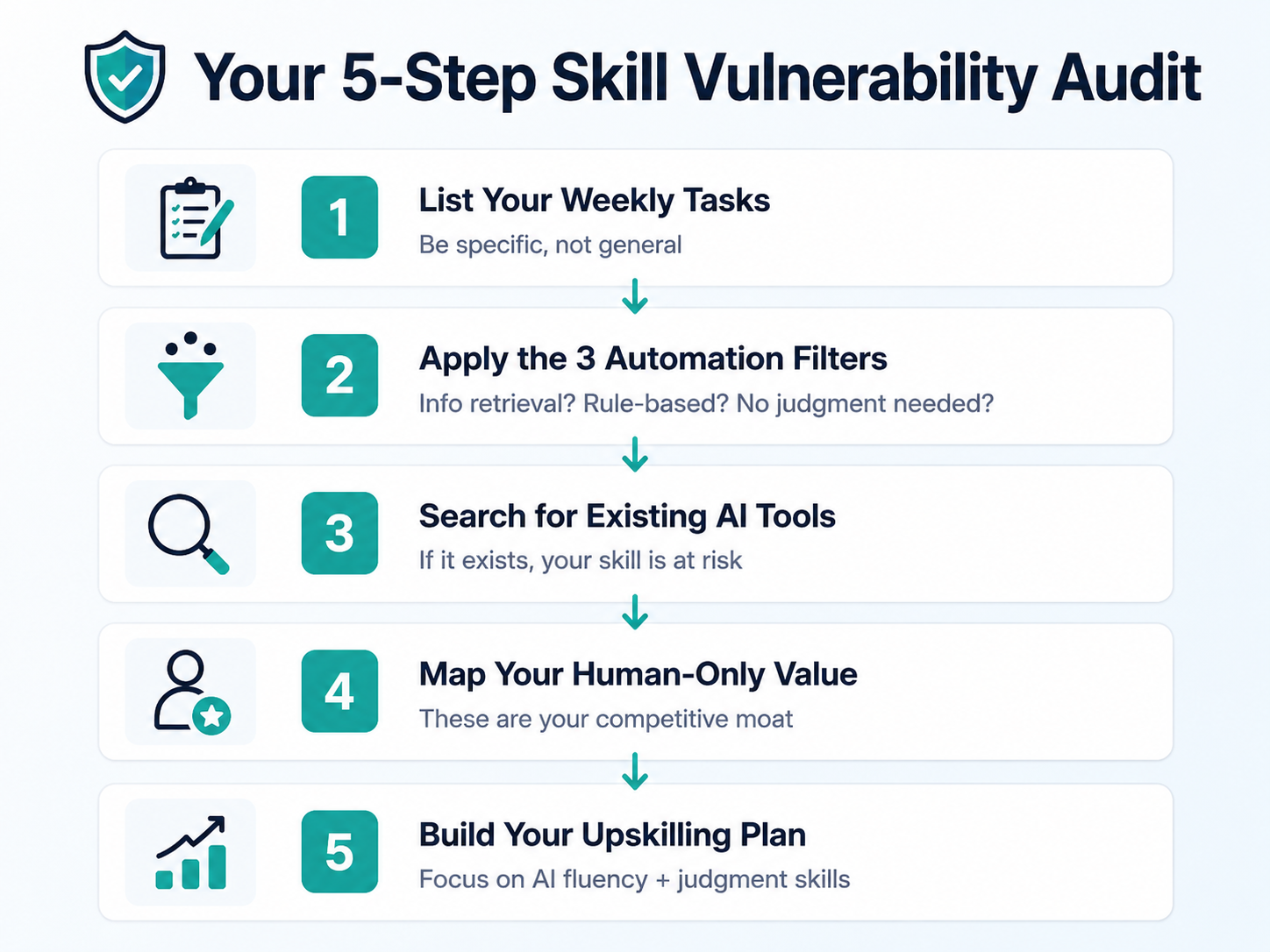
Auditing AI vulnerability involves cataloging your daily work tasks, mapping each against existing AI tool capabilities, and identifying which portions of your role can already be performed by currently available software. Here’s how I’d actually do it:
Step 1 — Get specific about what you do. Not “writing” or “analysis” — those are categories. List the actual tasks. “Write first-draft product descriptions from a brief.” “Pull weekly sales data from Salesforce and build the Monday report.” The more specific, the more useful this exercise is.
Step 2 — Apply three filters. Does the task involve retrieving or summarizing information that already exists somewhere? Can it be defined by clear rules or patterns that don’t change much? Does it require no physical presence and no real-time human judgment about a unique situation? If you’re answering yes to most of those, the task is likely automatable.
Step 3 — Do a quick tool search. Search whether a current AI tool already does what you just described. If it does — and it usually does for anything that passed those filters — your skill is at risk not in theory but right now.
Step 4 — Find your human-differentiated value. The tasks that genuinely don’t fit those filters are your competitive moat. They’re the things worth investing in and making more visible to your organization.
Step 5 — Build toward what remains. Focus on prompt engineering as a career skill and on AI-augmented workflow design. Use our personal skill vulnerability audit resource for a more structured process. Upskilling for an AI-driven workplace isn’t a career enhancement anymore — it’s table stakes.
A 2026 workforce survey found that 99% of CEOs now expect AI-driven role reductions in junior positions — Source: Mercer Survey, 2026. That’s not fringe thinking. It’s board-level consensus. The question is whether you find out about your vulnerability from your own audit or from an HR conversation.
According to LinkedIn’s Future of Work AI report, the share of job postings requiring AI skills has grown by over 70% since 2022 — and roles that combine domain expertise with AI literacy are commanding 20–30% higher compensation than their non-AI counterparts.
Will AI Create Enough New Jobs to Replace the Ones It’s Eliminating?
Honestly? Probably, over a long enough horizon. But the honest version of that answer is messier than the optimistic headline suggests.
Research does indicate that while roughly 85 million jobs may be displaced globally by 2030, approximately 97 million new roles could emerge — Source: World Economic Forum, 2023. New categories are already appearing: AI supervision, model auditing, automation design, prompt engineering, AI ethics review. These roles didn’t exist five years ago and are growing fast.
The problem is transition friction. The new roles require different skills, different educational backgrounds, and different professional networks than the roles being displaced. A data entry clerk in their 40s doesn’t automatically become an AI workflow designer. The net job numbers might balance out in a spreadsheet while creating serious human hardship in practice.
MIT’s Work of the Future research initiative consistently finds that technology doesn’t just eliminate roles — it restructures them, concentrating demand in tasks requiring judgment and adaptability while commoditizing execution-layer work.
From what I’ve seen, the professionals who navigate this best are the ones who don’t wait for the transition to happen to them — they get ahead of it deliberately.
Conclusion: Adapt Before You’re Asked To
How AI is replacing jobs and skills in 2026 is not a catastrophe — but it’s also not something you can afford to treat as background noise. The professionals who are going to come out of this period stronger aren’t the ones who resisted AI, and they’re not the ones who just passively started using a chatbot. They’re the ones who looked clearly at which of their own skills had already been commoditized and made a deliberate decision about what to build next.
The skill audit above takes less than an hour. It’ll give you more clarity about your actual position than any amount of reading industry predictions. Start there.
And here’s a reframe worth sitting with: your career was never really your job title, and it was never really your skill set. It was always your capacity to learn faster than the environment changes. That part — AI can’t touch yet.
If you’re ready to move from defensive to offensive, our guide to realistic ways to make money with AI in 2026 is the natural next step — it covers specific income methods, what each realistically pays, and how to get started without wasting time on approaches that don’t work.
Frequently Asked Questions
FAQ 1: Which jobs are most impacted by AI automation currently?
In 2026, the roles facing the steepest AI-driven displacement include content writers, data entry clerks, Tier-1 customer support agents, junior graphic designers, translators, administrative assistants, junior software developers, and entry-level financial analysts. These roles share a common thread: their core work involves information processing, pattern recognition, or rule-based generation — the exact areas where large language models and automation platforms now outperform human speed and cost. Roles requiring physical presence, complex interpersonal judgment, or genuine creative strategy remain substantially more insulated.
FAQ 2: What companies are leading AI tools that replace human skills?
The dominant players in 2026 span Big Tech and specialized startups. Microsoft (Copilot across Office 365), Google (Gemini across Workspace), Salesforce (Einstein AI), and Adobe (Firefly in Creative Cloud) are displacing skills at enterprise scale. Vertical-specific startups include Harvey AI in legal, Intercom and Sierra in customer support, GitHub Copilot and Cursor in development, Midjourney in visual design, DeepL in translation, and Reclaim.ai and Motion in scheduling. These tools have moved from experimental to operational — they’re embedded in workflows and generating measurable ROI.
FAQ 3: Which career paths will remain secure as artificial intelligence advances?
The careers with the highest resilience to AI displacement require contextual ethical judgment, emotionally nuanced human relationships, physical world interaction, or creative synthesis in ambiguous domains. Mental health therapists, skilled tradespeople, strategic consultants, executive leaders, investigative journalists, educators, and AI architects all fall into this category. Importantly, most of these roles aren’t immune to AI — they’re augmented by it. Professionals in these paths who embrace AI fluency compound their value significantly over those who resist it.
FAQ 4: How do I identify which of my current skills are most vulnerable to algorithmic replacement?
List every task you perform in a typical workweek, then ask three questions about each: Does it involve retrieving or summarizing information that already exists? Can it be defined by a clear set of rules or patterns? Can it be done without physical presence or real-time human judgment? If you’re answering yes, that task is likely automatable today. Cross-reference against existing AI tools — if something already does your task, your skill is at risk. What survives that filter is your human-differentiated value.
FAQ 5: What skills are becoming obsolete due to advanced automation technologies?
In 2026, the skills facing the fastest obsolescence are basic copywriting and content templating, manual data entry, boilerplate code writing, keyword research execution, rule-based customer query handling, standard document translation, scheduling and calendar coordination, basic image editing, standard financial report generation, and simple market data aggregation. These are defined by repetition, volume, and rule-following — exactly what machine learning systems are built to do at scale. Professionals whose entire professional value proposition rests on any one of these skills face the most urgent need to reposition.
Written by Mason Carter: Mason Carter is a technology and future-of-work writer specializing in artificial intelligence, workplace automation, digital productivity, and emerging career trends. His work focuses on how AI is reshaping industries, transforming job roles, and changing the skills professionals need to stay competitive in a rapidly evolving digital economy.
Reviewed by: Editorial Research Team & Content Strategy Contributors.
Disclaimer: This article is based on industry research, technology trend analysis, and observations from the evolving AI and automation landscape. The impact of artificial intelligence on jobs, workplace tools, and professional skills may vary across industries and continue to change rapidly over time. Readers are encouraged to independently evaluate current market conditions, technology adoption trends, and career requirements before making professional or business decisions. This content was initially drafted with AI assistance and has been carefully reviewed, refined, and fact-checked by human editors to ensure clarity, accuracy, originality, and editorial quality.