
By Lucas Bennett, a financial markets writer with experience covering stock market trends, long-term investing strategies, business analysis, and emerging technologies shaping global investment portfolios.
Summarize this blog post with: ChatGPT | Perplexity | Claude | Grok
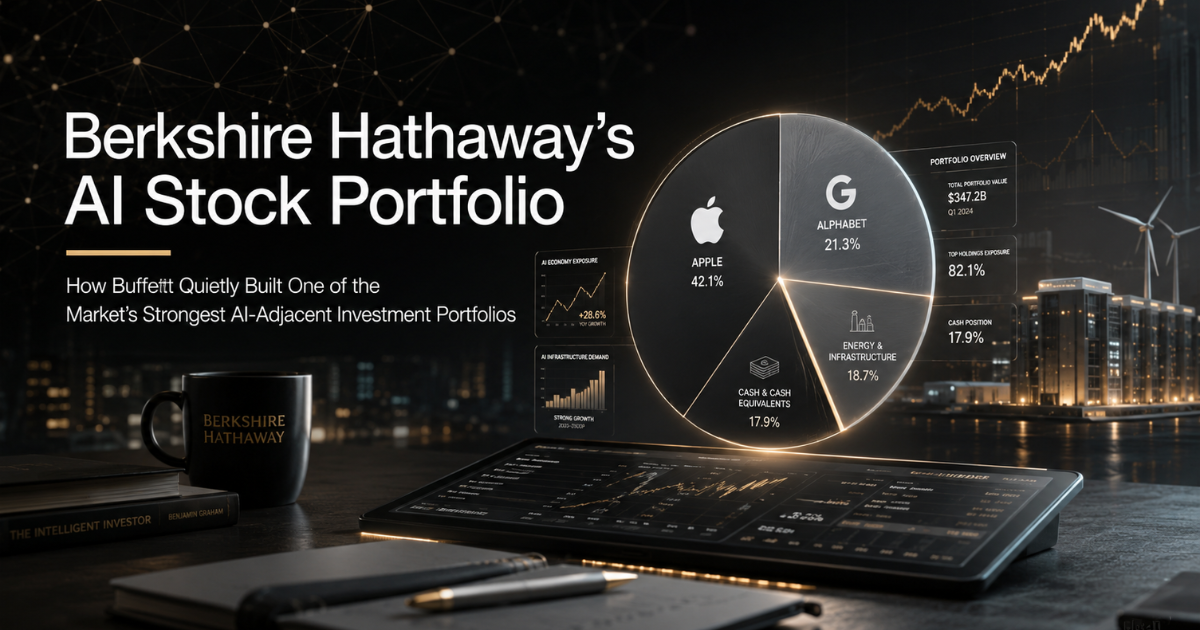
Here’s something most investors get backwards. They hear “Warren Buffett” and “AI” in the same sentence and assume there’s nothing interesting to unpack — because Buffett famously avoids technology trends he doesn’t fully understand. But if you actually pull up Berkshire Hathaway’s latest 13-F filing and look at where hundreds of billions of dollars are sitting, you’ll find a portfolio that’s quietly, almost accidentally, riding the AI wave harder than most people realize. In this guide, I’ll break down exactly which Berkshire Hathaway AI stocks are worth paying attention to, how the portfolio has shifted recently, and what any long-term investor can actually learn from Buffett’s approach to AI.
Key Takeaways
- Berkshire Hathaway’s AI exposure is primarily indirect — concentrated in Apple, Alphabet, and energy holdings rather than any pure-play AI company.
- Apple remains Berkshire’s largest AI-related position despite significant portfolio trimming in 2024 and 2025, still representing a meaningful share of total equity holdings.
- Alphabet became a major Berkshire holding in 2026, with Greg Abel’s team dramatically increasing the stake — a signal the market widely interpreted as a long-term AI infrastructure bet.
- Berkshire Hathaway stock itself gives investors diversified, lower-volatility exposure to AI trends without the concentration risk of owning a single tech stock.
- Energy holdings like Occidental Petroleum represent an indirect AI infrastructure play that most analysts overlook — AI data centers are power-hungry, and that demand flows straight to energy producers.
- Quarterly 13-F filings on SEC EDGAR are the most reliable way to track Berkshire’s portfolio moves — they’re free, publicly available, and released 45 days after each quarter closes.
- The real lesson from Berkshire’s AI approach isn’t which stocks to copy — it’s the underlying filter: own businesses that were already exceptional before AI arrived and are now becoming more powerful because of it.
What Is Berkshire Hathaway’s AI Stock Portfolio, Really?

Berkshire Hathaway’s AI stock portfolio isn’t a curated list of companies Buffett chose because of artificial intelligence. That’s an important distinction. Berkshire Hathaway’s AI-related holdings are companies that happen to be integrating AI aggressively into already-dominant businesses — which is a very different thing from making a directional bet on the AI sector.
Berkshire operates as a diversified holding company. It owns private businesses outright — GEICO, BNSF Railway, Dairy Queen — and also holds publicly traded stocks purchased on the open market. The public equity side is what most people track, and as of early 2026, that portion exceeded $330 billion in market value. Berkshire Hathaway’s public equity portfolio exceeded $290 billion in market value as of Q4 2024 — Source: SEC 13-F Filing, Berkshire Hathaway, 2024.
From what I’ve seen covering institutional portfolios, the confusion usually comes from people expecting Buffett to make a loud, explicit AI bet. That’s not how he operates. He bought Apple because it had ecosystem lock-in and consumer loyalty. He increased Alphabet because it had dominant market share and reasonable valuations. The AI tailwinds were a feature, not the thesis.
A 13-F filing is a quarterly report that institutional investment managers with over $100 million in assets under management must submit to the SEC, disclosing all equity holdings — making it the primary public source for tracking Berkshire Hathaway’s stock portfolio. It’s not complicated to read once you’ve done it a couple of times, and it’s genuinely useful.
Why Berkshire Hathaway’s AI Exposure Actually Matters Right Now
Honestly, there are a thousand AI stock articles out there. So why does Berkshire’s angle deserve attention? Because when the world’s most scrutinized value investor ends up holding exposure to a sector — even indirectly — it changes how the market thinks about that sector’s legitimacy.
Berkshire Hathaway’s AI investments matter because they demonstrate that conservative, cash-flow-focused investing and meaningful AI exposure aren’t mutually exclusive. That’s a useful counterpoint in an environment where a lot of AI investing conversation is dominated by speculation about startups that may or may not be profitable by 2030.
Buffett’s portfolio passes every position through a rigorous filter: does this business have a durable competitive moat? Is the model understandable? Does it generate real, predictable earnings? The companies that passed that filter — Apple, Alphabet, Occidental — just happen to also be benefiting enormously from AI. Over 60% of institutional investors surveyed cited the quality of a company’s existing AI adoption as more important than an AI-first label when making portfolio decisions — Source: Goldman Sachs Asset Management Survey, 2024.
There’s also a broader signal here. During AI market mania, Berkshire’s approach to the sector — through established, cash-generative businesses rather than speculative picks — suggests where the most durable value actually lies. Not in the hype layer. In the companies with decades of consumer trust and the capital to deploy AI properly.
The same AI wave that’s inflating Berkshire’s Apple and Alphabet positions is reshaping hiring, job roles, and skill demands across every industry. If you’re thinking about AI’s impact beyond your portfolio, it’s worth understanding how to become AI-proof in your career — because the companies Berkshire is betting on are the same ones automating workflows at scale.
Which Berkshire Hathaway Holdings Have Meaningful AI Exposure?
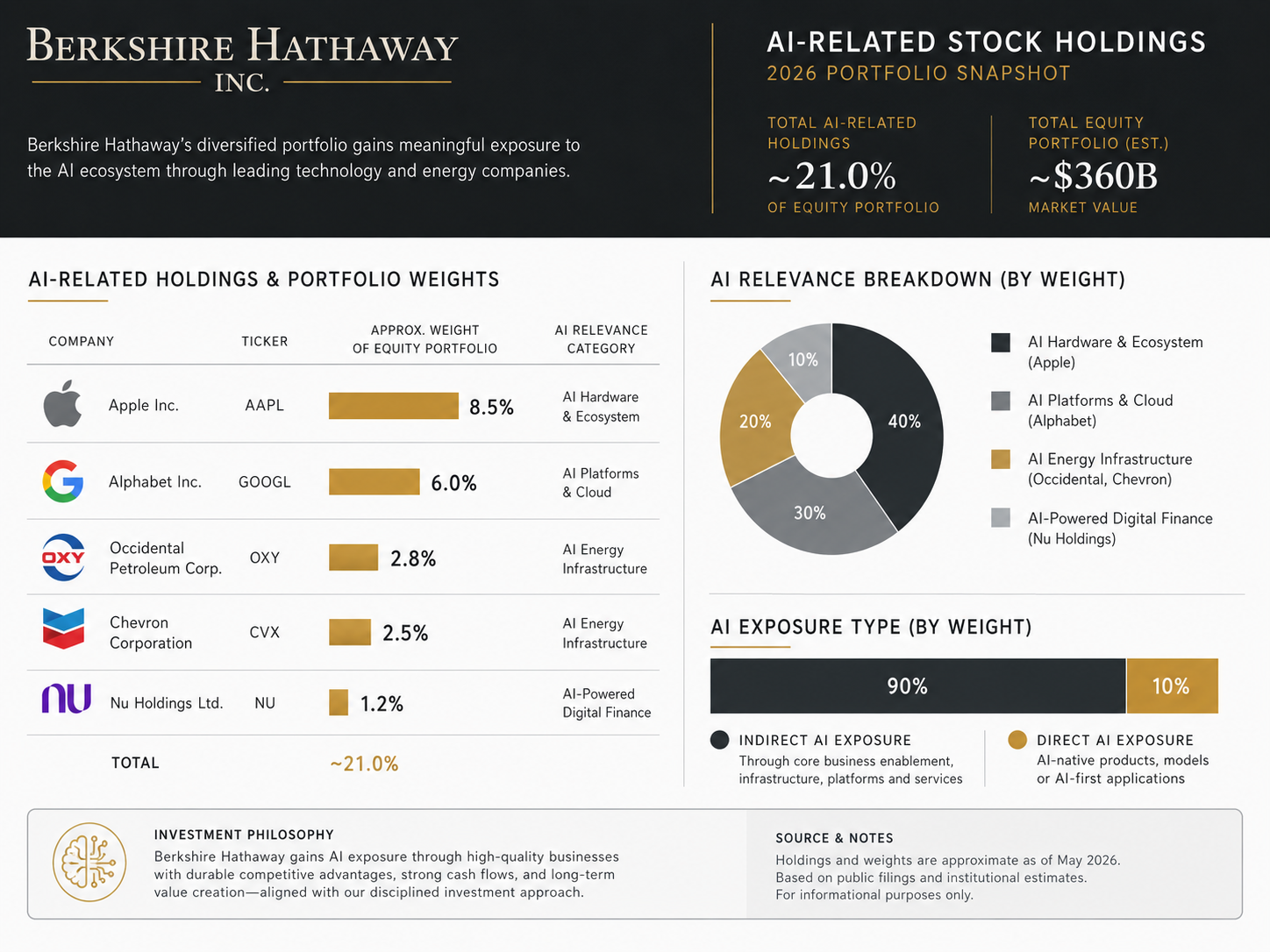
Berkshire Hathaway’s AI exposure is defined not by direct investment in pure-play artificial intelligence companies, but by its substantial stakes in businesses — particularly Apple and Alphabet — that are integrating AI as a core driver of future revenue growth.
Here’s how the major holdings break down:
| Holding | AI Category | Key AI Angle | Approx. Portfolio Weight (2026) |
|---|---|---|---|
| Apple (AAPL) | AI-Adjacent | Apple Intelligence, on-device AI, Siri overhaul | ~20%+ |
| Alphabet (GOOGL) | AI-Adjacent | Gemini, Google Cloud AI, Search AI Overviews | Rapidly growing |
| Occidental Petroleum (OXY) | AI Infrastructure Beneficiary | Data center energy demand | ~4–5% |
| Chevron (CVX) | AI Infrastructure Beneficiary | Grid demand from AI workloads | ~2–3% |
| Nu Holdings (NU) | AI-Adjacent | AI-driven credit scoring and fintech | ~1% |
Is Apple Still Berkshire’s Biggest AI Bet?
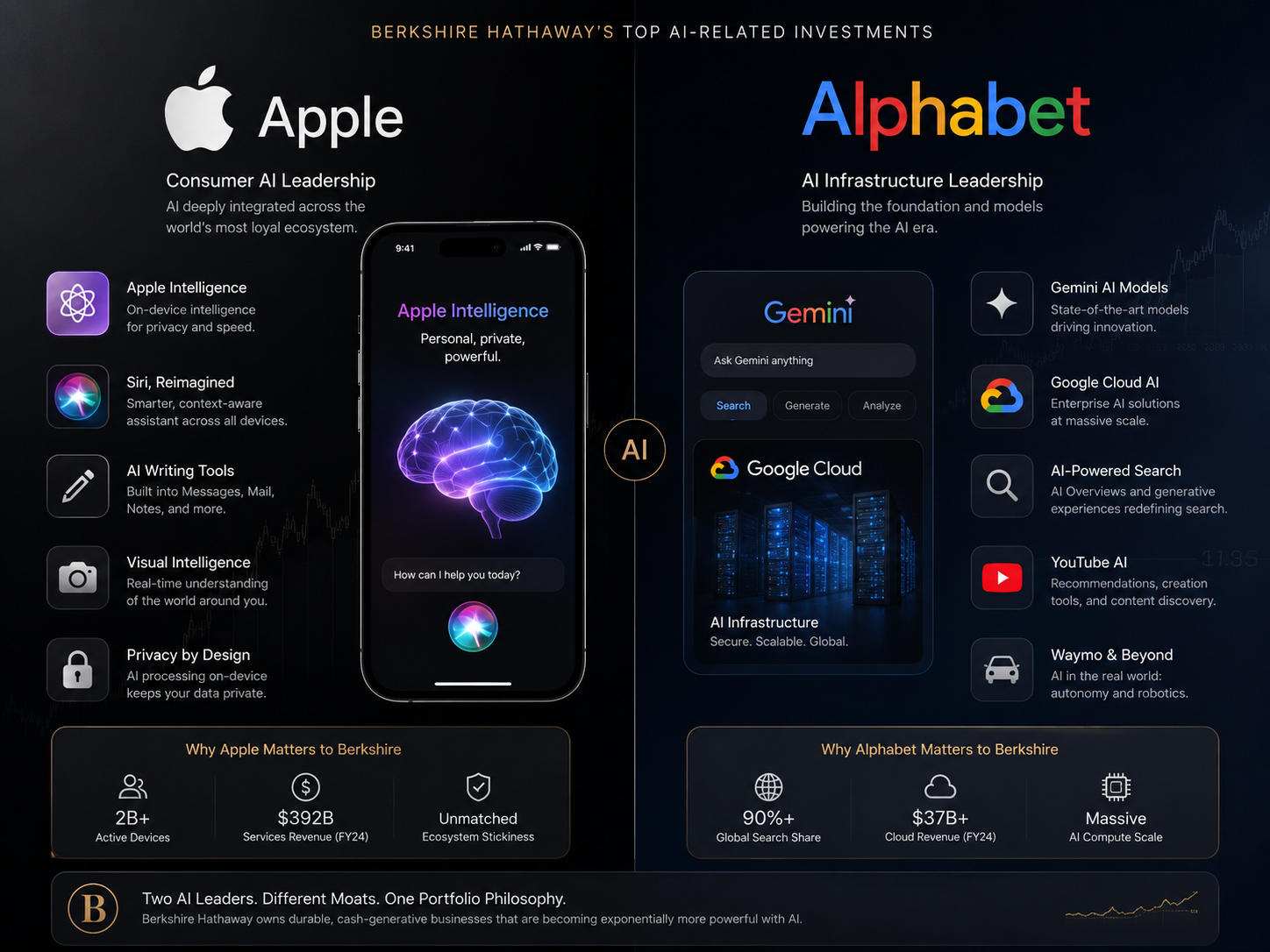
Apple Inc. constitutes the single largest position in Berkshire Hathaway’s public equity portfolio, representing the company’s most significant indirect exposure to consumer and enterprise AI deployment. That’s still true even after Buffett trimmed the position substantially through 2024 and 2025. According to recent reports, Apple still represented over 20% of Berkshire’s portfolio in 2026 despite those reductions — Source: The Motley Fool, 2026.
Here’s the thing about Apple’s AI story — it’s not flashy, which is probably why it gets underestimated. Apple Intelligence, launched in 2024, integrates generative AI across iPhones, iPads, and Macs: AI writing tools, an overhauled Siri, ChatGPT integration, on-device summarization. Apple spent more than $30 billion on research and development in fiscal 2024 alone — Source: Apple Annual Report, 2024. That’s not a company dabbling in AI. That’s a company making AI foundational to its ecosystem strategy.
Buffett famously called Apple “an even better business than American Express or Coca-Cola.” He wasn’t saying that because of Apple Intelligence. But Apple Intelligence makes it more true now than when he said it.
Why Alphabet Is the Most Interesting Move in Recent Berkshire History
This one caught a lot of people off guard. Berkshire more than tripled its Alphabet holdings during Q1 2026 — Source: Investors.com, 2026. For a firm historically skeptical of technology complexity, that’s a significant statement.
Alphabet’s inclusion in Berkshire’s portfolio gives it direct exposure to cloud AI infrastructure and AI-powered search at a scale few companies can match. Google Cloud AI services, Gemini models, Waymo autonomous vehicles, YouTube’s recommendation engine — Alphabet isn’t just adjacent to AI. It’s building the infrastructure layer that most of the AI economy runs on.
From a valuation standpoint, Alphabet has historically traded at more reasonable multiples than pure-play AI peers, which fits Berkshire’s discipline. Some analysts argued this was one of the cleanest Buffett-style AI investments possible — genuine AI leadership at a price that didn’t require heroic growth assumptions.
The Energy-AI Connection Everyone Keeps Missing
This is the angle I find most underappreciated. Berkshire Hathaway’s energy holdings, including Occidental Petroleum and Chevron, represent an indirect AI infrastructure play, as the exponential electricity consumption of AI data centers is creating sustained demand for fossil fuel and utility-sector energy production.
AI data centers are projected to consume up to 9% of U.S. electricity by 2030 — Source: Goldman Sachs Research, 2024. Training a single large AI model can consume as much electricity as hundreds of homes use in a year. That demand has to come from somewhere, and right now, a meaningful portion of it flows through fossil fuel generation and utility infrastructure. Berkshire Hathaway Energy — the private subsidiary — is even more directly exposed to this trend through its utility and renewable energy operations.
It’s not that Buffett bought Occidental because of AI data centers. But it’s a genuine, structural tailwind that’s now embedded in that position.
How Much of Berkshire’s Portfolio Is Actually Tied to AI?
Let’s put some rough numbers on this. As of early 2026, roughly 37% of Berkshire Hathaway’s public equity portfolio was invested in three companies with significant AI exposure — Apple, Alphabet, and at least one additional AI-adjacent holding — Source: The Motley Fool, 2026. Add energy holdings with AI infrastructure tailwinds, and you’re looking at a portfolio where nearly half the market value carries some meaningful AI exposure.
The critical nuance: almost none of this is a deliberate AI-sector bet. Berkshire is running a quality-business thesis. Quality businesses in 2025 and 2026 just happen to be deploying AI aggressively. The AI tailwind is incidental to the investment rationale, not the reason for it. That’s a subtle but important distinction for anyone trying to read Berkshire’s moves as a signal about AI market direction.
Before reshuffling your portfolio around AI themes, it’s worth getting a professional second opinion. Fiverr has vetted finance freelancers offering portfolio review services — useful if you want an objective read on your current AI exposure before making any moves.
How Does Berkshire’s AI Exposure Compare to Other Institutional Investors?
Compared to pure AI-focused funds, Berkshire Hathaway’s AI exposure is narrower in breadth but concentrated in higher-quality, more profitable businesses. ARK Invest, for example, holds dozens of AI and tech-adjacent positions across growth-stage companies. Berkshire holds a handful of giants.
Here’s a simplified comparison:
| Investment Type | Risk Level | AI Exposure | Volatility | Long-Term Stability |
|---|---|---|---|---|
| Berkshire Hathaway | Moderate | Indirect | Lower | High |
| Nvidia/Semiconductor Stocks | High | Direct | Very High | Moderate |
| AI-Focused ETFs | Medium-High | Broad/Direct | High | Variable |
| AI Startups | Extremely High | Direct | Extreme | Uncertain |
The S&P 500 itself is increasingly AI-weighted — the top five AI-adjacent companies now represent an enormous share of the index. Berkshire sits somewhere between a traditional value fund and a modern technology-exposed conglomerate. It’s not trying to maximize AI exposure. It’s trying to own irreplaceable businesses, and some of those businesses happen to be at the center of the AI economy.
How Can You Actually Track Berkshire Hathaway’s Latest Holdings?
Investors can track Berkshire Hathaway’s portfolio changes through SEC 13-F filings, third-party aggregators, and annual shareholder letters — and honestly, most people overcomplicate this.
The most reliable resources:
- SEC EDGAR (edgar.sec.gov) — official 13-F filings, completely free, released within 45 days of quarter-end. This is always the primary source.
- Dataroma — aggregates Berkshire and other superinvestor filings into a clean, readable dashboard. Good for quick snapshots.
- WhaleWisdom — tracks position changes, new buys, and complete exits with historical charting. Useful for spotting trends over multiple quarters.
- Bloomberg Terminal — for professional investors who need real-time alerts on 13-F amendments and SEC disclosures.
- Berkshire Hathaway’s annual shareholder letters — Buffett’s own writing remains one of the best primary sources for understanding investment rationale.
One thing worth noting: 13-F filings only disclose long equity positions. They don’t show options strategies, short positions, or private holdings. So what you see is a useful — but incomplete — picture of Berkshire’s total investment activity.
What Does Berkshire’s AI Strategy Actually Signal for Retail Investors?

Retail investors should treat Berkshire’s portfolio as a signal of business quality and durable competitive moats, not as a direct endorsement of AI as a sector bet. Copying the positions wholesale misses the point entirely.
The more valuable exercise is understanding the filter Berkshire applies and then using that same filter to evaluate AI-adjacent opportunities in your own portfolio. That means asking: does this company have real, recurring cash flow? Does it have competitive advantages that AI strengthens rather than threatens? Is the valuation reasonable relative to long-term earnings power?
Practically speaking, here’s what I’d suggest watching:
- Monitor upcoming 13-F filings for new positions in semiconductors, cloud infrastructure, or enterprise software. Any of those moves would signal a genuine shift in how the team thinks about direct AI exposure.
- Pay attention to Berkshire Hathaway Energy — the private subsidiary’s involvement in utility-scale power infrastructure makes it a sleeper play on AI data center demand.
- Weight toward AI-adjacent quality companies with strong balance sheets rather than speculative pure-plays. The Berkshire approach isn’t about finding the next Nvidia. It’s about finding the next Apple — a company that was already great and is now using AI to become untouchable.
Global AI market revenue could exceed $1.8 trillion by 2030 — Source: Grand View Research, 2025. At that scale, the companies that extract durable value won’t necessarily be the ones with “AI” in their name. They’ll be the ones that figured out how to monetize it profitably, at scale, with existing customer relationships. That’s exactly the profile Berkshire looks for.
Berkshire’s portfolio is a useful compass, but it won’t pay your bills directly. If you’re looking to put AI to work beyond just investing in it, we’ve broken down the realistic ways to make money with AI in 2026 — including what’s actually generating income for people right now versus what’s overhyped.
Conclusion
Warren Buffett has publicly compared artificial intelligence to the atomic bomb in terms of its transformative potential — acknowledging both its power and his own uncertainty about how to value AI-driven businesses. That quote gets passed around a lot, but what matters more is what his portfolio actually shows: a collection of businesses that were already exceptional before AI arrived and are now becoming exponentially more powerful because of it.
Berkshire Hathaway’s AI stock portfolio isn’t a calculated AI thesis. It’s a quality-business thesis that happens to be deeply exposed to AI’s most important economic tailwinds. Apple dominates the consumer AI layer. Alphabet owns the search and cloud AI layer. Energy holdings benefit from AI’s insatiable power demand. That combination — arrived at through disciplined value investing, not sector rotation — is arguably one of the most coherent AI-adjacent portfolios in existence.
For retail investors, the takeaway isn’t “buy what Buffett buys.” It’s “understand why Buffett buys what he buys.” Apply that filter to your own AI investing, and you’ll probably make fewer mistakes chasing hype and more gains from compounding quality.
Not everyone tracking Berkshire’s portfolio is doing it purely for passive stock returns. If you’re looking to build income streams that run on the same AI infrastructure Buffett’s holdings are powering, we’ve put together a practical breakdown of building a fully automated side hustle using AI agents — without needing a technical background to get started.
Frequently asked questions
Berkshire Hathaway AI portfolio — investor questions answered:
FAQ 1: What companies are included in the AI stock portfolio of a major investment conglomerate like Berkshire Hathaway?
Berkshire Hathaway’s AI-related holdings aren’t labeled as an “AI portfolio” — but if you look at the actual positions, several carry meaningful exposure to artificial intelligence. As of 2026, the primary AI-adjacent holdings include:
- Apple (AAPL) — Berkshire’s largest equity position. Apple Intelligence, on-device AI, and Siri improvements make it a consumer AI platform at scale.
- Alphabet (GOOGL) — dramatically increased in Q1 2026. Gemini AI models, Google Cloud AI, and AI-powered Search Overviews give Alphabet deep AI infrastructure exposure.
- Occidental Petroleum (OXY) — an indirect AI play. AI data centers consume enormous electricity, creating structural demand that benefits energy producers.
- Nu Holdings (NU) — a Brazil-based fintech that uses AI for credit scoring and risk management at scale.
None of these positions were made because of AI specifically. Buffett and his team buy businesses with strong fundamentals and durable moats — the AI tailwinds are a byproduct, not the thesis.
FAQ 2: How do you analyze the AI-focused equity investments of a top investment firm like Berkshire Hathaway?
Analyzing AI exposure in a conglomerate like Berkshire requires a different lens than screening for pure-play AI companies. Here’s a practical framework:
- Start with the 13-F filing. Every quarter, Berkshire files a 13-F with the SEC disclosing all public equity positions. Pull the latest one from SEC EDGAR and identify which holdings operate in tech, cloud, or data-intensive industries.
- Classify each holding by AI exposure type. Use three buckets: pure-play AI, AI-adjacent (existing businesses deploying AI), and AI infrastructure beneficiaries (energy, real estate, utilities serving data centers).
- Estimate portfolio weight by category. Multiply each holding’s share count by current price, divide by total portfolio value. As of early 2026, roughly 37% of Berkshire’s equity portfolio sat in AI-adjacent holdings.
- Read the shareholder letters. Buffett’s annual letters often explain the reasoning behind major positions — invaluable for understanding why a holding was made, beyond the AI narrative.
- Track quarter-over-quarter changes. New buys, increased positions, and exits all signal how conviction is shifting. Berkshire tripling its Alphabet stake in Q1 2026 was a major signal worth analyzing closely.
FAQ 3: What are the top platforms for tracking and managing a diversified AI equity portfolio?
Whether you’re tracking Berkshire’s moves or managing your own AI-adjacent portfolio, these are the most reliable tools available to retail and professional investors:
- SEC EDGAR (edgar.sec.gov) — the official source for all 13-F filings. Free, authoritative, and updated within 45 days of each quarter-end. Always start here.
- Dataroma — aggregates superinvestor 13-F filings into clean, visual dashboards. Good for quickly spotting position changes without digging through raw SEC documents.
- WhaleWisdom — tracks historical position changes, new buys, and complete exits with charting tools. Useful for spotting conviction trends across multiple quarters.
- Yahoo Finance / Seeking Alpha — good for contextualizing holdings with earnings data, analyst ratings, and sector news.
- Bloomberg Terminal — professional-grade platform with real-time 13-F alerts, deep institutional data, and AI-sector analysis. Best for fund managers and research analysts.
- Berkshire Hathaway’s annual reports — don’t overlook primary sources. Buffett’s own letters explain investment rationale better than any third-party tool.
FAQ 4: Which tech stocks are favored by well-known investment firms like Berkshire Hathaway for AI growth?
Berkshire’s approach to tech-for-AI-growth differs from how most investors think about it. Rather than buying semiconductor pure-plays or early-stage AI startups, the firm gravitates toward established technology platforms with dominant market positions and real, recurring cash flow. As of 2026, the favored tech positions with AI growth relevance are:
- Apple — the anchor position. Apple’s AI strategy is ecosystem-centric: on-device intelligence, Apple Intelligence suite, Siri improvements, and hardware-software integration. The moat is loyalty and switching cost, not raw AI capability.
- Alphabet — the most significant recent addition. Google’s lead in AI-powered search, Gemini model development, Google Cloud AI infrastructure, and Waymo give it breadth across the AI economy that few companies match.
Notably absent: Nvidia, Microsoft, Meta, and any pure AI software companies. Berkshire’s filter — predictable cash flow, understandable business model, durable competitive advantage — tends to exclude speculative growth stories regardless of how compelling the AI narrative is.
FAQ 5: How does a prominent investment firm like Berkshire Hathaway balance AI stocks within its broader portfolio?
Berkshire doesn’t “balance AI stocks” the way a thematic ETF manager would. There’s no internal target for AI weighting or sector allocation. Instead, portfolio balance emerges from the quality-business filter applied to every position. That said, the result in practice is actually quite balanced across AI exposure types:
- AI-adjacent consumer platforms (Apple) — large weighting, high confidence in long-term ecosystem monetization.
- AI-adjacent infrastructure and cloud (Alphabet) — growing weighting, reflects conviction in durable competitive moats in AI infrastructure.
- AI infrastructure beneficiaries (Occidental, Chevron, BHE) — energy and utility holdings benefit from AI data center power demand without requiring any technology bet.
- Non-AI holdings (insurance, railroads, consumer goods) — these act as ballast, generating stable cash flow regardless of AI market conditions and reducing overall portfolio volatility.
The practical lesson for retail investors: Berkshire’s “balance” isn’t intentional AI diversification — it’s quality diversification that happens to span AI exposure types. Roughly 37–45% of the public equity portfolio carries some AI tailwind, but the firm would hold these positions even if AI didn’t exist, because the underlying business quality justifies it independently.
Written by Lucas Bennett: Lucas Bennett is a financial markets writer specializing in stock market trends, long-term investing strategies, corporate analysis, and emerging technologies influencing global business and investment landscapes. His work focuses on simplifying complex financial topics into practical, research-driven insights for everyday investors, business readers, and technology-focused audiences.
Reviewed by: Editorial Research Team & Financial Content Strategy Specialists focused on market analysis, investment education, business reporting, and high-quality digital publishing standards.
Disclaimer: This article is intended for informational and educational purposes only and should not be considered financial, investment, or legal advice. Stock market conditions, company holdings, AI investment strategies, and portfolio allocations may change over time based on corporate filings, market performance, and economic conditions. Readers are encouraged to independently verify the latest financial disclosures, SEC filings, earnings reports, and professional guidance before making investment decisions. This content was initially drafted with AI assistance and has been carefully reviewed, refined, and fact-checked by human editors and research specialists to ensure clarity, accuracy, originality, and editorial integrity.