By Benjamin Reed | Technology and Entertainment Content Writer
Summarize this blog post with: ChatGPT | Perplexity | Claude | Grok
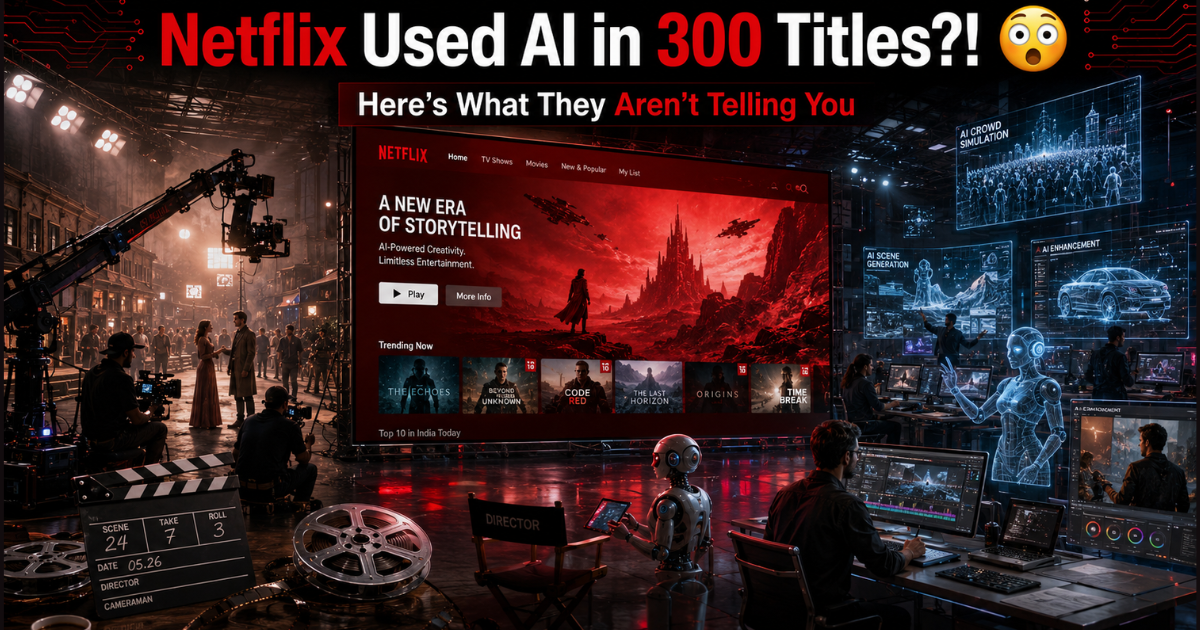
If you’ve spent any time on social media lately, you’ve probably seen someone claiming Netflix is “making movies with AI now.” That headline isn’t wrong exactly, but it’s missing almost all the nuance that actually matters. Netflix says around 300 titles used generative AI during 2026, according to its own Q2 earnings disclosure, and once you dig into what that really means, the picture looks a lot less alarming — and honestly, a lot more interesting — than the panic-driven takes suggest.
I’ve been following AI’s creep into entertainment production for a while now, and this is one of the first times a major studio has actually put a number on it instead of dancing around vague statements about “exploring new technologies.” That specificity is what makes this story worth paying attention to.
Key Takeaways
- Netflix disclosed that roughly 300 titles used generative AI somewhere in production during 2026, and it shared that figure directly in its Q2 earnings letter.
- Most of this AI use happened in post-production — think visual effects, not scriptwriting or replacing actors.
- Named examples include Glory, Brasil 70: A Saga do Tri, and The American Experiment, where AI helped build crowd scenes and battle sequences that would’ve been too expensive to shoot practically.
- Co-CEO Ted Sarandos pointed to one sequence that was finished twice as fast and at half the cost using generative AI tools.
- Netflix backed this strategy with a real acquisition — it bought Ben Affleck’s AI startup, InterPositive, for up to $600 million back in March 2026.
- Netflix insists AI is there to help filmmakers, not replace them, though that claim deserves some scrutiny when it comes to VFX jobs specifically.
- The disclosure has reignited an old debate about a uniform “Netflix look” and who actually owns AI-assisted visual work.
What Did Netflix Actually Announce?
Netflix’s generative AI disclosure is the company’s admission that roughly 300 titles used AI tools somewhere in their production pipeline in 2026 — not that AI wrote or directed those productions, which is a distinction that gets lost fast in casual conversation. The number came out in the company’s Q2 2026 earnings letter, the same document where it reported revenue and subscriber growth. Netflix wasn’t forced into this disclosure by a leak or an investigative report. It volunteered the number.
That matters. For context, before this, Netflix had only confirmed AI use on a handful of individual projects, most notably the 2025 series The Eternaut, which used generative visual effects reportedly completed about 10 times faster than a traditional VFX pipeline would allow. Going from “one show experimented with this” to “300 titles used it” in about a year is a big jump, and it tells you this isn’t a side project anymore. It’s become part of how Netflix makes things.
From what I’ve seen covering tech-meets-entertainment stories, companies usually stay quiet about numbers like this until competitors force their hand. Netflix going first here says something about how confident it feels in the technology — or maybe how much pressure it’s under to justify content costs to shareholders. Probably both.
For the full context straight from the source, Netflix’s own Q2 2026 shareholder letter lays out exactly how the company frames its generative AI usage across production.
Why This Disclosure Actually Matters
Here’s the thing: Netflix is the first major streamer to put a specific figure on its AI usage instead of speaking in vague generalities about “innovation” and “future-forward tools.” That specificity shifts the entire conversation. Instead of arguing about whether Hollywood is using AI, we’re now able to argue about how much, in what ways, and with what consequences.
The disclosure also puts pressure on the industry’s messiest unresolved question: intellectual property provenance. When part of a shot is AI-generated, who owns it? How do studios document that for licensing, insurance, or future disputes? Nobody has a clean answer yet, and some commentators have floated blockchain-based content verification as a possible fix — though that’s still mostly speculative and not something Netflix has committed to.
There’s also a competitive angle worth noting. If Netflix, with all its resources and legal exposure, felt comfortable disclosing 300 AI-assisted titles, it’s a safe bet other major studios are doing something similar and simply haven’t said so publicly. Disney, Amazon MGM, and Warner Bros. Discovery have all talked about AI research in animation, localization, and post-production, just without Netflix’s specificity.
Where Exactly Did Netflix Use Generative AI?
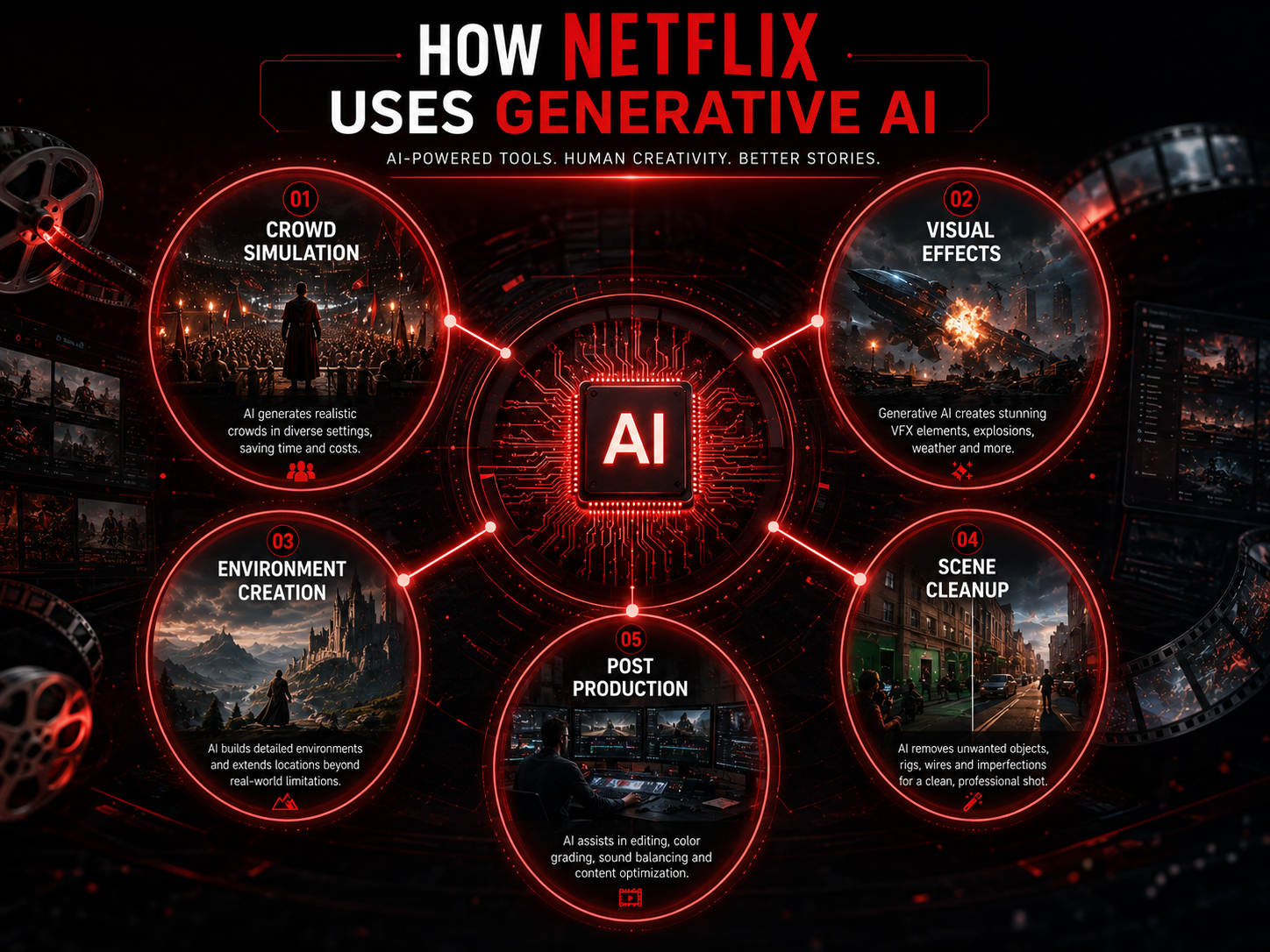
Generative AI at Netflix touched multiple stages of production — concept development, pre-visualization, post-production, and even release-stage work — but the heaviest concentration by far was post-production, particularly visual effects. That’s an important detail, because it means we’re talking about VFX teams using new tools, not AI systems replacing writers or directors.
In practice, that meant using AI to build things that would’ve been financially out of reach otherwise: enhanced crowd scenes, historical battle sequences, and world-building establishing shots. None of that is glamorous or headline-grabbing on its own, but it’s exactly the kind of expensive, labor-intensive work that benefits most from automation.
Named titles that used generative AI:
Glory, an Indian sports thriller centered on boxing, used AI-generated crowd work to expand its arena scenes without hiring hundreds of extras. Brasil 70: A Saga do Tri, a Brazilian soccer miniseries, leaned on similar tools to recreate packed stadium scenes from decades past — footage that would be nearly impossible (or absurdly expensive) to stage practically today.
The American Experiment, a docuseries about the American Revolution, is probably the clearest example of AI making something feasible that wouldn’t have been otherwise. Sarandos specifically cited a 17-minute sequence that was produced twice as fast and at half the cost using generative AI, compared to traditional production methods. That’s a concrete, verifiable claim — not marketing fluff — and it’s the kind of number that makes finance teams pay attention.
Why Is Netflix Betting So Heavily on This Technology?
Netflix is investing in generative AI mainly because it wants to deliver higher-quality output faster and at lower cost than traditional production allows — that’s essentially word-for-word what the company said in its earnings letter, and it’s worth taking at face value here since it lines up with the broader financial pressures Netflix is under.
Netflix projected roughly $20 billion in content spending for 2026. That’s an enormous number, and it comes at a time when investors have stopped rewarding streaming companies purely for subscriber growth. They want margin expansion now. In practice, that means every dollar spent on production needs to justify itself more than it used to.
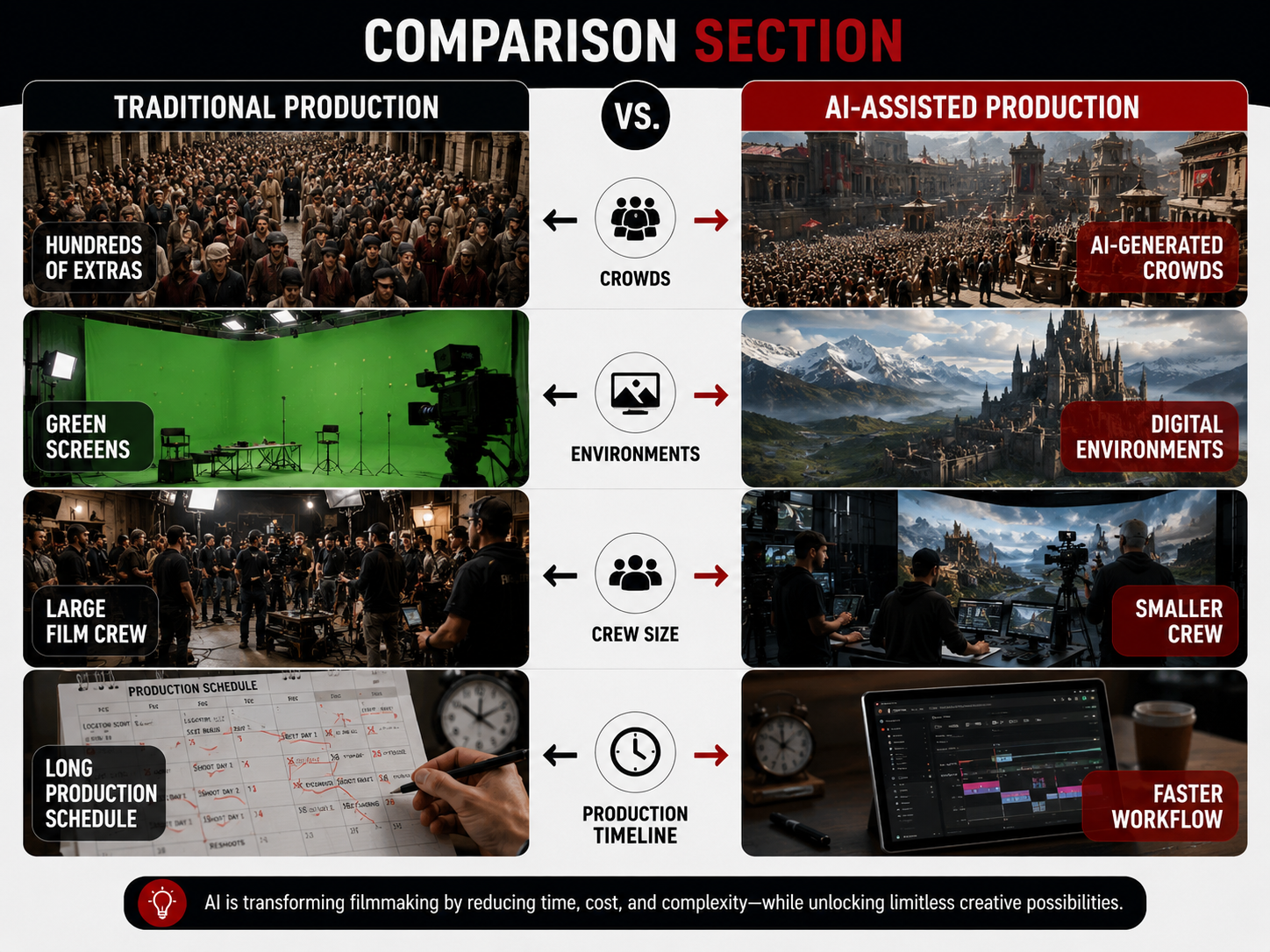
A useful comparison: a crowd scene that once required hundreds of paid extras, a big location shoot, and a full VFX crew working for weeks can now be built starting with a smaller practical crowd and AI-assisted multiplication. That doesn’t mean the scene is “fake” in any meaningful sense — it means the visual scale audiences expect gets delivered without the budget scaling proportionally.
Modern blockbuster productions often contain 2,000 to 3,000+ VFX shots — Source: Visual Effects Society, 2025. That volume is exactly why studios are looking for ways to automate the more repetitive parts of that pipeline.
What’s the Deal With the InterPositive Acquisition?
Netflix’s InterPositive acquisition refers to its March 2026 purchase of an AI startup founded by Ben Affleck, reportedly for up to $600 million. InterPositive was built specifically around filmmaker-focused generative AI tools, and the deal brought a 16-person team into Netflix’s operations.
Do the math on that and you get roughly $37.5 million per employee — which is a wild number for an acquisition, even in tech circles where talent acquisitions routinely carry inflated price tags. That figure alone tells you Netflix isn’t just buying software; it’s buying expertise and positioning itself with someone who has actual filmmaking credibility, not just engineering credentials.
Affleck took on a senior advisor role at Netflix, focused specifically on building tools tailored to working filmmakers rather than generic consumer AI products. According to Sarandos, the integration is still in its “early days,” but Netflix has already seen its impact on productions alongside the company’s other in-house tools. That’s a fairly honest admission — it’s not “this changed everything overnight,” it’s “we’re seeing early results.”
Is Generative AI Actually Replacing Filmmakers?
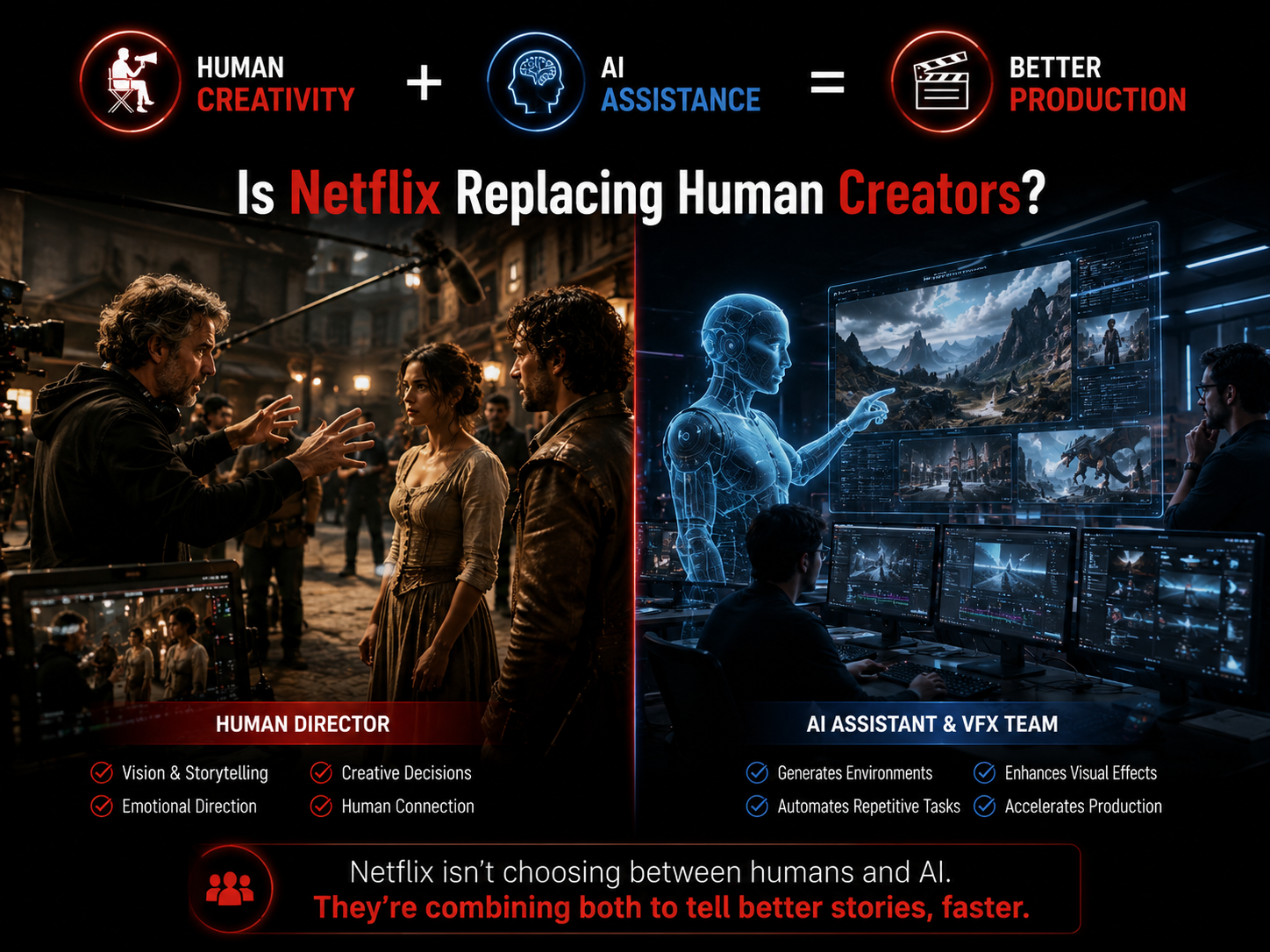
No — and this is where I think a lot of the online outrage gets ahead of the facts. Netflix has been explicit that generative AI isn’t meant to replace human filmmakers. Sarandos put it plainly: “it takes great artists to make something great,” and he’s maintained that AI isn’t changing that.
That said, I’d push back gently on taking that at face value without qualification. The claim that “AI isn’t replacing filmmakers” is true in the narrow sense that directors, writers, and actors aren’t being swapped out for algorithms. But VFX-specific roles are a different story. If a task that used to require a team of artists working for weeks can now be done by a smaller team supervising AI-generated output, that’s a real shift in labor demand — even if no individual job title disappears entirely. Both things can be true at once: creative control stays human, and the workforce needed to execute certain tasks shrinks.
| Production Stage | Traditional Approach | Generative AI Approach |
|---|---|---|
| Crowd Scenes | Hire hundreds of extras. | AI-multiplied smaller crowds. |
| Historical Battle Sequences | Elaborate practical staging. | AI-enhanced digital recreation. |
| Establishing Shots | Location scouting and filming. | AI-generated world-building visuals. |
| Example Sequence Timeline | Full production schedule. | Completed nearly twice as fast. |
| Example Sequence Cost | Full budget. | Roughly half the cost. |
This tension between AI assistance and AI replacement isn’t unique to Hollywood — it’s playing out just as visibly in content creation and social media, where we’ve dug into the same question in AI Influencers vs Human Creators: Who Really Wins in 2026? (And Why the Answer Might Surprise You).
How Much Has Netflix Actually Saved?
Netflix has only shared one concrete figure publicly: that The American Experiment sequence completed twice as fast and at half the cost. Beyond that single example, the company hasn’t broken down aggregate savings across all 300 titles, and I’d be cautious about extrapolating too aggressively from one data point.
That said, even one verified example gives outside analysts something real to work with. If similar efficiency gains apply across even a meaningful slice of those 300 titles, the cumulative impact on Netflix’s roughly $20 billion content budget could be significant — though again, Netflix hasn’t confirmed a company-wide total, and it would be premature to treat one sequence’s numbers as representative of everything.
What Concerns Has This Raised?
The biggest concerns center on job impact for VFX artists, the emergence of a uniform “Netflix look,” and unresolved IP questions. Critics worry that as generative AI takes over more crowd work and world-building tasks, demand for certain VFX specialties shrinks — a concern that, as I mentioned above, has some legitimate basis even if the “AI isn’t replacing creators” framing is technically accurate at the storytelling level.
There’s also a stylistic worry that’s harder to quantify but keeps coming up in industry discussions: if a lot of productions lean on similar AI tools and training data, does everything start to look the same? That’s the so-called “Netflix look” debate, and it’s less about labor and more about whether visual variety suffers when studios standardize on a handful of AI production tools.
Finally, IP and copyright provenance remain genuinely murky. When part of a scene is AI-generated, ownership, licensing, and attribution all get more complicated. This isn’t a Netflix-specific problem — it’s an industry-wide gap that regulation hasn’t caught up to yet.
A majority of creative professionals surveyed across media and entertainment expect AI to become a routine production tool within five years, though many also want stronger transparency standards — Source: Deloitte Digital Media Trends, 2025.
How Does Netflix’s AI Approach Compare to Other Studios?
Netflix isn’t operating in a vacuum here. Disney has talked about AI research tied to animation and localization. Amazon MGM Studios has explored AI-assisted production workflows. Warner Bros. Discovery has looked at AI for content management and production optimization. YouTube, on the creator side, has leaned into AI dubbing and creator assistance tools.
What sets Netflix apart right now isn’t necessarily the scale of its AI use — it’s the willingness to actually put a number on it. That transparency, whether strategic or genuine, gives outside observers something concrete to evaluate instead of vague corporate language about “exploring innovative technologies.”
The global AI in media and entertainment market could exceed $100 billion by the early 2030s as adoption accelerates across production, marketing, and personalization — Source: Grand View Research, 2025. That context matters: Netflix’s 300-title disclosure isn’t an isolated event, it’s an early, visible data point in a much larger industry shift.
Deloitte’s Digital Media Trends report is one of the more widely cited, methodologically transparent surveys on how creative professionals across the industry actually feel about AI adoption.
What Tools Are Actually Involved?
Netflix hasn’t published a full breakdown of every tool it uses, but its generative AI toolkit clearly blends in-house technology with what it acquired through InterPositive. The company has also mentioned building an AI animation studio and applying AI to its advertising business and content recommendations — so production is just one piece of a much broader AI push.
More broadly across the industry, AI-assisted filmmaking tends to combine several categories of software rather than relying on one all-purpose tool: video editing platforms, visual effects and compositing software, AI video generation tools for early concept visuals, image generation tools for asset creation, and audio tools for voice cleanup and enhancement. Professional productions typically layer these together rather than treating any single AI tool as a complete solution.
What Should You Actually Watch For Next?
If you’re a viewer, keep an eye on how credits and behind-the-scenes coverage evolve — studios are likely to face growing pressure to disclose AI usage as scrutiny increases, and Netflix’s move here may set a precedent others feel obligated to follow.
If you work in VFX or production, it’s worth tracking how guild negotiations handle this. Groups like the WGA and SAG-AFTRA have already pushed for AI disclosure and job protections in past negotiations, and this disclosure will almost certainly become a reference point in future conversations.
For anyone watching this from a business or investing angle, the next earnings cycle is the thing to watch. If the 300-title figure grows substantially by the next quarter, that’s a strong signal generative AI has become permanent production infrastructure rather than a passing experiment. If it plateaus, that tells you something different — maybe the low-hanging fruit has already been picked.
If you want a broader sense of where AI autonomy in production workflows might be headed beyond entertainment, our piece on What Is Agentic AI? The Quiet Revolution Already Reshaping Work and Daily Life covers how this shift is already showing up across other industries.
Conclusion
Netflix saying around 300 titles used generative AI in 2026 is a genuinely significant moment for the streaming industry, not because AI is suddenly writing scripts or directing actors, but because it marks the first time a major studio has attached a hard number to how deeply this technology has embedded itself in everyday production. From crowd scenes in Glory to cost-cutting sequences in The American Experiment, the practical use cases so far are narrower and more technical than the scarier headlines suggest — but the labor and IP questions this raises are real and worth continuing to watch closely.
If there’s one thing worth taking away from all this, it’s that AI in filmmaking isn’t a binary story of “replacing humans” versus “just a harmless tool.” It’s messier than that, and probably will stay messy for a while as the technology, the labor market, and the legal frameworks all try to catch up to each other at the same time.
Frequently Asked Questions
FAQ 1: Did Netflix actually confirm the 300-title number, or is this a rumor?
It’s confirmed. Netflix put that figure directly in its own Q2 2026 earnings letter — this wasn’t leaked or reported by a third party first. The company chose to disclose it on its own terms, which is part of why the story got so much attention.
FAQ 2: Does “used generative AI” mean Netflix is making AI-generated movies now?
Not really, no. In almost every example Netflix has talked about, AI was used for specific post-production tasks — mostly visual effects like crowd scenes or battle sequences — not for writing scripts, directing performances, or replacing actors. Think of it less like “AI made this show” and more like “AI helped a VFX team finish a shot that would’ve otherwise blown the budget.”
FAQ 3: Which shows or movies has Netflix actually named?
Netflix has publicly pointed to a handful of titles: Glory (an Indian boxing thriller), Brasil 70: A Saga do Tri (a Brazilian soccer miniseries), and The American Experiment (a docuseries on the American Revolution). It hasn’t released the full list of all 300 titles, so there’s a lot we still don’t know about the specifics.
FAQ 4: What’s the deal with Ben Affleck being connected to this?
Netflix bought Affleck’s AI company, InterPositive, back in March 2026, reportedly for up to $600 million. Affleck now advises Netflix on building AI tools that are actually built with filmmakers in mind, rather than generic AI products repurposed for Hollywood. It’s an unusual pairing on paper, but it makes more sense once you consider Netflix wanted someone with real filmmaking credibility involved, not just engineers.
FAQ 5: Is this going to cost VFX artists their jobs?
Honestly, it’s complicated, and I don’t think there’s a clean yes-or-no answer yet. Netflix maintains that AI supports creators rather than replacing them, and at the level of directors, writers, and actors, that’s true. But if a task that used to need a full team working for weeks can now be done faster with a smaller crew supervising AI output, that’s a real change in how much labor certain jobs require — even if no single job title vanishes outright. Both things can be true at the same time.
FAQ 6: Why would Netflix want to save money on production when it’s already doing well financially?
A few reasons, really. Netflix is projecting around $20 billion in content spending for the year, and investors have gotten a lot less patient about rewarding subscriber growth alone — they want to see margins improve too. Cutting costs on expensive, repetitive VFX work is one of the more painless ways to do that without touching the parts of a show that audiences actually notice, like writing or performances.
FAQ 7: Is Netflix the only streamer doing this?
No, and it’s pretty unlikely. Disney, Amazon MGM Studios, and Warner Bros. Discovery have all mentioned exploring AI in some form, whether that’s animation, localization, or production workflows. What makes Netflix stand out here is that it actually attached a specific number to its usage instead of speaking in vague terms — most companies haven’t gone that far yet.
FAQ 8: Should I be worried about a show “looking wrong” because AI was involved?
That’s actually one of the more legitimate concerns floating around, sometimes called the “Netflix look” debate. If a lot of productions lean on similar AI tools, there’s a fair question about whether visual variety starts to suffer. It’s not something that’s been proven at scale yet, but it’s worth keeping an eye on as more AI-assisted titles come out.
FAQ 9: What happens if a scene is partly AI-generated — who owns it?
That’s genuinely unresolved right now, and it’s not just a Netflix problem. Ownership, licensing, and attribution all get murkier once AI is involved in creating part of a shot. Some people have floated ideas like blockchain-based verification systems to track this, but nothing like that has actually been adopted industry-wide.
FAQ 10: Will this affect what I pay for my Netflix subscription?
There’s no direct evidence pointing that way. Production savings tend to get reinvested into more content or absorbed into overall margins rather than passed on to subscribers as lower prices. If anything, the more realistic outcome is Netflix using the savings to fund more ambitious projects without raising its budget proportionally.
Written by Benjamin Reed: Benjamin Reed is a technology and entertainment content writer covering digital trends, streaming platforms, and emerging technologies. His work focuses on explaining technology developments and industry updates in a clear, accessible way to help readers understand how innovation is shaping digital entertainment and media.
Reviewed by: Editorial Review Team & Technology Content Specialists.
Disclaimer: This article is based on publicly available information, official company statements, news reports, industry publications, and other reliable sources available at the time of publication. Developments related to artificial intelligence, streaming platforms, and media technologies can evolve rapidly as companies release new information and policies. Readers are encouraged to verify the latest updates through official announcements and trusted sources before relying on this information for business or professional decisions. This content was initially drafted with AI assistance and has been carefully reviewed, edited, refined, and fact-checked by human editors to ensure accuracy, clarity, originality, and editorial quality.