By Ryan Mitchell | Technology Content Writer
Summarize this blog post with: ChatGPT | Perplexity | Claude | Grok
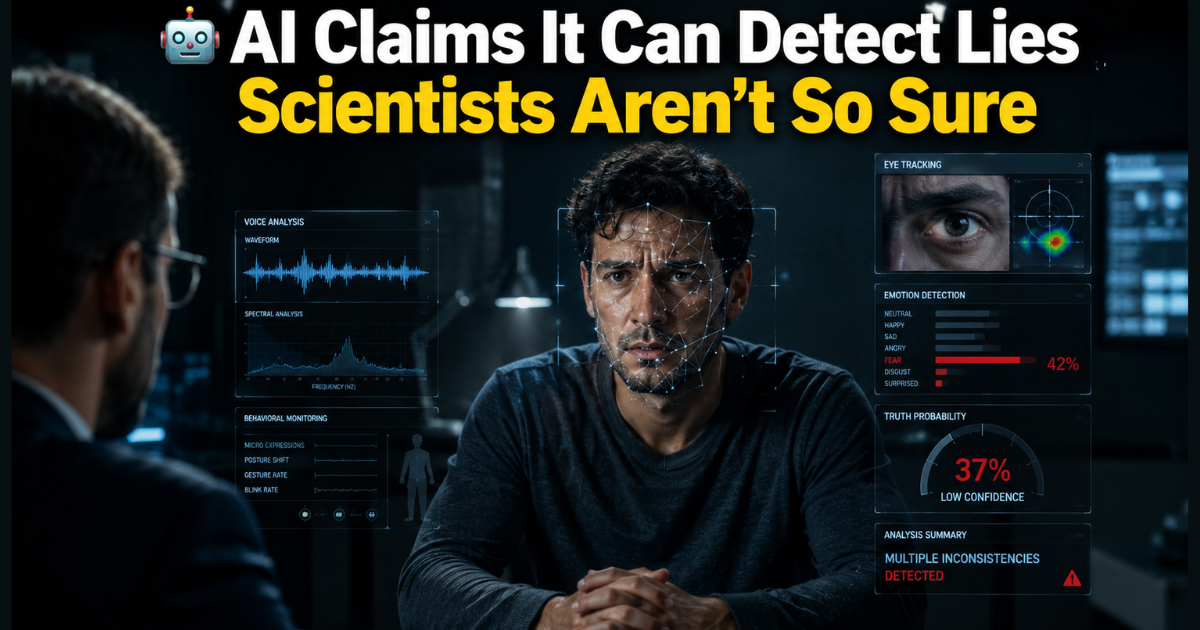
You’ve probably seen the headlines. “AI can now detect liars with 90% accuracy.” “New software reads your face and knows if you’re lying.” It sounds impressive — maybe even a little unsettling. But honestly, after digging through the actual research on AI lie detection, the picture looks a lot messier than those headlines suggest. Some of the science is genuinely interesting. A lot of the commercial claims, though, are way ahead of what the evidence supports. In this guide, I’ll walk you through how AI lie detection actually works, what researchers are finding, and — maybe most importantly — why the gap between marketing claims and real-world reliability should concern all of us.
AI is becoming increasingly capable of analyzing speech, images, and human behavior, much like many of the technologies driving today’s workplace transformation.
Key Takeaways
- AI lie detection analyzes behavioral signals like voice patterns, facial micro-expressions, and linguistic cues to flag potential deception — but no system has been independently validated for reliable real-world use.
- Lab accuracy rates for most AI deception tools sit between 60–80%, but independent testing consistently shows that performance drops sharply outside controlled environments.
- The fundamental problem isn’t the algorithms — it’s that stress, anxiety, and fear produce the same physiological and behavioral signals as lying, making false positives almost inevitable.
- Both AI systems and traditional polygraphs share the same core flaw: they measure arousal and cognitive load, not deception itself.
- This technology is already deployed in airport screening, insurance fraud detection, and some HR hiring platforms — often with little transparency and almost no regulation.
- Facial expression AI has taken heavy criticism from the scientific community, with researchers pointing out that emotions can’t be reliably read from faces across different cultures.
- Anyone subject to automated screening — which is increasingly all of us — has a real stake in understanding what these systems can and can’t do.
What Is AI Lie Detection, and How Is It Different From a Polygraph?
AI lie detection is the use of machine learning algorithms to analyze behavioral signals — including vocal patterns, facial micro-expressions, linguistic cues, and physiological responses — with the goal of identifying whether a person is being deceptive.
Here’s the thing that trips most people up: AI doesn’t actually “see” a lie. It can’t. What it does is look for patterns — changes in how someone speaks, moves, or writes — that researchers believe show up more often when people are being deceptive than when they’re not. That’s a very different claim from “this machine knows you’re lying.”
A traditional polygraph takes a different approach. It straps sensors to your body and measures heart rate, respiration, blood pressure, and skin conductance. AI deception detection, by contrast, works passively — analyzing video, audio, or text without any physical contact. That’s actually one of the reasons organizations have gotten so interested in it. You can screen someone at a border crossing or during a job interview without them even knowing they’re being evaluated. Whether that’s a feature or a bug kind of depends on your perspective.
But both systems share the same underlying problem: they measure arousal and cognitive load, not deception itself. A nervous person telling the truth looks almost identical to a nervous person telling a lie.
Researchers continue to debate the reliability of AI deception detection, with a recent research review on recent research on AI deception detection highlighting both the potential and limitations of these systems.
Why AI Lie Detection Matters — Even If You’re Not a Criminal
AI lie detection matters because it’s no longer theoretical — it’s actively being used in airports, hiring pipelines, insurance investigations, and courtrooms, often with consequences that directly affect people’s lives.
Think about that for a second. A false positive here isn’t just an interesting statistical footnote. It could mean a visa denial, a failed background check, or a wrongful accusation. The stakes are genuinely high, and from what I’ve seen in reviewing the research, most of the people being screened have no idea what criteria are being used to evaluate them — or what their options are if a system flags them incorrectly.
There’s also the basic human accuracy problem that AI is supposedly improving on. Researchers Maria Hartwig and Charles Bond conducted a sweeping meta-analysis and found that humans correctly identify lies only about 54% of the time — barely better than a coin flip — Source: Psychological Bulletin, 2011. So yes, AI proponents have a point when they say we need something better than human intuition. The question is whether current AI systems actually deliver that. Spoiler: the evidence is mixed at best.
How Does AI Actually Detect Deception?
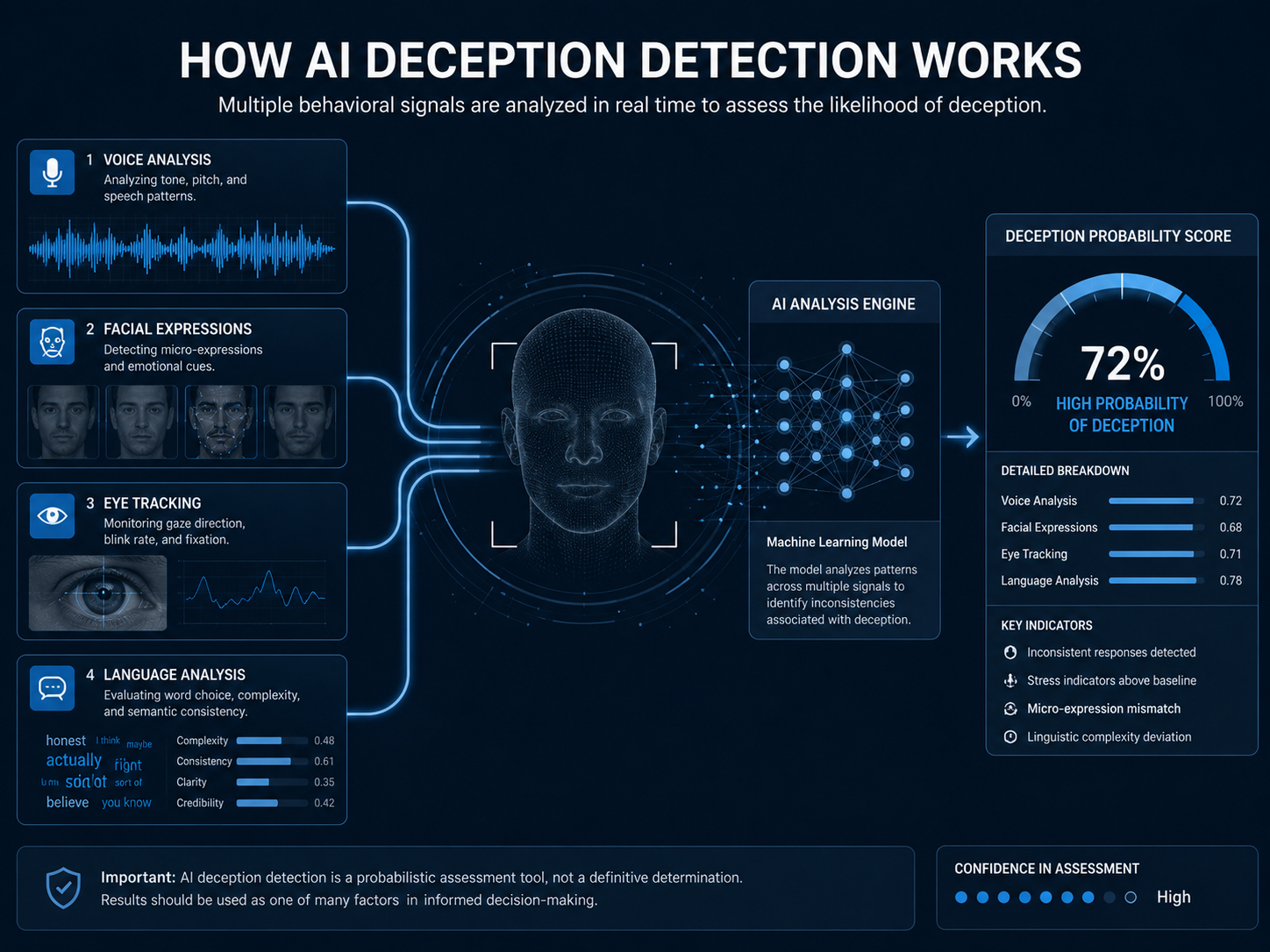
AI deception detection systems use one or more of five primary modalities — voice, facial expressions, eye movement, physiological signals, and linguistic patterns — to identify behavioral cues associated with lying.
Each of these approaches has its own strengths, its own weaknesses, and its own trail of skeptical peer-reviewed commentary.
Can AI Detect Lies From Voice Patterns?
AI voice stress analysis works by measuring micro-tremors, pitch changes, speech rate, pauses, and hesitations that are theorized to correlate with deception. Products like Layered Voice Analysis have been sold to insurance companies and law enforcement for years on exactly this premise.
The problem is that the independent research hasn’t been kind to these systems. A 2016 study in PLOS ONE tested voice stress analysis tools in controlled conditions and found they performed no better than chance — Source: Harnsberger et al., PLOS ONE, 2016. That’s not a minor caveat. That’s a fundamental validity problem.
Vocal stress is a symptom of anxiety. Not dishonesty. And anxious truthful people — like, say, someone nervous at a border checkpoint — sound exactly like anxious liars. The algorithm can’t tell the difference, and neither can most humans.
Can AI Read Facial Expressions to Detect Lies?
This one gets a lot of press, partly because it sounds so impressive. Facial expression AI uses computer vision to identify micro-expressions — brief, involuntary facial movements thought to reveal hidden emotions — based largely on research by psychologist Paul Ekman and his Facial Action Coding System (FACS).
In theory, it makes sense. In practice? The scientific community has become increasingly skeptical. A 2019 review by the Association for Psychological Science looked at the evidence and concluded there simply isn’t enough support for the idea that emotions can be reliably inferred from facial movements — especially across different cultures — Source: APS, 2019. A raised eyebrow doesn’t mean the same thing everywhere. And an algorithm trained primarily on Western faces may misread nearly everyone else.
Ongoing facial expression analysis research suggests that distinguishing genuine emotions from posed expressions remains one of the biggest challenges in AI-based deception detection.
Multimodal Systems: Does Combining Everything Help?
Modern AI deception tools are increasingly trying to solve this by combining multiple signals simultaneously — voice, face, language, body language — rather than relying on any single indicator. The logic is reasonable: if each individual signal is weak, maybe combining them strengthens the overall picture.
And honestly, research does suggest multimodal approaches tend to outperform single-signal systems in controlled environments. The catch is that “better than a weak baseline in a lab” is a pretty low bar.
How Accurate Is AI Lie Detection? Here’s What the Research Actually Shows
No AI lie detection system has been independently validated to reliably distinguish deception from truth in real-world, high-stakes conditions — that’s the scientific consensus, not a fringe opinion.
Vendors love citing their accuracy numbers. You’ll see claims of 80%, 85%, sometimes 90%+ in marketing materials. Those figures almost always come from controlled laboratory settings where the conditions are nothing like real-world use. In a lab, a participant lies about a playing card. In real life, a genuinely innocent person being questioned by police is under enormous stress.
Here’s the thing that makes these accuracy figures especially misleading: the base-rate problem. If only 1 in 100 people at a border crossing is actually being deceptive, even an 80% accurate system generates far more false positives than correct detections. It flags innocent people constantly — and that’s not a hypothetical scenario, that’s math.
A 2025 study led by Michigan State University specifically examined whether AI systems could outperform humans at deception detection. Their conclusion? Not yet — and they explicitly warned against over-relying on current systems for consequential decisions — Source: Michigan State University, 2025.
| Signal Type | Lab Accuracy (Vendor Claims) | Real-World Performance (Independent Research) |
|---|---|---|
| Voice stress analysis | 70-85% | ~50% (near chance) |
| Facial expression AI | 65-80% | Inconsistent; varies by culture |
| Multimodal AI systems | 75-90% | Limited independent validation |
| Traditional polygraph | 80-90% (vendor) | ~70-75% (NAS estimate) |
Sources: NAS Polygraph Report (2003), Harnsberger et al. (2016), APS (2019), MSU (2025)
Where Is AI Lie Detection Being Used Right Now?
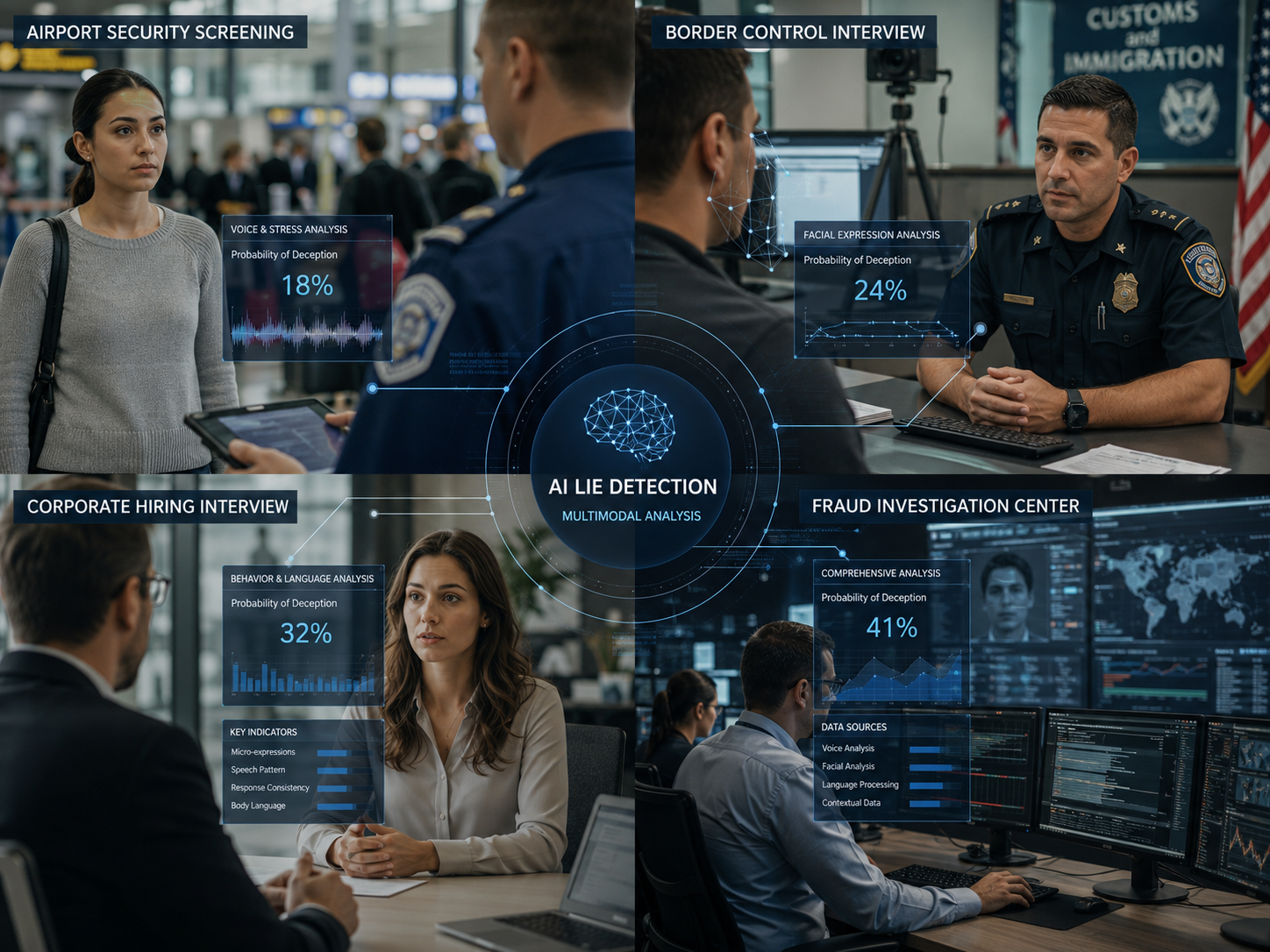
AI-powered deception detection is already deployed in border control, insurance fraud detection, corporate hiring, and law enforcement — often with limited transparency.
The most high-profile example is probably the EU’s iBorderCtrl project, which piloted AI facial analysis at border crossings in Hungary, Latvia, and Greece to assess whether travelers were being truthful during immigration interviews. Independent assessments raised serious flags about the system’s scientific validity — and specifically warned it could produce discriminatory outcomes for minority and non-European travelers.
Converus EyeDetect, an eye-tracking system marketed as a polygraph alternative, has been sold to police departments, corporations, and government agencies. Insurance companies have explored AI voice tools for screening fraud calls. Some corporate HR platforms have quietly added behavioral analysis features to video interviews. Most candidates have no idea this is happening.
Can ChatGPT Actually Detect Lies?
Short answer: no — not in any meaningful sense. Large language models like ChatGPT can flag linguistic inconsistencies and logical contradictions in text, but that’s fundamentally different from detecting deception.
ChatGPT can’t verify facts in real time, can’t observe body language, and has no way to access a person’s intentions or emotional state. What it can do is notice when a story’s timeline doesn’t add up, or when someone’s account contradicts itself. That’s useful for text analysis. It’s not lie detection. Treating it as such would be a pretty serious category error.
Future deception detection systems will likely be powered by increasingly advanced machine learning models similar to those behind today’s most powerful developer and productivity tools.
The Real Problems With AI Lie Detection
The fundamental limitation of AI lie detection is that no behavioral signal exists that reliably and uniquely indicates deception across all people, all cultures, and all situations — and that’s not a technology problem, it’s a science problem.
No matter how good the algorithms get, you can’t train a model to detect something that doesn’t have a consistent signal. Stress, embarrassment, fear, and guilt all produce overlapping behavioral responses. Deception isn’t cleanly separable from the rest of human experience.
On top of that, research consistently shows these systems perform worse on women, people of color, and non-native speakers — often the exact populations being screened in high-stakes contexts. Training data bias isn’t a side note; it’s a core structural issue.
And there’s basically no regulatory framework anywhere that specifically governs how AI lie detection can be used in employment or law enforcement. Which means organizations can deploy these tools on vulnerable populations with very little accountability.
Will AI Replace Human Investigators?
Honestly, probably not anytime soon — and most researchers would say that’s a good thing. AI is most credibly positioned as a support tool that flags anomalies for human review, not as a replacement for investigative judgment.
The broader psychology of lie detection suggests that humans are often only slightly better than chance at identifying deception.
The most realistic near-term scenario is a hybrid model: AI processes large volumes of data, identifies patterns worth examining, and surfaces those to trained human investigators who then apply context, judgment, and evidence-based reasoning.
The multimodal fusion research is genuinely promising. Combining voice, face, language, and behavioral signals together does tend to perform better than any single modality. But “better in a lab” still hasn’t translated into “reliable enough for high-stakes decisions in the real world.”
Conclusion
So, can AI detect lies? The honest answer is: sometimes, partially, in controlled conditions — and not reliably enough to make consequential decisions about real people’s lives.
The ongoing scientific debate around AI lie detection reflects both excitement about technological progress and concern about premature real-world deployment.
AI lie detection can identify behavioral and linguistic signals associated with stress and cognitive load, but stress isn’t the same as deception — and no algorithm has convincingly bridged that gap. The technology is real, it’s advancing, and it’s already being deployed in situations that affect people’s jobs, travel, and freedom. That makes understanding its limitations genuinely important, not just academically interesting.
The right response isn’t to dismiss this technology entirely — some of the underlying research is legitimately fascinating. But it is to demand evidence, push back on inflated accuracy claims, and stay engaged with the policy questions that are being decided right now, often without public debate. Because the way AI lie detection gets regulated — or doesn’t — over the next decade will matter for a long time.
Frequently Asked Questions
FAQ 1: Can AI really detect lies?
AI systems can identify behavioral patterns associated with deception — changes in voice, facial movements, language — but no system has been independently validated to reliably distinguish lies from truth in real-world conditions. They estimate probabilities, not certainties.
FAQ 2: How does AI lie detection work?
AI lie detection uses machine learning to analyze one or more behavioral signals — voice pitch and rate, micro-expressions, eye movements, or linguistic patterns — and flags deviations from what a baseline “truthful” response looks like. The key word there is “associated with” deception, not proof of it.
FAQ 3: Is AI more accurate than a polygraph test?
Not clearly. Both face the same foundational problem: they measure arousal and cognitive load, not deception specifically. Independent studies suggest neither is reliably accurate enough for high-stakes evidentiary use.
FAQ 4: Can AI detect lies from voice recordings?
AI voice stress analysis tools claim they can, but peer-reviewed research has repeatedly found their accuracy near chance levels — around 50–55% — when tested independently. Vocal stress reflects anxiety, not dishonesty.
FAQ 5: Can AI detect lies through facial expressions?
Facial expression AI can detect emotional cues, but the scientific community has grown increasingly skeptical that these cues reliably indicate deception — particularly across different cultures and demographic groups.
FAQ 6: Can AI replace human investigators?
No. AI can support investigations by flagging patterns and anomalies, but human judgment, contextual understanding, and evidence evaluation aren’t replaceable by current technology.
FAQ 7: Is AI lie detection used by law enforcement?
Yes, in some contexts. The EU’s iBorderCtrl and tools like Converus EyeDetect have been used by law enforcement and security agencies, though scientific validity and legal admissibility remain actively contested.
FAQ 8: How accurate is AI lie detection technology?
Vendor claims often cite 70–90% in lab settings. Independent real-world studies tell a different story — particularly for voice stress analysis, which performs near chance. Multimodal systems show more promise but still lack large-scale independent validation.
FAQ 9: What are the limitations of AI lie detection?
The main ones: no behavioral signal is uniquely tied to deception; systems show cultural and racial bias; false positive rates are high; real-world accuracy lags far behind lab claims; and there’s almost no regulatory oversight.
FAQ 10: Can AI detect lies in video interviews?
Some platforms claim they can analyze video interviews for deceptive signals. The scientific evidence for this is weak, and forensic psychology researchers have been vocal in cautioning against using these tools for employment decisions.
Written by Ryan Mitchell: Ryan Mitchell is a technology content writer focused on emerging technologies, digital trends, and practical technology insights for everyday readers. His work emphasizes clear, research-driven explanations of how new technologies affect consumers, businesses, and society, with a focus on separating evidence-based findings from hype and speculation.
Reviewed by: Editorial Research Team & Technology Content Strategy Contributors focused on science communication, digital publishing standards, fact-checking practices, and responsible coverage of AI and emerging technologies.
Disclaimer: This article is intended for informational and educational purposes only and does not constitute legal, medical, psychological, or professional investigative advice. Claims about AI-based lie detection remain an active area of scientific research and are subject to significant methodological, ethical, and legal debate. Accuracy rates, capabilities, and limitations vary widely across studies, datasets, and commercial systems, and many public claims exceed what the evidence currently supports. Readers should independently verify the latest research findings, regulatory guidance, and expert consensus before relying on any AI system for high-stakes decisions involving truthfulness, credibility, employment, healthcare, law enforcement, or legal proceedings. This content was initially drafted with AI assistance and has been carefully reviewed, refined, and fact-checked by human editors to ensure clarity, originality, accuracy, and editorial quality.