
By Ethan Walker | Technology and Science Content Writer
Summarize this blog post with: ChatGPT | Perplexity | Claude | Grok
Most people saw the June 6 SpaceX launch notification, scrolled past it, and moved on. Another Starlink mission. Another rocket landing on a drone ship. Routine stuff at this point, right?
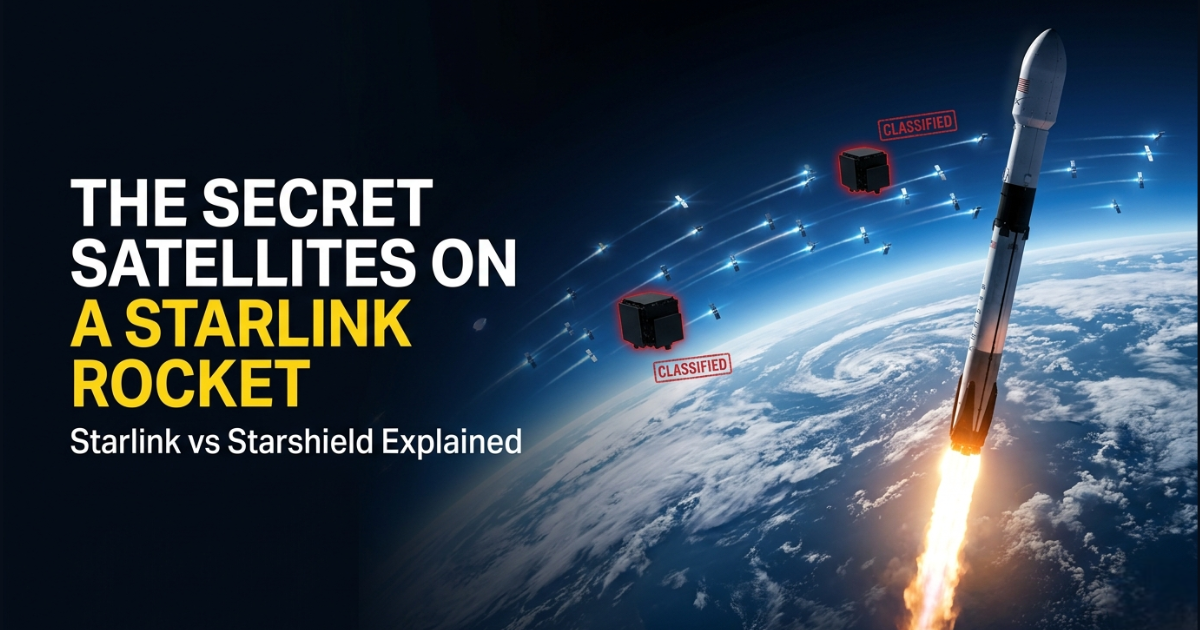
Here’s the thing — it wasn’t entirely routine. Tucked aboard that Falcon 9 alongside a batch of civilian internet satellites were two classified military payloads that the U.S. government has never officially attributed to any agency, program, or mission objective. They’re in the public orbital tracking databases, sure, but listed under generic designation numbers with zero explanation attached.
I’ve been following SpaceX launches closely for years, and honestly, the Starshield story is one of the more underreported developments in modern defense technology. So let’s unpack what actually happened on June 6, what Starshield is, how it compares to the Starlink you might actually use, and why this quiet co-manifest mission is quietly reshaping U.S. military space strategy.
Key Takeaways
- The Starlink 17-43 mission (June 6–7, 2026) launched from Vandenberg Space Force Base and carried both commercial Starlink internet satellites and 2 classified Starshield military satellites on a single Falcon 9.
- Starshield is SpaceX’s national-security satellite program, underpinned by an approximately $1.8 billion NRO contract, building a classified surveillance and communications constellation in low Earth orbit.
- Starshield satellites are government-owned, carry military-grade encryption, and can host classified payloads — none of which apply to standard Starlink hardware.
- SpaceX’s Falcon 9 uses autonomous AI systems for booster landing (the G-FOLD algorithm) and collision avoidance on every satellite.
- The NRO has launched 13 batches of Starshield satellites between May 2024 and June 2026, making it arguably the fastest-assembled surveillance constellation in U.S. intelligence history.
- In May 2026, the U.S. Space Force awarded SpaceX a $2.29 billion contract for the Space Data Network Backbone — a laser-linked military communications mesh built on Starshield.
- SpaceX surpassed 50 Starlink missions by late May 2026 — Source: Spaceflight Now, 2026.
What Is the SpaceX Starshield Starlink Launch — And Why Does It Keep Happening?
The short answer: SpaceX has made a habit of co-manifesting classified Starshield military satellites alongside commercial Starlink payloads on the same Falcon 9. The most recent example is Starlink 17-43, which lifted off at 9:24 p.m. PDT on June 6, 2026 from Space Launch Complex 4 East at Vandenberg.
On the surface it looked like every other Starlink launch. But two of those satellites weren’t going to serve your home internet. They were Starshield payloads — government-owned, classified hardware that the U.S. Space Force logged in public databases under USA designation numbers and then said nothing more about.
This pattern — civilian hardware and classified government satellites sharing a fairing — is now a recurring feature of SpaceX’s launch cadence. And from what I’ve seen tracking these missions, the practice is only becoming more common, not less. There are real strategic reasons for it, which I’ll get to. But first, you need to understand what Starshield actually is, because the public coverage of it has been pretty thin.
What Is Starshield? SpaceX’s Military Satellite Program, Explained Plainly
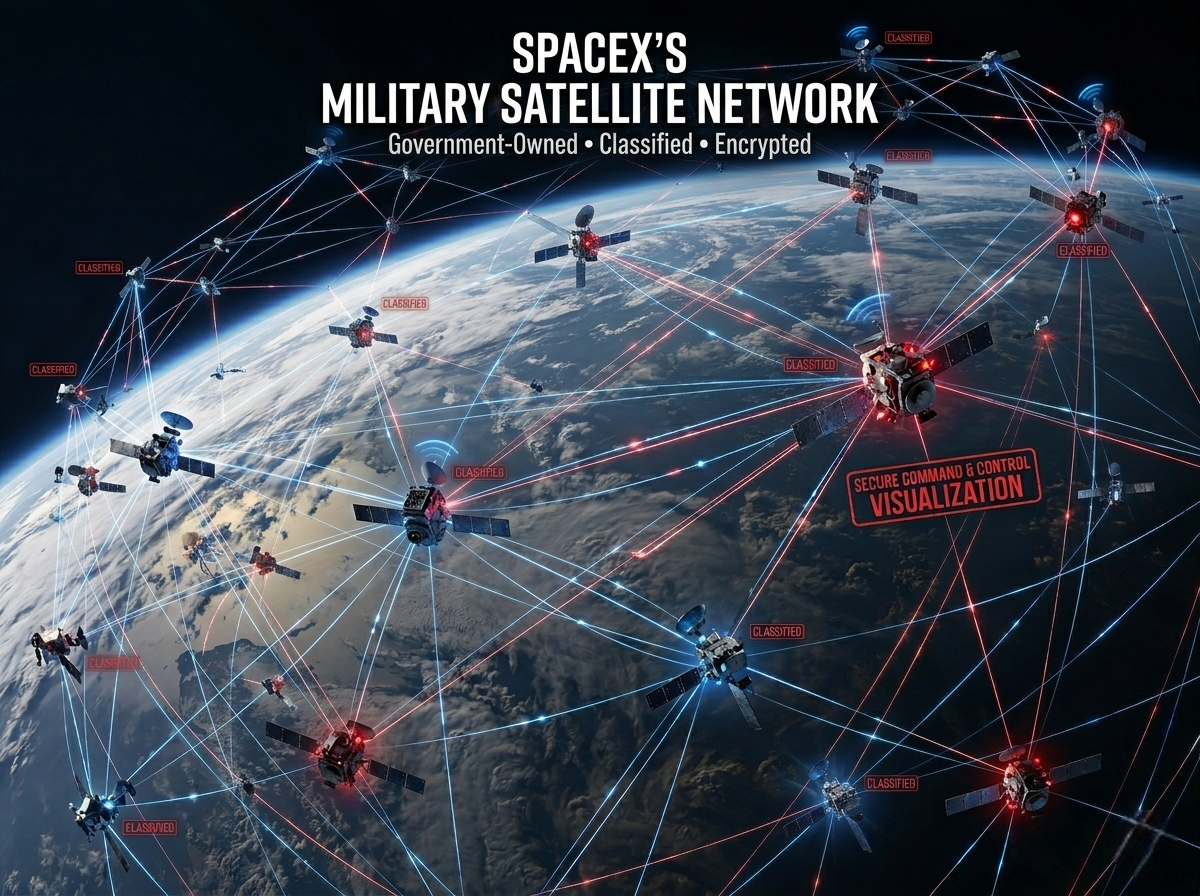
Starshield is SpaceX’s classified, government-focused satellite program. It was formally announced in December 2022, though the underlying NRO contract that made it possible was reportedly signed back in 2021 — valued at approximately $1.8 billion — Source: Reuters, 2024 — predating the public announcement by over a year. That gap alone tells you something about how this program was designed to operate.
According to SpaceX’s official Starshield page, the program was described at launch as expanding Starlink satellite technology into military applications — deliberately vague language that has stayed consistent ever since.
The core idea is relatively straightforward. Take the Starlink satellite bus — the same hardware SpaceX assembles by the thousands at its Redmond, Washington factory — and adapt it for classified national security use. Same production line, same basic architecture, but with significant modifications: military-grade end-to-end encryption, the ability to host government-owned classified payloads directly on the satellite bus, and support for hardened ground terminals that meet national security standards.
What makes this strategically clever is that it lets the U.S. intelligence community scale up a surveillance constellation using commercial manufacturing efficiencies rather than the old model of spending $2–3 billion on a single geostationary spy satellite that takes a decade to build. Between May 2024 and June 2026, the NRO launched 13 batches of Starshield satellites — a pace that analysts have described as the fastest-built surveillance constellation in the recorded history of U.S. intelligence. That’s not a small thing.
The $2.29 Billion Space Force Contract You Probably Missed
In May 2026, the scale of federal investment in Starshield became impossible to ignore. The U.S. Space Force awarded SpaceX a $2.29 billion contract — Source: Defense reporting via Basenor.com, May 2026 — to build something called the Space Data Network (SDN) Backbone. This is, essentially, a laser-interlinked military communications mesh built on the Starshield platform — satellites talking to each other via optical inter-satellite links rather than radio frequency, enabling worldwide tactical communications without relying on vulnerable ground infrastructure.
Think about what that inverts. Traditional military satellite comms depended on a handful of expensive geostationary birds sitting 35,000 kilometers up — high-value targets that adversaries could theoretically disable. A distributed mesh of hundreds of low-orbit satellites, communicating via laser links, is much harder to degrade. Lose a few nodes and the network keeps working. It’s a fundamentally different philosophy of resilience.
Starshield vs. Starlink: What’s Actually Different?
This comes up a lot, and honestly, it’s worth being precise about because the two programs get conflated in casual coverage. They share a satellite bus and a manufacturer. That’s basically where the similarity ends.
| Feature | Starlink | Starshield |
|---|---|---|
| Purpose | Commercial broadband internet | Military surveillance & comms |
| Ownership | SpaceX-owned and operated | U.S. government-owned |
| Customers | Consumers, businesses, maritime, aviation | NRO, DoD, U.S. Space Force |
| Encryption | Standard commercial-grade | Military-grade end-to-end |
| Hosted Payloads | No | Yes — government-owned sensors/cameras |
| Orbital Data | Publicly tracked in detail | Logged without program attribution |
| Contract Type | Commercial service agreements | Classified government contracts |
Starlink is a commercial product. You can buy a subscription. SpaceX owns the satellites and sells you connectivity. Starshield is government property — the U.S. government literally owns those satellites, and SpaceX is essentially a manufacturer and launch provider rather than an operator.
The ability to host classified payloads is probably the most significant hardware difference. A Starshield satellite can carry a government-owned camera, sensor, or communications package that SpaceX has no visibility into. From a practical standpoint, that means the NRO can build what’s effectively a custom spy satellite using a commercially-priced bus and a commercially-priced launch. The economics are genuinely transformative compared to what they were doing ten years ago.
Mission Details: Falcon 9 Booster B1097’s 10th Flight
The Starlink 17-43 mission used booster B1097 — its tenth flight. Previous missions for this booster included NROL-172, the Twilight rideshare, and seven Starlink batches. Eight minutes after liftoff, B1097 targeted a landing on the drone ship Of Course I Still Love You in the Pacific. If that landing succeeded as planned, it would mark the 201st landing on that vessel and the 620th booster landing in SpaceX history overall — Source: Spaceflight Now, June 2026.
That number is worth sitting with for a second. Six hundred and twenty successful booster recoveries. When SpaceX first attempted a drone ship landing in 2015, nobody was sure it was even possible. Now it’s so routine that the milestone barely registers in the news cycle.
The two classified Starshield payloads aboard were logged by the U.S. Space Force in public tracking databases without agency attribution. This is consistent with earlier missions — in 2025, Starlink 13-1 and 13-4 each carried two Starshield satellites, designated USA 485, 486, 549, and 550.
For the most current mission timelines and payload details, Spaceflight Now’s live launch schedule is the most reliable publicly maintained resource for tracking upcoming Falcon 9 and Starship missions.
Does the Falcon 9 Actually Use AI? (The Real Answer Is More Interesting Than You’d Expect)
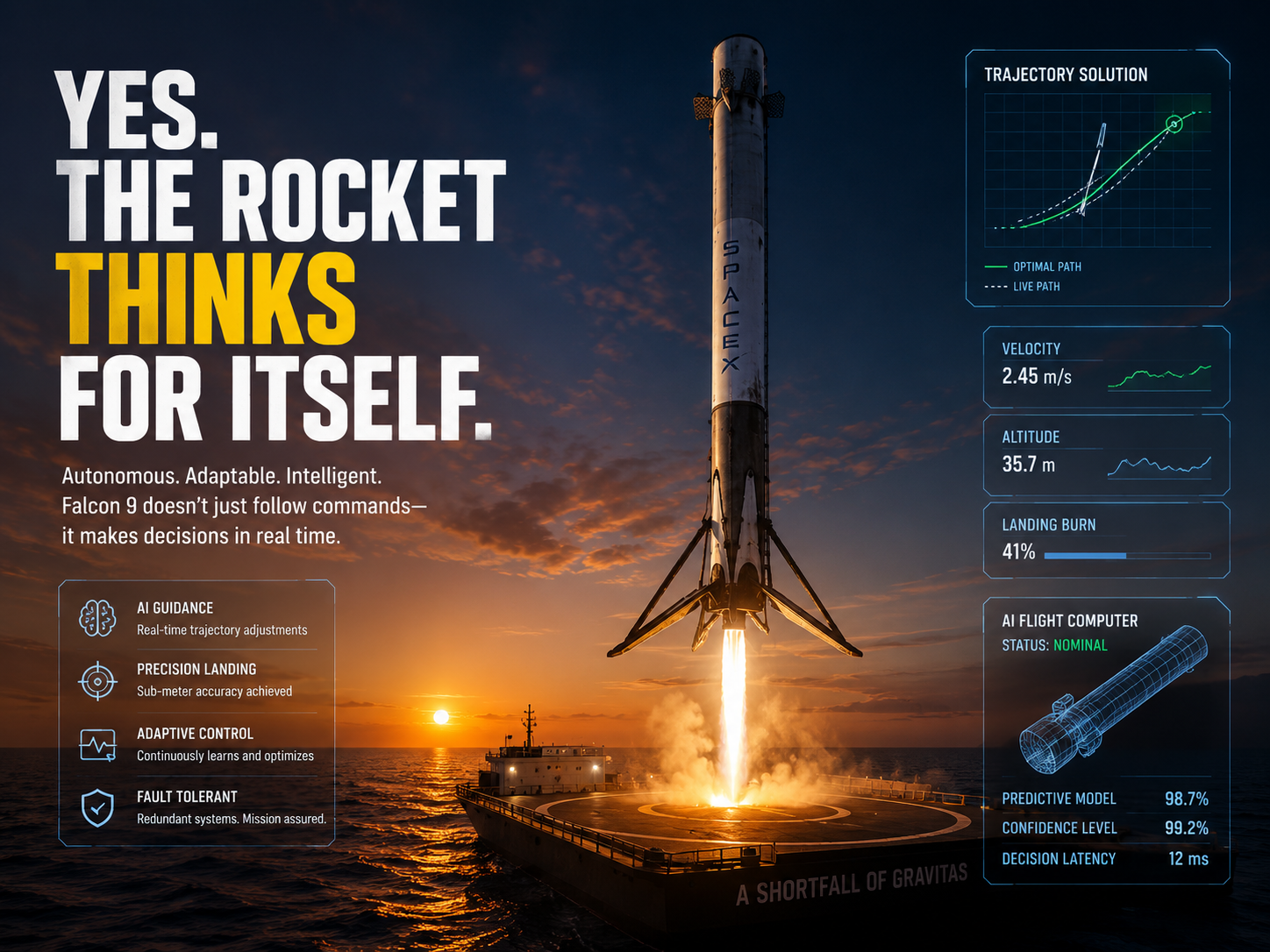
Yes — though with some important nuance. SpaceX doesn’t describe Falcon 9 as “AI-controlled” in the way that term gets thrown around in tech press, but the autonomous systems running throughout a mission are genuinely sophisticated and, in some cases, represent real advances in applied machine learning.
G-FOLD: The Algorithm That Lands the Rocket
The most visible example is G-FOLD — Guidance for Fuel-Optimal Large Diverts. This is a convex optimization algorithm that runs onboard the returning booster, computing a fuel-optimal return trajectory in real time without human input. It’s solving, in milliseconds, a trajectory problem that would take a human mathematician hours — accounting for atmospheric drag, remaining propellant, the drone ship’s position, and wind simultaneously.
From what I’ve seen in the technical literature around G-FOLD, it originated from NASA research and was adapted by SpaceX for operational use. The fact that it works reliably enough to have enabled 620+ successful landings is a testament to how well it’s been refined over the years.
Autonomous Collision Avoidance on Every Satellite
Every Starlink satellite in orbit — and by extension, every Starshield satellite on the same bus — runs autonomous collision avoidance software. It ingests U.S. Department of Defense tracking data and fires krypton ion thrusters without waiting for a human to approve the maneuver. SpaceX applies a stricter probability threshold for triggering avoidance than most other operators, meaning the system acts earlier and more conservatively than the industry norm.
Given that SpaceX’s Starlink constellation includes over 9,400 active satellites — Source: industry estimates, 2026, running manual collision avoidance on all of them simultaneously would be physically impossible. Autonomous decision-making isn’t a nice-to-have here; it’s a baseline operational requirement.
Machine Vision on Crew Dragon
A little further from the Starshield story, but worth mentioning: Crew Dragon docks autonomously with the ISS using machine vision. Cameras cross-referenced against LIDAR and relative GPS track the docking port in real time. It’s a multi-sensor fusion approach — no single data source is trusted alone, every critical judgment gets verified across independent streams. That design philosophy runs through SpaceX’s broader autonomous systems work.
As AI takes on more autonomous roles — from landing rockets to managing satellite constellations to eventually navigating deep space missions without real-time human input — questions about AI judgment and reliability become more consequential. For a grounded look at where AI pattern recognition works and where it doesn’t, what the science actually says about AI detecting lies is a surprisingly relevant read.
Why Co-Manifest? The Strategic Logic Behind Mixed Payloads
This is the question I find most interesting, and it doesn’t get discussed enough. Why put classified government satellites on the same rocket as civilian internet hardware?
Three reasons, basically. First, cost. SpaceX is already launching a Falcon 9 for the Starlink batch — adding two government satellites doesn’t double the launch cost. It dramatically reduces the per-satellite cost for the NRO. Second, operational security. A classified deployment buried in a routine commercial launch is much harder to analyze than a dedicated military launch. The cadence, timing, and exact number of classified satellites deployed become harder for adversaries to track. Third, speed. SpaceX conducted over 50 Starlink missions in 2026 by late May alone — Source: Spaceflight Now, 2026. That cadence is what allows the NRO to assemble a large-scale constellation quickly. There simply isn’t a dedicated military launch vehicle that can match it.
For the broader industry, this mission model signals something important: the line between commercial and military space infrastructure isn’t really a line anymore. It’s a blur — and it’s getting blurrier.
How Big Is the Starshield Constellation, and What Can It Actually Do?

Exact numbers stay classified, but from tracking public orbital data and reporting from Reuters and Spaceflight Now, analysts have assembled a rough picture. The constellation includes both larger imaging satellites carrying government-owned sensors and smaller relay satellites optimized for high-bandwidth data throughput. They communicate via laser inter-satellite links, which means the network can function without depending on ground relay stations.
The Department of Defense reportedly plans to field over 100 dedicated Starshield satellites under the “Satcom 2029” program — Source: SpaceNews, 2024, with full operational capability targeted for 2029, contingent on Congressional funding. Paired with the NRO’s ongoing classified deployment cadence, Starshield could represent one of the largest government satellite constellations in low Earth orbit within this decade.
One detail that surfaced in October 2025 worth flagging: amateur radio astronomer Scott Tilley detected Starshield satellites transmitting on frequencies typically reserved for civilian use. That’s a small but real reminder that building a classified constellation in shared orbital and spectrum space creates friction with the civilian satellite community — friction that’s going to intensify as the constellation grows.
SpaceX’s 2026 Launch Cadence: What Comes Next?
Honestly, the pace is extraordinary even by SpaceX’s own standards. Three Falcon 9 launches in under 20 hours during the first week of June alone — Starlink 10-43 from Cape Canaveral on June 4, Starlink 17-47 from Vandenberg on June 3, and the Starlink 17-43 mission on June 6.
Coming up on the manifest is the Axiom Space Ax-4 crewed mission — notable because it’ll be the first time astronauts from India and Poland visit the International Space Station, commanded by former NASA astronaut Peggy Whitson. SpaceX’s Starship program, currently under an FAA-required mishap investigation following an anomaly, remains a wildcard on the calendar. Additional Starlink batches from both Cape Canaveral and Vandenberg will continue filling the schedule.
The Bigger Picture: What SpaceX’s Role in National Security Actually Means

Here’s my honest take on this, for what it’s worth. SpaceX’s growing role in U.S. defense isn’t just a business story — it’s a structural shift in how American military power gets assembled and projected. Traditional defense contractors built one expensive satellite over a decade. SpaceX builds satellites by the thousands, launches them frequently, and reuses the rocket that got them there. The economics and pace are genuinely without historical precedent.
That’s not inherently good or bad. There are legitimate questions about the concentration of critical national security infrastructure in a single commercial company, about spectrum coexistence with civilian operators, and about what it means for international norms when the line between commercial and military satellites becomes invisible. Those questions don’t have clean answers.
What is clear is that the next time a Starlink launch notification pops up on your phone, it’s worth a second look at the payload manifest. What’s described as a routine internet satellite deployment might be doing something rather more interesting than keeping your Netflix running.
This kind of commercial-government convergence is already showing up in how institutional investors are repositioning. It’s worth reading how Berkshire Hathaway’s AI stock portfolio reflects Warren Buffett’s evolving thinking on technology companies with dual commercial and strategic value.
Conclusion: The SpaceX Starshield Starlink Launch Is More Than Just a Rocket Story
The June 6, 2026 Starlink 17-43 mission was easy to scroll past. Another Saturday night launch, another booster landing on a drone ship, another batch of satellites headed to low Earth orbit. But if you look at what was actually aboard that rocket — and what it represents in the broader arc of where SpaceX is headed — the picture gets a lot more interesting.
The SpaceX Starshield Starlink launch isn’t really about one mission. It’s about a fundamental restructuring of how the United States builds and deploys national security space infrastructure. The old model — spend a decade and a few billion dollars on a single geostationary spy satellite, then worry about protecting that single point of failure — is being replaced in real time by something faster, cheaper, and considerably harder to degrade. Hundreds of small satellites, assembled on a commercial production line, launched frequently on a reusable rocket, communicating via laser links in low Earth orbit. That’s not a future concept. It’s already happening.
Starlink and Starshield growing side by side on the same platform, launched on the same rockets, built in the same factory — that convergence tells you something important about where the commercial and military space sectors are headed. The boundary between them was never perfectly clean, but it’s becoming genuinely difficult to see.
From what I’ve observed following this program, the pace of Starshield’s build-out is the part that deserves more attention than it gets. Thirteen mission batches in roughly two years. A $2.29 billion Space Force contract for a laser-linked military communications mesh. A DoD constellation target of over 100 dedicated satellites by 2029. These aren’t incremental developments — they represent a generational shift in how space-based military power gets assembled.
And then there’s SpaceX itself. The company started as a launch provider. It became an internet service provider. It’s now, unmistakably, a critical node in the architecture of American national security. Whether that’s reassuring or worth scrutinizing more carefully probably depends on your perspective — and honestly, both reactions seem reasonable to me.
The next time a Starlink notification shows up on your screen, it’s worth pausing before you dismiss it as background noise. The payload manifest might be more consequential than the headline suggests. And increasingly, that’s not an accident — it’s the strategy.
Frequently Asked Questions
FAQ 1: What is Starshield, and who uses it?
Starshield is SpaceX’s classified military satellite program, established in December 2022. It serves U.S. government agencies including the National Reconnaissance Office and the Department of Defense. Unlike Starlink, Starshield satellites are government-owned, carry military-grade encryption, and can host classified payloads — their orbits and mission objectives aren’t publicly disclosed.
FAQ 2: How is Starshield different from Starlink?
Starlink is a commercial broadband service you can subscribe to. Starshield is a classified, government-owned derivative of the same satellite bus, hardened with military-grade encryption and built to carry intelligence and surveillance payloads. Same manufacturer, same basic hardware platform — entirely different customers, legal frameworks, and operational purposes.
FAQ 3: Why does SpaceX put Starshield satellites on Starlink missions?
It reduces per-satellite launch costs significantly, maintains operational ambiguity around the timing and number of classified deployments, and lets SpaceX leverage its aggressive Falcon 9 cadence to accelerate the NRO’s constellation build-out in ways a dedicated military launch program simply couldn’t match.
FAQ 4: Does the Falcon 9 use artificial intelligence?
Yes, in meaningful ways. The G-FOLD algorithm autonomously computes and executes fuel-optimal booster landing trajectories in real time. Starlink (and Starshield) satellites autonomously avoid collisions using DoD tracking data without waiting for human approval. Crew Dragon docks with the ISS autonomously via machine vision. AI also supports engine design optimization, anomaly detection, and trajectory planning across SpaceX’s fleet.
FAQ 5: How many Starshield satellites has SpaceX launched?
The exact total is classified. At least 13 mission batches occurred between May 2024 and June 2026, each deploying multiple satellites. The June 6–7 Starlink 17-43 mission added 2 more. Earlier missions like Starlink 13-1 and 13-4 in 2025 each carried two Starshield satellites, logged as USA 485, 486, 549, and 550.
FAQ 6: What’s coming next on SpaceX’s launch schedule?
Additional Starlink batches from Cape Canaveral and Vandenberg, the Axiom Ax-4 crewed mission, and ongoing national security launches. SpaceX’s Starship program status depends on the outcome of the current FAA mishap investigation. The most current schedule is at Spaceflight Now and SpaceX’s official channels.
Written by Ethan Walker: Ethan Walker is a technology and science content writer covering emerging technologies, innovation, and digital trends for general audiences. His work focuses on making complex developments easier to understand through clear, accessible, and research-driven reporting.
Reviewed by: Editorial Research Team & Technology News Contributors specializing in fact-checking, digital publishing, and emerging technology coverage.
Disclaimer: This article is based on publicly available information, industry reports, official announcements, and news sources available at the time of publication. Details related to space missions, satellite deployments, government contracts, launch schedules, technical specifications, and operational capabilities may evolve as new information becomes available. Readers are encouraged to consult official statements, regulatory filings, and primary sources for the most current updates. This content was initially drafted with AI assistance and has been carefully reviewed, refined, and fact-checked by human editors to ensure accuracy, clarity, originality, and editorial quality.