
By Andrew Collins | Technology and Business Content Writer
Summarize this blog post with: ChatGPT | Perplexity | Claude | Grok
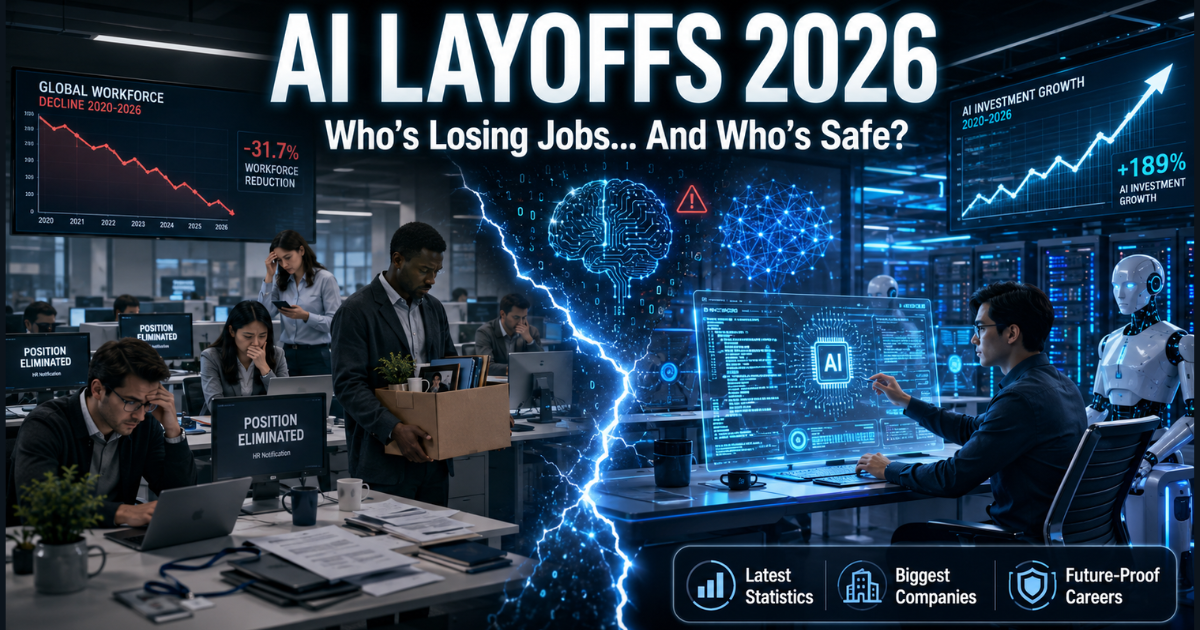
If you’ve spent any time on LinkedIn or scrolling tech news this year, you’ve probably noticed a pattern: a company posts record profits one week, then announces a few thousand layoffs the next — with “AI” somewhere in the press release. It’s a strange moment, honestly, and most of the coverage doesn’t explain what’s actually going on underneath the headline. In this guide, I’ll walk through what AI layoffs in 2026 actually look like, which companies are behind them, what the data really says, and — more importantly — what you can do about it if your job feels shaky.
Key Takeaways
- AI layoffs in 2026 hit record levels, with Challenger, Gray & Christmas naming AI as the top stated cause of U.S. job cuts for four straight months, March through June.
- Big names are behind the biggest numbers — Meta, Oracle, Amazon, Block, and Intuit have all made significant 2026 cuts while pouring more money into AI infrastructure, not less.
- “AI washing” is a real, documented pattern. Some companies blame AI for layoffs that are really about cost-cutting or correcting pandemic-era overhiring, which makes company statements an unreliable measuring stick on their own.
- Younger workers are getting hit hardest. Entry-level roles in AI-exposed fields have seen sharper employment declines than the same roles held by more experienced workers.
- This isn’t just a tech story. Finance, consulting, logistics, pharma, media, and retail have all reported AI-linked cuts this year.
- Judgment-heavy, relationship-driven, and hands-on jobs are holding up better — think healthcare, skilled trades, and high-stakes client work.
- The best defense isn’t avoiding AI — it’s getting good at working alongside it, while sharpening the human skills that are harder to automate.
What Are AI Layoffs, Really?
An AI layoff, in the strictest sense, is a workforce reduction that a company itself formally connects to artificial intelligence — through an official statement, an SEC filing, or an executive memo. That distinction matters more than it sounds. It means the label only applies when the company draws the line itself, not when a headline writer assumes AI is the cause because it’s the trendier explanation. Block is a clean example here: CEO Jack Dorsey said publicly that “intelligence tools,” combined with smaller, flatter teams, were changing what it means to build and run a company — and that statement is what puts Block’s cuts squarely in the AI-layoff category rather than a routine restructuring.
Here’s the wrinkle, though: not everything wearing the “AI” label actually deserves it. This is where the term AI washing comes in — it describes companies attributing layoffs to AI when the real driver is cost-cutting, correcting for pandemic-era overhiring, or plain financial pressure. Deutsche Bank analysts flagged this directly, calling “AI redundancy washing” a defining feature of the year, and even OpenAI’s Sam Altman has acknowledged that some companies are “blaming AI for layoffs they would otherwise do.” From what I’ve seen covering this space, that’s not cynicism for its own sake — it’s a legitimate accounting problem for anyone trying to measure AI’s actual labor impact.
So how do you tell the difference in practice? One decent test: does the company point to a specific automated process replacing specific tasks, or does it just wave vaguely at “the AI era” while revenue happens to be soft? Genuine AI displacement tends to show up in narrow, describable categories — first-line customer support tickets, boilerplate code, routine data entry. Washing tends to show up as a blanket explanation covering a broad, fuzzy cut. Neither pattern proves intent on its own, but together they’re a useful gut check.
AI Layoffs vs. Traditional Layoffs
| Traditional Layoffs | AI-Related Layoffs |
|---|---|
| Driven by falling revenue | Driven by AI investment and restructuring |
| Tied to economic downturns | Happen even during record profits |
| Usually across-the-board cuts | Often targeted at specific task categories |
| Followed by hiring freezes | Often paired with hiring into AI roles |
| Framed as cost survival | Framed as strategic reallocation |
Why Does This Matter Right Now?
AI layoffs matter because they point to a genuine structural shift in how companies split their money between people and machines — not just another downturn that’ll blow over. Economists have started calling this the AI employment paradox: profitable companies cutting human headcount and ramping up AI spending in the same breath. Oracle is the textbook case — the company posted $3.7 billion in quarterly net income, up 27% year-over-year, and still moved forward with cuts totaling 21,000 roles over twelve months, redirecting the savings toward AI data centers.
The scale of money involved makes this easier to understand. Alphabet, Microsoft, Meta, and Amazon are together expected to commit close to $700 billion to AI infrastructure in 2026 — Source: TechTimes, 2026. For a deeper breakdown of how this spending lines up against the layoffs, TechTimes’ reporting on the AI employment paradox lays out the Cappelli and Oxford Economics research in more detail than we have room for here. That spending keeps climbing at the same time these companies announce workforce cuts, which tells you the two things are connected rather than coincidental. In practice, this means the driver isn’t one struggling company — it’s an industry-wide bet on reallocating resources toward compute and away from headcount.
But here’s a detail that gets lost in most coverage: the bet doesn’t obviously pay off yet. Gartner surveyed 350 global executives at companies already piloting AI agents or automation and found that 80% had cut headcount — yet the companies that cut the most showed no better financial returns than the ones that cut the least. In a few cases, the companies that cut less actually did better. Gartner’s Helen Poitevin put it bluntly: chasing value through headcount reduction alone tends to lead to limited returns. That’s worth sitting with if you’re an executive reading this for strategy rather than career advice — the ROI story is far less settled than the press releases suggest.
Which Companies Have Made the Biggest AI-Related Cuts in 2026?
| Company | Jobs Cut | Timing | Stated AI Connection |
|---|---|---|---|
| Oracle | ~30,000 (21,000 disclosed over 12 months) | March–June 2026 | Redirecting savings toward AI data centers. |
| Amazon | ~30,000 corporate roles | Since late 2025 | Corporate restructuring tied to AI investment. |
| Meta | ~8,000 (7,000 moved into AI roles) | May 2026 | Reallocating employees toward AI-focused positions. |
| Block | 4,000 (nearly half its workforce) | February 2026 | CEO cited intelligence tools reshaping teams. |
| Intuit | ~3,000 (17% of workforce) | May 2026 | Reducing complexity while reallocating talent toward AI. |
| Cisco | ~4,000 | May 2026 | Pivoting investment toward AI networking and security. |
| Microsoft | ~4,800 (2.1% of workforce) | July 2026 | Restructuring; company stated roles weren’t directly AI replaced. |
| Accenture | ~11,000 | December 2025 | Reskilling strategy tied to automation and AI adoption. |
Salesforce is a particularly candid example — the company cut roughly 4,000 customer service roles after CEO Marc Benioff said on a podcast that the business needs “less heads” going forward. That’s about as blunt as these announcements get. Microsoft’s case is interesting for the opposite reason — the company explicitly said its ~4,800 July cuts weren’t a direct swap of people for AI, even while acknowledging AI is changing how the work gets done. That’s a useful reminder that “AI is changing our business” and “AI is replacing this job” are two different claims, and companies don’t always distinguish between them clearly.
If you want the sourced, company-by-company version of this list, Founder Reports’ AI layoffs tracker cites a specific CEO memo, filing, or statement for every entry, so you’re not relying on secondhand attribution.
Google is its own case study in ambiguity. Rather than announcing one headline number, it’s cut headcount through rolling performance reviews, a voluntary buyout program, and structural reorgs — with outside estimates putting the 2026 total somewhere between 1,500 and 3,000+ engineers, plus a 35% reduction in first-line managers. That’s exactly why leaning on any single company’s press release, or any single tracker’s total, will give you a skewed picture.
If you want to track this in real time rather than rely on a snapshot, TechCrunch’s running list of 2026 tech layoffs is updated as new companies announce cuts and name AI as a factor.
How Many Jobs Have Actually Been Cut Due to AI in 2026?
This is where I’d urge some caution, because the trackers genuinely don’t agree — and that’s not a knock on any of them, it’s just a methodology issue. Challenger, Gray & Christmas reported AI was cited in 101,743 U.S. job cuts through June 2026 — Source: Challenger, Gray & Christmas, 2026 — nearly double the 54,836 cuts attributed to AI in all of 2025. That number comes straight from Challenger, Gray & Christmas’s layoff tracking data, which has been the go-to source for monthly U.S. layoff reasons since 2023. In June alone, AI accounted for 31% of that month’s 45,849 job cuts, marking its fourth straight month as the top stated reason.
For a slightly different cut of the same trend, the SkillSyncer 2026 layoffs tracker counts events rather than just totals, which is useful if you want to see how many individual companies are behind a given number.
Other trackers tell a related but not identical story. Layoffs.fyi-based reporting puts tech-sector cuts alone somewhere between 120,000 and over 150,000 in the first half of 2026. A separate tracker counted 267 layoff events affecting 185,894 workers as of mid-July, with 56% of those events explicitly citing AI or automation. The honest takeaway: attribute any number you cite to its specific source rather than presenting one combined “master total,” because Layoffs.fyi, Challenger Gray, and TrueUp all count differently and will keep disagreeing.
What every tracker agrees on is the direction. TrueUp data shows layoffs topped 20,000 in every month of 2026 except April, and Goldman Sachs estimates AI-attributed payroll reductions at major U.S. employers running above 16,000 a month. Total announced job cuts in 2026 — regardless of stated cause — have already surpassed 2025’s full-year pace, according to Layoffs.fyi.
Which Industries Are Getting Hit the Hardest?
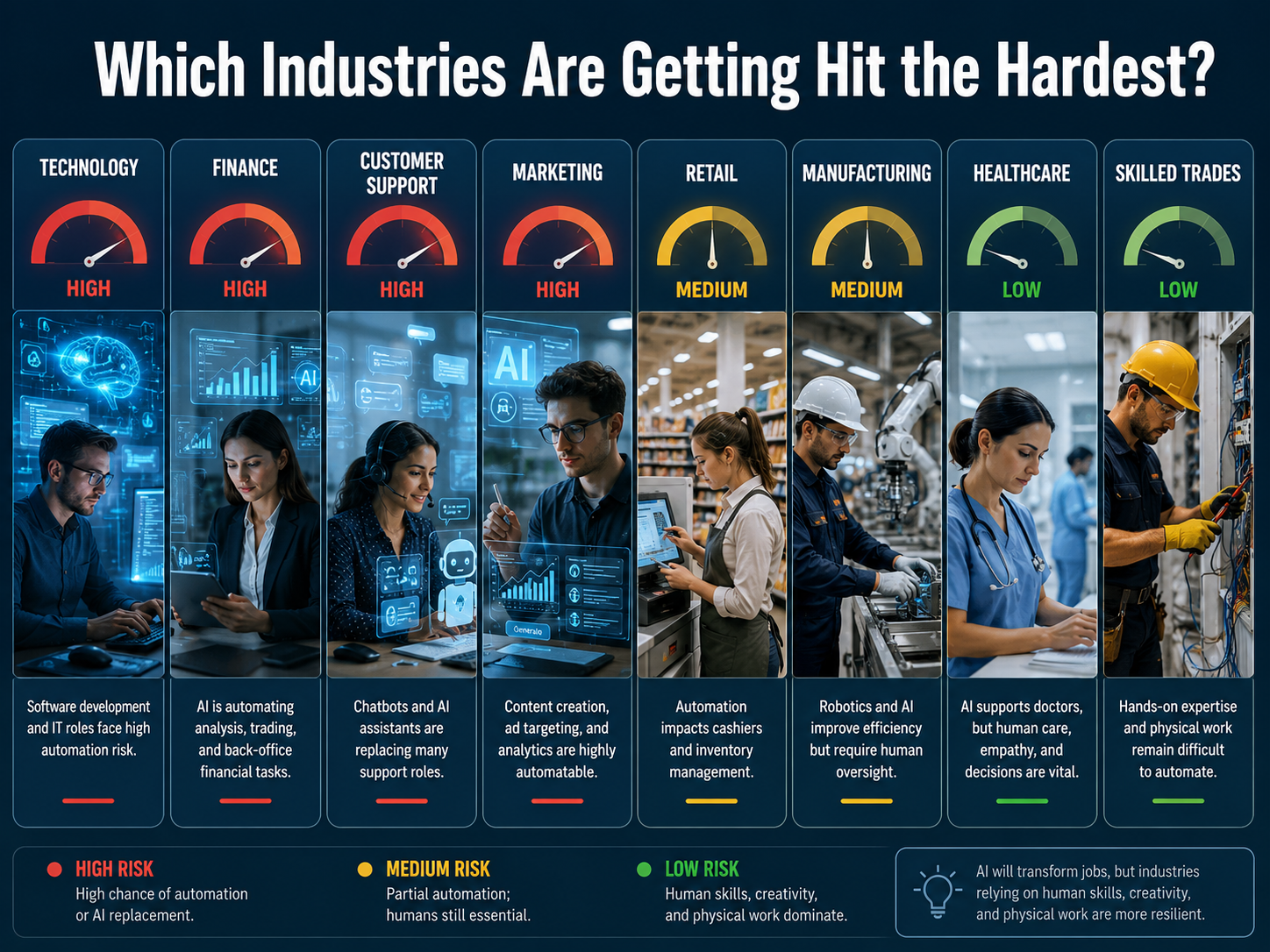
Tech is still ground zero, but AI-linked layoffs have spread well past it — into finance, consulting, logistics, pharma, media, and retail.
Technology and software has announced roughly 139,156 job cuts through June 2026, up 83% year-over-year, and now makes up nearly a third of all 2026 layoffs. That includes core engineering roles at companies like Oracle and Amazon, plus the managers who used to oversee those teams — Google’s 35% cut to first-line managers is a good example of that second wave.
Finance and professional services haven’t escaped either. Citigroup has targeted a roughly 20,000-role headcount reduction for 2026, and Accenture cut around 11,000 positions tied to reskilling and automation. Even law firms are affected — Baker McKenzie announced cuts of up to 10% of its global workforce tied to a shift toward AI-assisted legal work.
Logistics, pharma, and media round out the picture. C.H. Robinson cut about 1,400 jobs after rolling out AI tools for pricing and shipment tracking. Pharmaceutical layoffs are up nearly 550% year-over-year, hitting 12,732 cuts. And Chegg laid off 45% of its workforce as students shifted to free generative AI tools instead of paid homework help — probably the cleanest example anywhere of AI directly displacing a business model rather than just trimming headcount around the edges.
Programs.com’s breakdown of AI-driven layoffs by company goes deeper into some of the less-covered industries here, including law firms and financial services, if you want more examples outside the usual tech names.
Which Jobs Are Most at Risk From AI?
Jobs built around routine, repeatable, text-based, or rules-based work show the clearest overlap with what current AI tools can already do. That includes computer programmers (particularly junior ones), customer service reps, data entry workers, junior content writers, and templated marketing roles. Salesforce’s customer-service cuts followed directly from its adoption of AI-driven support tools — that’s a fairly direct line from tool adoption to job impact.
The part that doesn’t get enough attention: this risk isn’t evenly distributed by age. Employment for workers ages 22 to 25 in AI-exposed occupations has declined roughly 13% since late 2022, according to Stanford’s “Canaries in the Coal Mine” research — while employment for older workers in the same fields has held steady or even grown. That gap exists for a fairly intuitive reason: entry-level tasks are usually the ones used to train new hires, and those happen to be exactly the tasks current AI tools handle reasonably well. If you’re early in your career in one of these fields, this isn’t an abstract worry — it’s already showing up in the numbers for people your age.
If you want a closer look at this beyond job titles, we’ve broken down which specific skills AI is already replacing in 2026 — since in practice, it’s rarely a whole job disappearing at once, it’s specific tasks inside that job going first.
Which Jobs Are Safest From AI Right Now?
Roles built around human judgment, physical skill, or high-trust relationships are holding up noticeably better. Machine learning infrastructure, AI safety, applied research, healthcare, and skilled trades are all still seeing strong demand even as AI-exposed office roles shrink.
A nurse coordinating patient care across a team, or an electrician wiring a new building — neither of those is a job current AI can step into. Roles centered on high-stakes client relationships, like enterprise sales or wealth management, tend to survive for a similar reason: clients want an accountable person on the other end, not a chatbot. The common thread across every “safe” category is some mix of physical presence, real-time judgment, or trust that AI simply can’t replicate yet — not “creative” versus “technical,” which is the distinction a lot of older career advice leans on.
Why Are Profitable Companies Still Cutting Jobs While Spending More on AI?
Because this is fundamentally a capital-allocation decision, not a survival move. Cutting commoditized roles frees up budget for GPU procurement, data center buildouts, and the other infrastructure hyperscalers are racing to build. Oracle’s cuts landed in the same stretch it reported remaining performance obligations up 325% to $553 billion — a company reallocating, not scrambling.
That said, this bet hasn’t clearly paid off yet, and it’s worth saying so plainly. Wharton’s Peter Cappelli put it well: companies are saying “we expect AI will cover this work” — not that it already has. Oxford Economics reached a similar conclusion in January 2026, finding that firms “don’t appear to be replacing workers with AI on a significant scale.” That gap between what executives expect and what’s actually been confirmed is really the crux of why this whole wave of layoffs remains controversial among economists, and honestly, I think it’s the most important nuance missing from most coverage of this topic.
This gap between what companies expect from AI and what’s actually confirmed is exactly why regulators are starting to pay closer attention — we cover why governments are racing to regulate AI before it’s too late if you want to understand the policy side of this story.
Are AI Layoffs Really About AI — or Cost-Cutting in Disguise?
Both things are true at once, and separating them cleanly from the outside is genuinely hard. Sam Altman said as much at the India AI Impact Summit — acknowledging “some AI washing where people are blaming AI for layoffs they would otherwise do,” while also confirming real AI-driven displacement is happening in specific roles. Nearly 6 in 10 companies admit they frame layoffs or hiring slowdowns as AI-driven when the real reason is financial — Source: Founder Reports, 2026.
That said, writing off every AI-cited layoff as pure spin would be its own mistake. Chegg’s collapse as students switched to free AI tools is about as clean a case of direct AI substitution as you’ll find. The honest answer sits on a spectrum: some cuts are almost entirely AI-driven, some are almost entirely disguised cost-cutting, and most fall somewhere in the messy middle.
How Can You Future-Proof Your Career Against AI Layoffs?
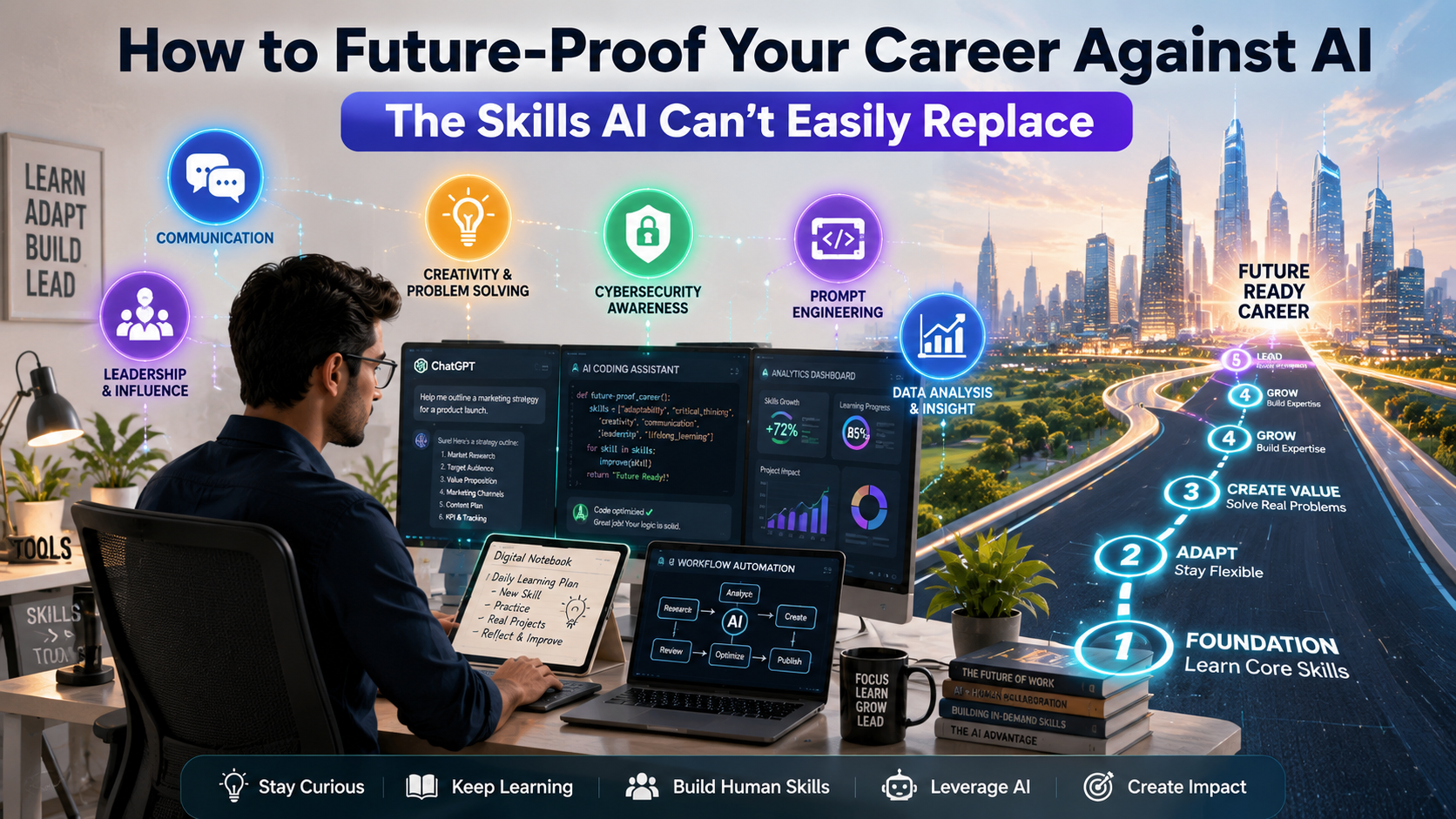
Future-proofing your career against AI displacement really comes down to three things: building AI fluency, sharpening judgment-based skills, and strengthening the relationships that make you hard to swap out. Here’s a practical way to work through it.
First, actually learn the AI tools used in your field — not just poke at ChatGPT once. Fluency signals adaptability to the people making these decisions.
Second, lean into the parts of your job that require in-person trust or complex decision-making. A marketer who can present strategy directly to a client — not just churn out content — is a lot harder to replace than one who only executes tasks.
Third, update your resume and professional profiles so they actually reflect these skills, since a growing number of companies screen candidates through automated systems before a human ever sees the resume. Building a visible presence — sharing your actual work and point of view on LinkedIn, for instance — also makes you a known quantity before a layoff ever happens.
Finally, if your role sits in a highly exposed category, build a backup income stream now, not after the layoff notice. And if your whole field is shifting under you, it may genuinely be worth exploring a broader pivot rather than waiting it out.
What Should You Do If You’ve Already Been Laid Off?
If you’re already dealing with this, your first move is understanding your severance and benefits before you sign anything. There’s often more room to negotiate — extended healthcare, a longer notice period — than people assume.
Next, file for unemployment as soon as you can, since eligibility rules and processing times vary a lot by state. At the same time, start updating your resume and reaching out to your network immediately rather than waiting — job searches in AI-exposed fields are taking longer right now than in past downturns. In practice, working through the boring, sequential steps — benefits, resume, network, applications — tends to shorten the gap far more than any one dramatic career pivot.
Common Myths About AI Layoffs
Myth one: every company citing AI is telling the full story. As covered above, AI washing means a real chunk of these announcements are ordinary cost-cutting dressed up in AI language.
Myth two: cutting workers to fund AI guarantees better returns. Gartner’s research directly contradicts this — there’s no reliable link between the size of the cuts and improved financial performance.
Myth three: only entry-level tech jobs are at risk. Not true. Law, consulting, pharma, and logistics have all seen AI-linked cuts this year, which tells you this trend cuts across seniority levels and industries, not just junior engineers.
Conclusion
AI layoffs in 2026 are real, they’re widespread, and they’re not going away anytime soon — but the “AI-driven” label attached to any given announcement deserves a healthy dose of skepticism. Some cuts genuinely reflect automation of specific, describable tasks. Others are cost-cutting wearing an AI costume because it sounds more strategic in a press release. Either way, the professionals coming out ahead of this shift are the ones building real AI fluency, doubling down on judgment-based skills, and keeping their resume, network, and backup plan ready before they need them. The labor market is changing shape — it isn’t closing. Understanding exactly what’s happening is still your best shot at staying on solid ground.
FAQs: AI Layoffs 2026
FAQ 1: Are AI layoffs actually caused by AI, or is that just an excuse?
It’s genuinely both, depending on the company. Some cuts trace directly to a specific automated process replacing specific tasks — Chegg losing users to free AI tools is a clear example. Others are what analysts call “AI washing,” where a company blames AI for cuts that are really about cost-cutting or correcting pandemic-era overhiring. Nearly 6 in 10 companies admit to framing layoffs as AI-driven when the real reason is financial — Source: Founder Reports, 2026.
FAQ 2: How many jobs have been lost to AI in 2026 so far?
It depends which tracker you trust, and they don’t agree. Challenger, Gray & Christmas puts AI-cited U.S. job cuts at 101,743 through June 2026 — Source: Challenger, Gray & Christmas, 2026. Other trackers using broader tech-sector criteria put the number well above 150,000 for the first half of the year alone. Always attribute a figure to its specific source rather than treating any single number as the definitive total.
FAQ 3: Which companies have made the biggest AI-related cuts this year?
Oracle, Amazon, and Meta lead by raw headcount, with Oracle’s cuts totaling roughly 21,000 over twelve months and Amazon eliminating around 30,000 corporate roles since late 2025. Meta cut about 8,000 while moving 7,000 employees into new AI-focused roles. Block, Intuit, Cisco, and Microsoft have all made smaller but still significant cuts tied to AI restructuring.
FAQ 4: Which jobs are most at risk from AI right now?
Roles built around routine, repeatable, text-based work carry the highest exposure — think junior programmers, data entry, first-line customer support, and templated content writing. Entry-level workers in these fields have been hit hardest: employment for 22-to-25-year-olds in AI-exposed occupations has dropped about 13% since late 2022, while older workers in the same fields have held steady — Source: Stanford Digital Economy Lab, “Canaries in the Coal Mine,” 2026.
FAQ 5: Which jobs are safest from AI automation?
Jobs that depend on physical presence, real-time judgment, or trust-based relationships are holding up best — healthcare, skilled trades, enterprise sales, and applied AI/ML roles themselves. The common thread isn’t “creative vs. technical,” it’s whether the job requires something AI genuinely can’t replicate yet, like hands-on skill or accountability in a high-stakes relationship.
FAQ 6: Why are profitable companies still cutting jobs while spending more on AI?
Because it’s a capital-allocation decision, not a survival move. Cutting commoditized roles frees up budget for GPU infrastructure and data centers. That said, the payoff isn’t proven — Gartner found companies that cut headcount the most showed no better financial returns than those that cut the least.
FAQ 7: What should I do if I’ve already been laid off due to AI?
Start with severance and benefits before signing anything, then file for unemployment right away since rules and processing times vary by state. Update your resume and start networking immediately rather than waiting — job searches in AI-exposed fields are taking longer than in past downturns, so the sequential basics (benefits, resume, network, applications) matter more than one dramatic pivot.
FAQ 8: How can I future-proof my career against AI layoffs?
Get genuinely fluent in the AI tools used in your field, not just a passing familiarity. Pair that with strengthening the human parts of your job — client relationships, complex judgment calls, leadership — that are harder to automate. Keep your resume and LinkedIn presence current, and consider a backup income stream if your role sits in a highly exposed category.
Written by Andrew Collins: Andrew Collins is a technology and business content writer covering digital trends, workplace developments, and emerging technologies. His work focuses on presenting complex topics in a clear, accessible way to help readers better understand the changing technology landscape.
Reviewed by: Editorial Review Team & Research Contributors.
Disclaimer: This article is based on publicly available research, company announcements, industry reports, government publications, labor market data, and news sources available at the time of publication. Workforce trends, AI adoption, hiring practices, layoffs, and corporate strategies can change rapidly as organizations respond to evolving business and economic conditions. Statistics, company information, and employment developments may be updated over time. Readers are encouraged to verify the latest information through official company statements and trusted sources before making career or financial decisions. This content was initially drafted with AI assistance and has been carefully reviewed, edited, refined, and fact-checked by human editors to ensure accuracy, clarity, originality, and editorial quality.