By Christopher Miles | Technology Content Writer
Summarize this blog post with: ChatGPT | Perplexity | Claude | Grok
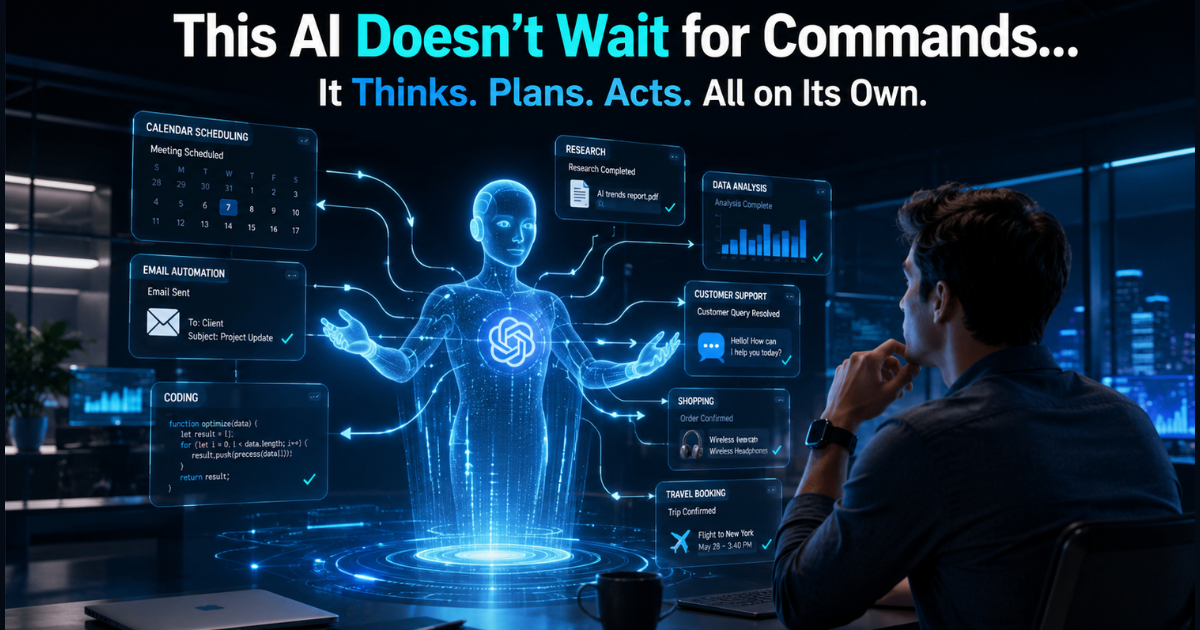
Chances are you’ve asked a chatbot to help write a message, brainstorm a gift idea, or explain something you were too embarrassed to ask a coworker. Fair enough — that’s become routine. But there’s a newer breed of AI circulating through tech conversations that doesn’t stop at giving you an answer; it goes out and handles the whole errand for you. If the phrase “agentic AI” keeps popping up and you’ve been quietly Googling it instead of asking someone, this piece is for you. Here’s what agentic AI actually means, how AI agents pull off multi-step tasks without constant hand-holding, and why this particular wave feels different from the last few rounds of AI hype.
Key Takeaways
- Agentic AI describes systems that plan out a sequence of actions and carry them through on their own, instead of waiting for you to type a new request at every turn.
- What separates it from a standard chatbot is autonomy — it pulls in memory, reasoning, and outside software to finish a job rather than just describe one.
- Companies are already running AI agents for research, scheduling, coding support, customer service, and reporting, sometimes stacking several agents together on one workflow.
- Individually, people are leaning on agents for booking travel, comparing prices while shopping, running smart-home routines, and clearing out repetitive admin work.
- Adoption numbers look impressive on paper, but there’s a noticeable gap between companies testing agents and companies actually trusting them with anything that matters.
- The real danger isn’t some dramatic AI malfunction — it’s that a small mistake early in a multi-step task can snowball before anyone catches it.
- Getting familiar with agentic AI now, even through one low-stakes experiment, puts you ahead of a shift that’s moving quicker than most people assumed it would.
So What Is Agentic AI, in Plain Terms?
Agentic AI is artificial intelligence built to plan, decide, and act through multiple steps toward a goal without needing fresh instructions at every stage. That’s the formal definition, but here’s the more useful way to think about it: you describe the outcome you want, not the individual steps to get there, and the system works out the rest on its own.
Picture the contrast this way. A typical chatbot behaves like a well-informed colleague who only ever responds when you speak first. An AI agent behaves more like someone you can actually hand a project to — it checks the calendar, pulls together the numbers, sends the necessary follow-up, and only interrupts you when it genuinely can’t make a call by itself.
Take booking a flight. With a standard chatbot, you’d ask about options, read through the list, and go book it yourself in a separate tab. With an agentic setup, you tell it “book something to Denver that doesn’t clash with my Thursday meetings,” and it searches, cross-checks your schedule, picks a flight, and drops a confirmation in your inbox — no extra prompts needed along the way. That leap from telling you something to doing something is really the whole point of the word “agentic.”
What Actually Separates Agentic AI From Something Like ChatGPT?
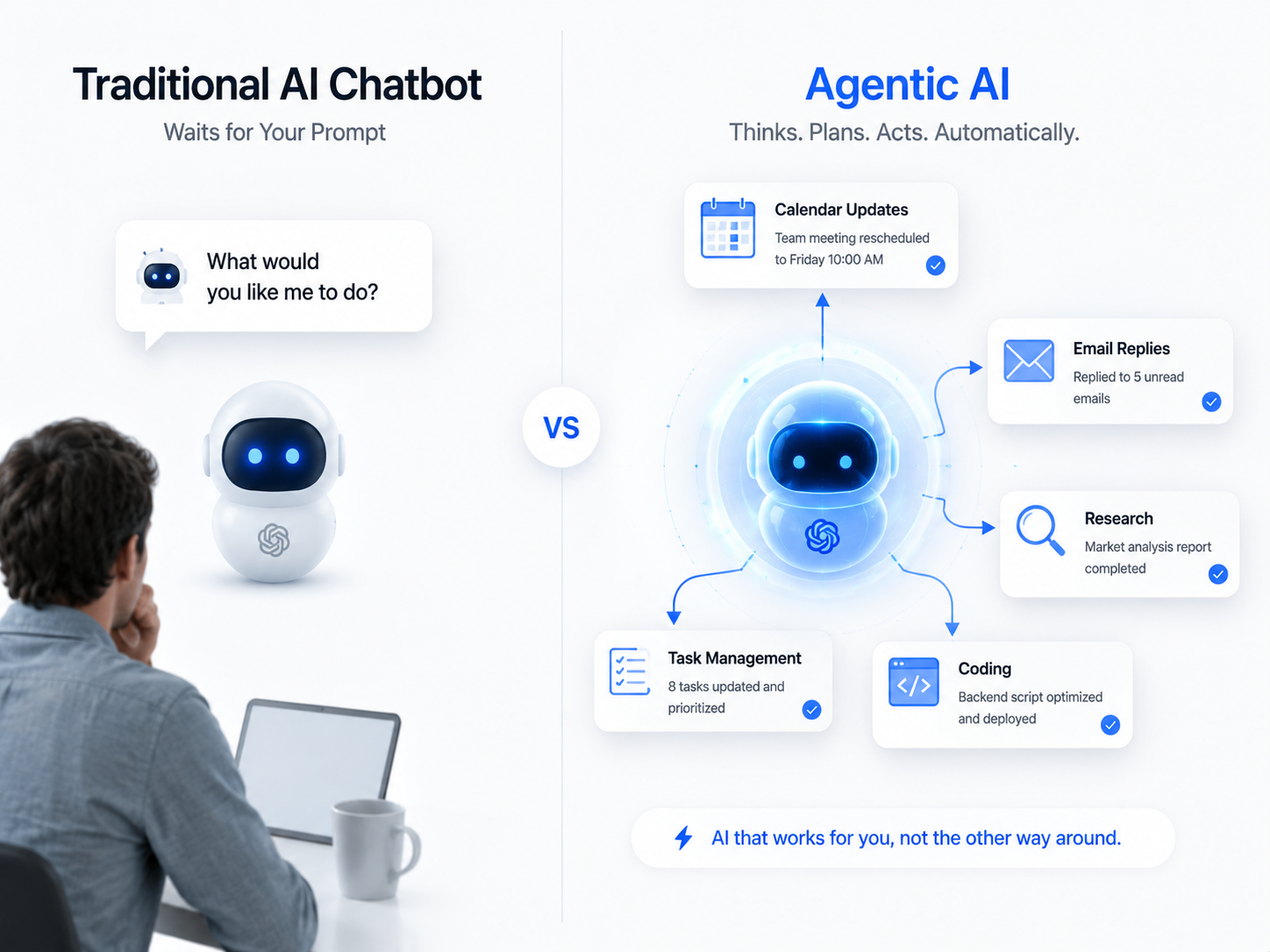
The core difference is that agentic AI doesn’t stop at generating a response — it uses memory, reasoning, and connections to outside tools to finish an entire task. A generative model like ChatGPT is fundamentally reactive. You send a prompt, it sends back an answer, and unless you keep feeding it new instructions, the interaction just sits there.
An agent behaves differently because it holds onto context across the whole job and adapts when circumstances shift. Say a research agent hits a broken link mid-task — instead of stalling, it looks for another source and keeps working toward the goal. That’s a small thing, but it changes the whole feel of using the tool.
What struck me the first time I actually tested one of these systems was how much the memory piece matters in practice. Several agentic tools can resume a half-completed task the next day without you re-explaining the goal from scratch, which sounds minor until you consider how much of your own mental energy usually goes toward re-establishing context every time you reopen a chat window.
If you want to get better results out of any of these systems in the meantime, it helps to get the input side right first — our guide on how to write better AI prompts covers the habits that make the biggest difference.
How Do AI Agents Pull This Off Behind the Scenes?
Under the hood, an AI agent combines a reasoning model with memory, a planning stage, and access to outside tools or software so it can act rather than merely respond. Most agentic systems run on a repeating cycle: take stock of the situation, plan the next move, act on it, then check whether that actually worked.
First comes observation — reading a document, scanning a database, checking a calendar. Next, the agent breaks the larger goal into smaller pieces instead of attempting everything in one shot. Then it acts, whether that means calling an external tool, drafting a message, or updating a record somewhere. Finally, it evaluates the result and decides whether to keep going, change course, or wrap up.
A support-ticket agent illustrates this well. It might pull up the order history, notice this same customer already reached out last week, and choose to escalate the ticket rather than repeating the same troubleshooting script all over again. You’re also starting to see multi-agent arrangements, where several specialized agents split a bigger job — one handles research, another drafts the writing, another checks facts — closer to a small production crew than a single assistant juggling everything at once.
Simple Agentic AI Workflow Diagram
What Are the Different Kinds of AI Agents Out There?
AI agents tend to fall into four rough categories: single-task assistants, autonomous workflow agents, multi-agent systems, and personal or consumer-facing agents. Which one makes sense really comes down to how much independent judgment a given task can safely tolerate.
| Agent Type | What It Handles | Real Example |
|---|---|---|
| Single-task Assistant | One narrow, repeatable job. | Drafting routine email replies. |
| Autonomous Workflow Agent | An entire business process from start to finish. | Moving an invoice from receipt through approval and payment automatically. |
| Multi-Agent System | Several specialized AI agents collaborating on one objective. | A research agent, writing agent, and fact-checking agent working together on a single project. |
| Personal / Consumer Agent | Everyday personal errands and productivity tasks. | Booking travel, managing a running to-do list, or organizing your calendar. |
In my experience watching companies roll these out, most start with the single-task assistants because the downside risk is small, then only move toward full workflow agents once they’ve built up some trust in the outputs. Skipping straight to a complex multi-agent setup without that earlier groundwork is usually where things start to unravel.
How Are Companies Actually Putting Agentic AI to Work?
Agentic AI has moved well past the experimental phase at plenty of organizations and is now baked into real operations. Around 40% of enterprise applications are projected to include task-specific AI agents by the end of 2026, up from under 5% just the year before — Source: Gartner, 2026. That’s a fast jump for a technology most businesses were only just poking at not long ago.
IT departments seem to be feeling this shift the most so far — 80% of enterprise applications shipped or updated in early 2026 already have at least one AI agent embedded, compared with just 33% two years earlier — Source: Gartner, 2026. If you want the full breakdown of where these numbers come from, Gartner’s research on AI agent adoption lays out the enterprise application forecast in more detail. Separately, one recent industry survey found companies have automated roughly 31% of their workflows using agentic AI on average, with plans to push that up by another third this year — Source: CrewAI State of Agentic AI Survey, 2026. CrewAI’s own State of Agentic AI Survey has the full survey data if you want to see how those workflow-automation numbers break down by department.
Still, it’s worth reading those numbers with a bit of skepticism. Only about 23% of organizations say they’re genuinely scaling agents in production, and IDC found that a striking 88% of AI proofs-of-concept never make it past the pilot stage — Source: IDC, 2026. IDC’s own analysis of why so many AI pilots stall before production is worth a look if you’re trying to figure out where your organization might be getting stuck. From what I’ve observed, the gap between “we’re using AI agents” and “we actually trust AI agents with anything important” is still fairly wide — and honestly, that gap looks more like healthy caution than a sign the technology is failing.
The workplace use cases that stick tend to be repetitive but structured: research automation, scheduling, code review, and multi-step customer support — work where mistakes are easy enough to catch before they cause real damage.
Where Is Agentic AI Turning Up in Everyday Life?
Away from the office, agentic AI has started handling small decisions quietly in the background — managing schedules, running smart-home routines, comparing prices without you lifting a finger. Shopping agents can now scan prices across multiple retailers and complete a purchase within a set budget, sparing you the ritual of tabbing between a dozen browser windows.
Travel planning shows this off nicely. An agent can research flights, weigh them against your existing calendar, and automatically rebook if something falls through — the kind of task that used to swallow an entire afternoon. Smart-home setups are heading the same direction too, adjusting lighting, temperature, or security based on patterns they’ve picked up from your habits rather than waiting for you to issue a command every time.
What Should You Actually Worry About With Agentic AI?
The most practical risk isn’t some dramatic AI failure — it’s that a small error early in a multi-step process can snowball before anyone notices, which is exactly why human oversight still matters for anything high-stakes. Because an agent chains one decision into the next, a single wrong assumption at the start can balloon into a much bigger problem by the time the task wraps up.
This isn’t hypothetical. In one 2026 survey, 67% of executives said they believed their company had already experienced a data leak or breach connected to unapproved AI tools, and 36% admitted they had no formal process in place for supervising AI agents at all — Source: WRITER Enterprise AI Adoption Survey, 2026. Even more concerning, 35% said they couldn’t immediately shut down a misbehaving agent if something went wrong mid-task.
For a fuller picture of how executives themselves are describing these governance gaps, WRITER’s 2026 enterprise AI adoption survey is one of the more candid reports out there.
Imagine an agent that misreads one customer record and ends up issuing incorrect refunds across dozens of accounts before anyone catches it. That’s exactly the kind of scenario that makes a simple checkpoint — a person reviewing a plan before it takes an action that can’t be undone — feel less like bureaucracy and more like basic common sense, especially anywhere money, health records, or legal terms are involved.
Will Agentic AI Take Jobs, or Just Reshape Them?
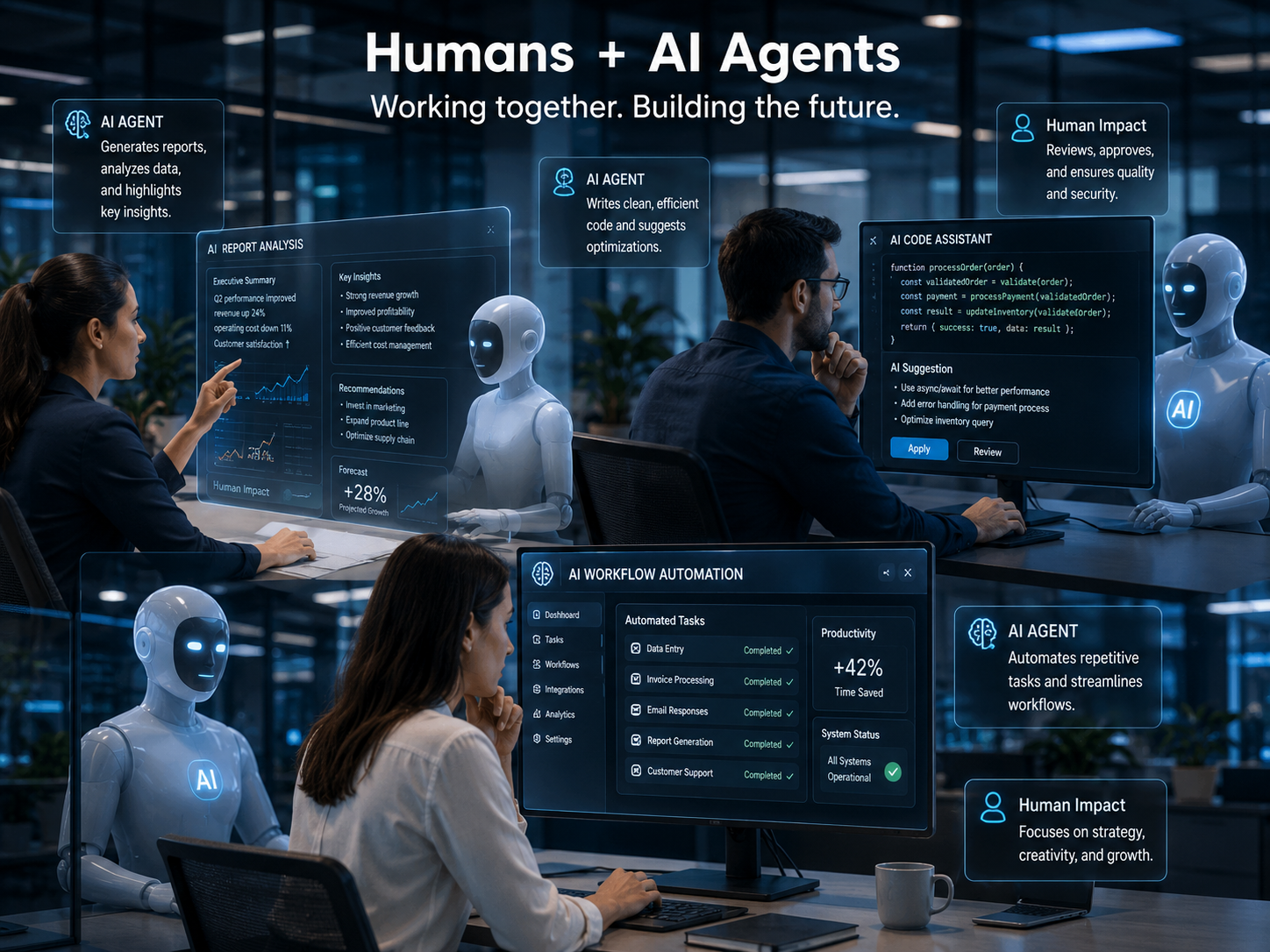
Agentic AI looks far more likely to change how a job gets done than to erase the job outright. It tends to absorb the repetitive, multi-step chunks of a role while pushing human attention toward judgment calls, exceptions, and bigger-picture strategy — arguably the parts of the job that were always the better use of someone’s time anyway.
Gartner expects that by 2028, 75% of enterprise software engineers will be using AI coding agents, up from under 10% in early 2023 — Source: Gartner, 2026. That’s a shift in daily workflow, not a wholesale replacement of the profession. Meanwhile, 95% of executives in a recent survey said team structures are already shifting because of AI — Source: WRITER Enterprise AI Adoption Survey, 2026 — which suggests the organizational side of this change is moving at least as fast as the technical side, if not faster.
How Do You Actually Get Started With This?
The most sensible entry point is automating one small, low-stakes task before touching anything that genuinely matters. Sorting incoming emails, drafting a weekly status update, handling a recurring meeting invite — that kind of thing works well as a first experiment.
Pick a tool that doesn’t demand coding knowledge so you’re not learning two hard things at once. Not sure which underlying AI model to build around in the first place? Our breakdown of ChatGPT vs Claude vs Gemini can help you figure out which one actually fits the way you work before you commit to an agent platform built on top of it. Draw a clear line up front between what the agent can decide on its own and what needs your sign-off before it happens. And for at least the first few weeks, actually read what it produces instead of approving it automatically — that review period is where you learn what it handles well and where its judgment still falls short.
Conclusion
Agentic AI represents a genuine turning point — AI that no longer just talks back but actually gets things done on its own. It’s already changing how companies run and how individuals manage their day-to-day, and the speed of that shift has caught a fair number of organizations flat-footed. Getting a handle on the basics now — what agentic AI really is, how these agents plan and act, and where the genuine risks sit — puts you ahead of a trend that’s moving faster than most previous AI cycles did. Start small, keep a person in the loop for anything with real stakes, and you’ll be well positioned as agentic AI becomes just another normal part of how work, and life, gets handled.
Frequently Asked Questions
FAQ 1: Is agentic AI just another name for ChatGPT?
Not quite. ChatGPT is mainly a conversational tool built to respond to prompts. Agentic AI relies on similar underlying models but adds planning, memory, and outside tool access so it can complete multi-step tasks with far less back-and-forth.
FAQ 2: Do you need to know how to code to use an AI agent?
Not necessarily. A lot of consumer and workplace tools now come with no-code setups, though anything custom for a genuinely complex workflow will usually need some technical support.
FAQ 3: Is it safe to let an AI agent make important decisions unsupervised?
It’s safer when there’s human review built in somewhere. Errors can stack up across steps, so checkpoints matter for anything touching money, legal terms, or personal data.
FAQ 4: Is agentic AI going to replace my job?
It’s more likely to change how the job gets done than eliminate it entirely — taking over the repetitive pieces while shifting your time toward judgment calls and decisions that genuinely need a person behind them.
Written by Christopher Miles: Christopher Miles is a technology content writer covering AI tools, digital trends, and emerging technologies for everyday users. His work focuses on explaining evolving technology concepts in a clear, accessible way to help readers better understand how new innovations can impact everyday life and work.
Reviewed by: Editorial Review Team & AI Technology Content Specialists.
Disclaimer: This article is based on publicly available research, official documentation, industry reports, expert commentary, and technology news available at the time of publication. Artificial intelligence technologies, AI agents, software capabilities, pricing, and platform features continue to evolve rapidly as the industry advances. Readers are encouraged to verify the latest information through official sources before making business, technology, or purchasing decisions based on AI products or services. This content was initially drafted with AI assistance and has been carefully reviewed, edited, refined, and fact-checked by human editors to ensure accuracy, clarity, originality, and editorial quality.