By Ethan Brooks | Technology Content Writer
Summarize this blog post with: ChatGPT | Perplexity | Claude | Grok
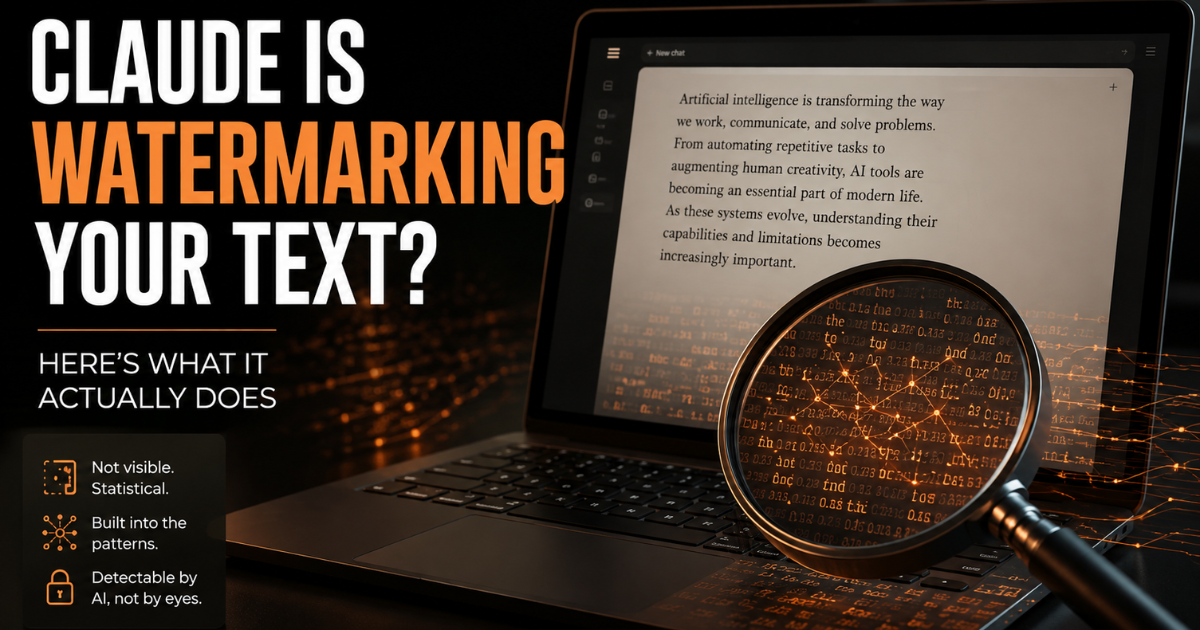
If you use Claude to write, draft, or edit anything, there’s something you should know: as of August 2026, Anthropic confirmed that supported Claude models are now embedding an invisible statistical watermark into generated text — not just in Europe, but globally. This isn’t a conspiracy theory, and it’s not a visible stamp at the bottom of your document. It’s something quieter and technically more interesting than that, which is exactly why the reaction from writers and developers has been so heated.
In this guide, you’ll get a clear, honest breakdown of how Claude’s text watermark actually works, what it changes (and what it doesn’t), why critics are calling it a “perversion of writing,” and what you — as a writer, researcher, or professional — should realistically do about it.
Key Takeaways
- AI text watermarking embeds a statistically detectable signal into generated text by influencing word selection during generation — not by adding hidden characters or visible marks.
- Claude’s watermark is based on Google’s SynthID-Text technology and operates by guiding low-stakes token choices using a secret key and recent text context.
- The signal is designed to be invisible to readers but detectable by a compatible system analyzing the aggregate pattern of word choices across a passage.
- Watermarking is fundamentally different from AI detection — the watermark is created during generation, while detectors search for evidence in text after the fact.
- A detected watermark indicates Claude may have been involved, not that Claude originated the ideas or that human editing didn’t occur substantially.
- The signal degrades with editing, paraphrasing, or translation, though Anthropic says it may survive some editing — developers have already found workarounds.
- The ethics debate is real and worth understanding: the core tension isn’t whether watermarking is useful, but whether users should have more say in whether it applies to their output.
What Is an AI Text Watermark, Exactly?
An AI text watermark is a statistically detectable signal embedded into generated text during the model’s generation process — not something added to the finished document afterward. That distinction matters more than it might seem at first.
When most people hear “watermark,” they picture a semi-transparent logo across a photo or the faint crest pressed into premium paper. Those are visible authentication marks. Claude’s watermark is nothing like that. There’s no badge appearing in your output, no hidden Unicode character you can find by pasting into Notepad, and no footer declaring AI involvement. The signal lives in which words were chosen, not in any extra content added to the text.
Here’s how it works at a basic level. Large language models generate text by assigning probability scores to possible next tokens — a token being roughly a word, part of a word, or punctuation. Normally, when multiple plausible options exist, the model picks among them based on those probabilities. With watermarking active, the selection process is nudged by a secret key combined with recent text context, biasing the choice toward a specific subset of options. The individual choices look completely ordinary. The watermark emerges only from the statistical pattern across many such decisions — Source: Anthropic, 2026.
For example, suppose Claude is completing the phrase “the sky looked…” and both “overcast” and “grey” are equally natural continuations. Without watermarking, the choice is probabilistic. With watermarking, the secret key might consistently favor one over the other in detectable ways, across hundreds of similar micro-decisions throughout a piece.
Crucially, Anthropic says the technique doesn’t add hidden characters, doesn’t require extra tokens, and doesn’t store information about you personally. The signal is about the pattern of word selection, nothing more — Source: Anthropic, via PublicNow, 2026.
Why Anthropic Is Doing This Now
The timing here is deliberate. Anthropic’s implementation is tied directly to regulatory pressure, particularly around the EU AI Act’s transparency requirements. As of August 2, 2026, new Claude models launched in the EU are required to support machine-readable content marking at launch. Anthropic went further than the minimum requirement, applying the marking globally across supported products — including Claude, Claude Code, Claude Platform, and Claude Cowork — rather than limiting it to European users — Source: Anthropic Help Center, 2026.
But regulation isn’t the only driver. The broader context is that AI-generated text has become genuinely difficult to identify without specialized tools, and that’s created real problems. Unreliable AI content detectors routinely flag human-written text as AI-generated and vice versa. Academic institutions are struggling to enforce integrity policies with blunt instruments. And the spread of synthetic content in journalism and politics has made provenance — knowing where content came from — an increasingly serious concern.
A 2023 MIT study found that AI-generated misinformation spreads roughly six times faster than human-generated false content on social media — Source: MIT Media Lab, 2023. That’s the problem watermarking is attempting to address, at least in part.
Honestly, the case for some kind of provenance system is reasonable. What’s more contested is whether embedding that system covertly in a writing tool, without a meaningful opt-out, is the right way to do it.
How Claude’s Text Watermark Actually Works Under the Hood
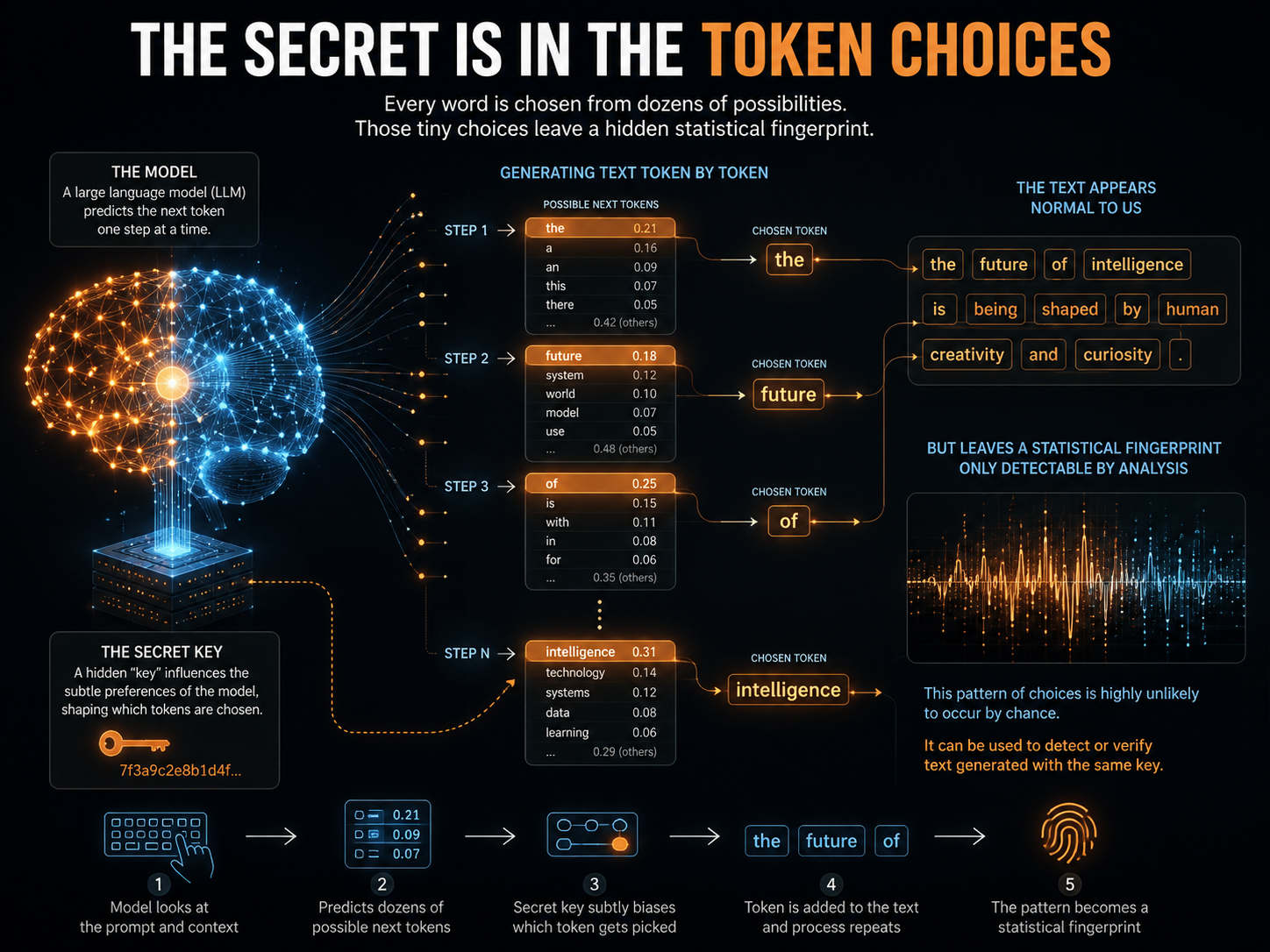
Anthropic’s implementation is based on Google’s SynthID-Text technology, the same underlying approach that Google has applied to Gemini-generated content — Source: Android Authority, 2026. The mechanism is a form of what researchers call soft watermarking or token-level statistical watermarking, and it’s worth understanding how it differs from earlier ideas.
The foundational research came from a 2023 University of Maryland paper by Kirchenbauer et al., which introduced the green-list/red-list approach. At each generation step, a pseudo-random function divides the model’s vocabulary into two groups — a “green list” and a “red list.” The model is then biased to favor green-list tokens. A detector can later run the same pseudo-random function on a piece of text, count how many tokens land in the green list, and compare that ratio to the roughly 50/50 split you’d expect from unwatermarked text. A statistically significant skew toward green-list tokens signals AI involvement — Source: Kirchenbauer et al., arXiv, 2023 — you can read the full original research at A Watermark for Large Language Models on arXiv if you want to understand exactly how the math works.
What makes this approach notable is what it doesn’t do. It doesn’t rewrite your sentences. It doesn’t change your meaning. It doesn’t introduce grammatical awkwardness. The nudge happens within the space of tokens that are already plausible choices — it’s selecting “examine” over “look at,” or “however” over “but,” in situations where both would read naturally.
In practice, the watermark is more detectable over longer passages and weaker over short ones. A single sentence can’t carry enough data points to establish the statistical pattern reliably. That’s an important limitation.
Does the Watermark Actually Affect Writing Quality?
This is the question writers care about most, and the honest answer is: probably not in ways most readers would notice — but the principle behind the complaint is still worth taking seriously.
Anthropic says internal testing found no meaningful impact on content quality, creativity, or readability. The Kirchenbauer et al. research used perplexity scores — a standard measure of text fluency — and found watermarked text performed comparably to unwatermarked text — Source: Kirchenbauer et al., 2023. For most practical use cases — business writing, research summaries, drafting emails — the quality difference is negligible.
That said, tech writer John Gruber made a pointed argument on Daring Fireball that deserves a fair hearing. His position is that even apparently trivial word choices are part of what writing is, and that nudging those choices for purposes the author didn’t consent to constitutes an alteration of the creative process — Source: Daring Fireball, 2026. The counterargument from Anthropic is that the nudge stays within a range of equally valid options. Both positions can be true simultaneously: the watermark may cause no detectable quality loss while still representing a real, if subtle, constraint on generation.
If you’re curious whether AI-generated writing actually holds up against human output beyond the watermarking question, we broke down what a recent study found — read AI-Generated Stories Beat Human Writers? New Study Explained for the full picture.
Where the quality concern has more traction is in high-stakes creative work — poetry, literary prose, any writing where exactly the right word in exactly the right place genuinely matters. A novelist might reasonably object to any probabilistic thumb on the scale, even one that’s statistically invisible to most readers.
Can the Watermark Be Removed or Detected?
Here’s the thing about detection: it requires the same secret key used during generation. That means only Anthropic’s detection system can reliably identify Anthropic’s watermark. General-purpose AI detectors like GPTZero or Originality.ai use stylometric pattern analysis — they’re looking for different signals entirely and cannot detect a cryptographic watermark they weren’t designed for.
Anthropic has said it’s working to provide detection capabilities for users and third parties, but that infrastructure isn’t fully in place yet — Source: Anthropic Help Center, 2026.
As for removal: paraphrasing, heavy editing, translation, or rewriting enough of the text can weaken the signal to the point where it’s statistically undetectable. If you replace enough tokens, the green-list ratio drops toward 50/50, and the pattern disappears. WIRED reported that developers had already found workarounds through paraphrasing and other transformations shortly after Anthropic’s announcement — Source: WIRED, 2026.
Whether deliberately editing to defeat a detection signal is something you should do is a separate question. From a craft perspective, editing AI output heavily to improve it is always a good idea. Editing it specifically to remove a provenance signal, while continuing to use the output commercially or in institutional contexts with AI restrictions, raises obvious ethical questions that don’t have clean answers.
The Ethics Debate: Real Concerns, Real Trade-offs
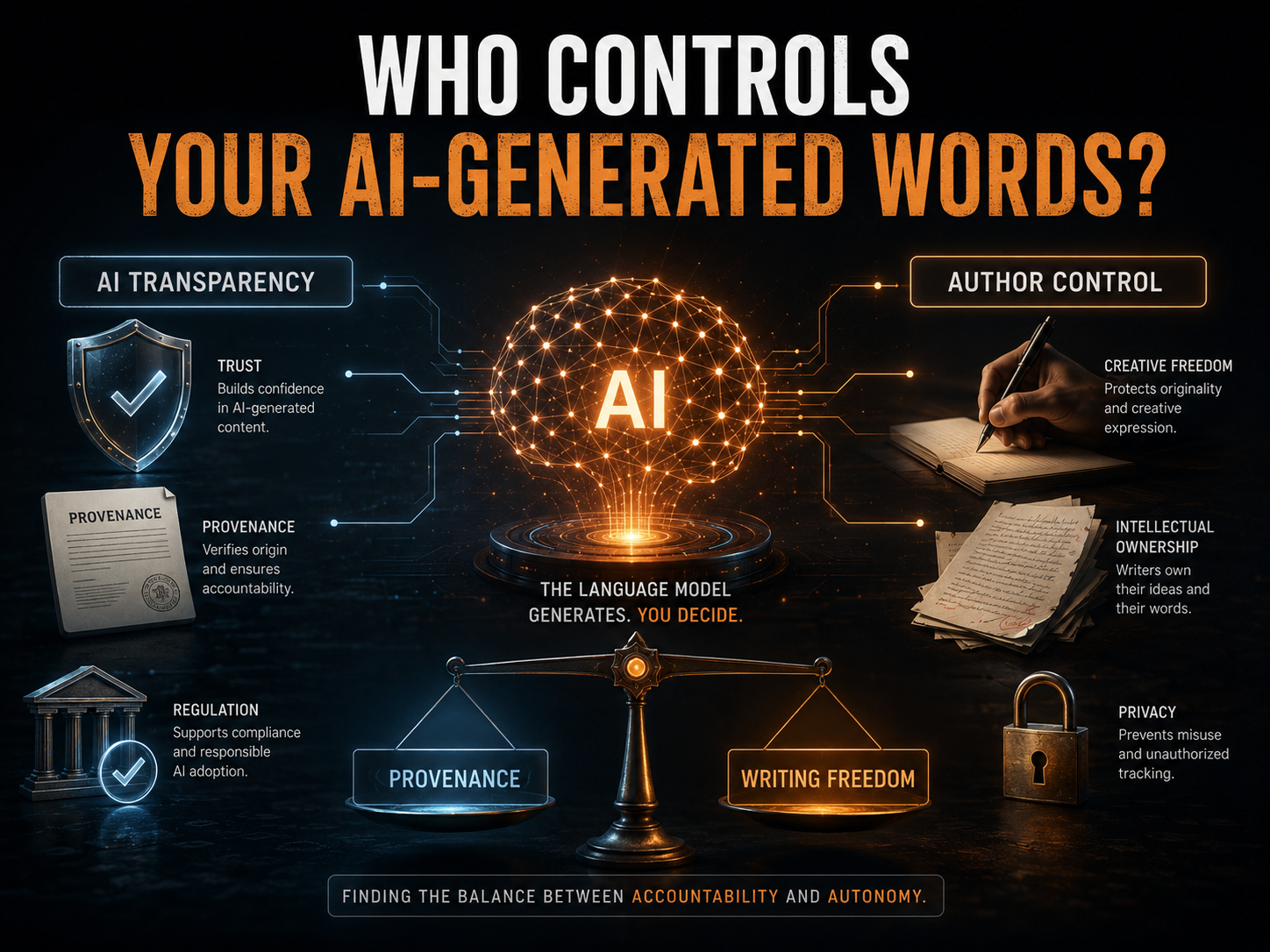
The informed-consent issue is the sharpest edge of this debate. When you generate text with Claude, you may not know that the output has been structurally altered — however minimally — for third-party detection purposes. A researcher asking Claude to proofread their own paragraph could end up with processed text that carries a watermark suggesting Claude involvement, even though the ideas and most of the words are theirs. Ars Technica flagged exactly this concern: the marking can apply to content Claude has processed, not just content it generated from scratch — Source: Ars Technica, 2026.
The pro-watermarking case rests on genuine public goods: making AI content attributable at scale, helping institutions establish provenance, and reducing the ease with which synthetic content can be passed off as human work. Nature reported that Anthropic’s implementation is part of a broader response to regulatory pressure around AI-generated content, and that researchers remain cautiously skeptical about how well it will work in practice — Source: Nature, 2026.
The most defensible criticism isn’t that watermarking exists — it’s that implementation without a clear opt-out and without prominent disclosure puts the burden on users who may not realize their output is being shaped by a mechanism that serves interests beyond their own writing.
| Dimension | Pro-Watermarking Case | Concerns Worth Considering |
|---|---|---|
| Societal benefit | Enables provenance at scale | Benefit doesn’t require covert implementation |
| User consent | Covered by terms of service | Structural alteration deserves clearer disclosure |
| Quality impact | Minimal under current designs | Still constrains creative token selection |
| Attribution risk | Helps identify AI involvement | Can misrepresent the role AI played |
| Regulatory compliance | Meets EU AI Act requirements | Global rollout goes beyond regulatory minimum |
Tools and Alternatives Worth Knowing About
Beyond Claude’s watermark, there are parallel approaches to AI content provenance that work differently and are worth understanding.
The C2PA (Coalition for Content Provenance and Authenticity) standard takes a metadata-based approach: cryptographically signed provenance data is attached to a file rather than embedded in the text itself. Anthropic already uses this for supported image formats like PNG, JPG, and SVG. The advantage of C2PA is that it doesn’t touch the content at all — your text stays exactly as generated, and the provenance lives in the file metadata. Many researchers consider this a more ethically clean approach, since authorial control of the text is fully preserved.
Google’s SynthID applies statistical watermarking to Gemini-generated text using the same foundational approach as Claude’s implementation. OpenAI has discussed text watermarking but hasn’t publicly shipped a production implementation.
What Should You Actually Do About This?
For most writers, the practical steps are straightforward. Keep your own drafts, revision history, research notes, and source materials for any important work — these provide provenance context that no automated detection system can replicate. If your institution, employer, or client has AI disclosure requirements, follow them proactively; a watermark and a disclosure policy are related but distinct things.
Don’t rely on public AI detectors to tell you whether your Claude output is watermarked — they’re not designed to detect it. And don’t assume that a heavily edited passage is definitely watermark-free; depending on how much original text survives, the signal may still be detectable.
Most importantly: treat the watermark as one piece of provenance information, not an authoritative verdict on authorship. Anthropic itself says a detected mark indicates Claude may have been involved — it doesn’t establish who supplied the ideas, how much human editing occurred, or whether the final work qualifies as AI-generated under any particular policy — Source: Search Engine Land, 2026.
Watermarking is just one piece of how AI systems are quietly changing how work gets done — if you want to understand the bigger shift happening underneath, What Is Agentic AI? The Quiet Revolution Already Reshaping Work and Daily Life is a good place to start.
Conclusion
Claude’s AI text watermark is a real, confirmed implementation — not a rumor or a misunderstanding of how language models work. It embeds a statistical signal into generated text by influencing token selection during generation, in ways that are invisible to readers but potentially detectable by a compatible system. The signal is built on established research, tied to regulatory commitments, and applied globally across supported Claude products.
The quality impact for most writing is likely minimal. The ethical questions around informed consent and opt-out are not. Both things can be true at the same time, and both deserve honest engagement rather than dismissal in either direction.
The smart approach is to understand what the watermark actually does, keep your own evidence of your writing process, disclose AI assistance where you’re obligated to, and push for clearer transparency from AI companies about how these systems work and what choices users actually have.
Frequently Asked Questions
FAQ 1: Does Claude’s watermark show up visibly in my text?
No. Claude’s watermark is completely invisible to readers. There’s no badge, symbol, footer, or hidden character in your output. The signal exists only in the statistical pattern of word choices made during generation — you won’t see it by reading or copying the text.
FAQ 2: Can I remove Claude’s watermark by editing my text?
Heavy editing, paraphrasing, or translation can weaken the watermark signal significantly, because replacing enough tokens disrupts the statistical pattern. However, Anthropic says the mark may survive some editing, and the extent of degradation depends on how much original text remains. Editing specifically to defeat the signal, rather than to improve quality, raises separate ethical questions worth considering.
FAQ 3: Is Claude watermarking all of my text, or only some of it?
Anthropic applies watermarking to supported models globally, including across Claude, Claude Platform, Claude Code, and related products. However, the implementation is currently rolling out in phases — newer models are covered at launch, while older models are being brought into compliance during a transition period.
FAQ 4: Does a detected Claude watermark mean Claude wrote the entire piece?
No. Anthropic explicitly states that a detected mark indicates Claude may have been involved in the text — not that it authored the original ideas, wrote every sentence, or that significant human editing didn’t occur. Even text you wrote yourself could carry a mark if you ran it through Claude for proofreading or editing.
FAQ 5: Why can’t regular AI detectors like GPTZero find Claude’s watermark?
Because they’re looking for different things entirely. General AI detectors analyze stylometric patterns — sentence structure, vocabulary diversity, perplexity — to guess whether text resembles AI writing. Claude’s watermark is a specific cryptographic signal that requires Anthropic’s detection key to verify. Without that key, public detectors have no mechanism to identify it.
FAQ 6: What is SynthID-Text, and how does it relate to Claude?
SynthID-Text is Google’s statistical text watermarking technology, originally developed for Gemini. Anthropic has said its own watermarking approach is based on this technology. It works by using a secret key and text context to guide token selection during generation, creating a statistically detectable pattern in the word choices.
FAQ 7: Is there an opt-out for Claude’s watermark?
As of August 2026, no public opt-out mechanism is available for standard Claude users. Anthropic has acknowledged the feature and said it plans to provide detection capabilities and additional technical documentation for users and third parties, but a user-facing opt-out hasn’t been announced.
FAQ 8: Does watermarking slow down Claude or affect response quality?
Anthropic says internal testing found no meaningful impact on content quality, creativity, or readability. The mechanism operates at the point of token selection without requiring additional processing that would noticeably slow generation or degrade output for most use cases.
Author & Editorial Information
Written by Ethan Brooks: Ethan Brooks is a technology content writer covering AI, digital trends, and emerging technologies for general readers. His work focuses on explaining technology developments and changing digital trends in a clear, accessible, and practical way.
Reviewed by: Editorial Review Team & Technology Content Specialists.
Disclaimer: This article is based on publicly available research, technical information, company announcements, news reports, and other reliable sources available at the time of publication. AI technologies, text-generation methods, detection techniques, and related policies can change as new developments and research emerge. Descriptions of how AI text watermarking works are provided for general informational purposes and may not reflect future changes to the technology or its implementation. Readers are encouraged to consult official documentation, research publications, and other reliable sources for the latest information. This content was initially drafted with AI assistance and has been carefully reviewed, edited, refined, and fact-checked by human editors to improve accuracy, clarity, originality, and editorial quality.