By Ryan Carter, an AI automation expert with 10+ years of experience specializing in workflow systems, cost optimization, and scalable digital operations.
Summarize this blog post with: ChatGPT | Perplexity | Claude | Grok
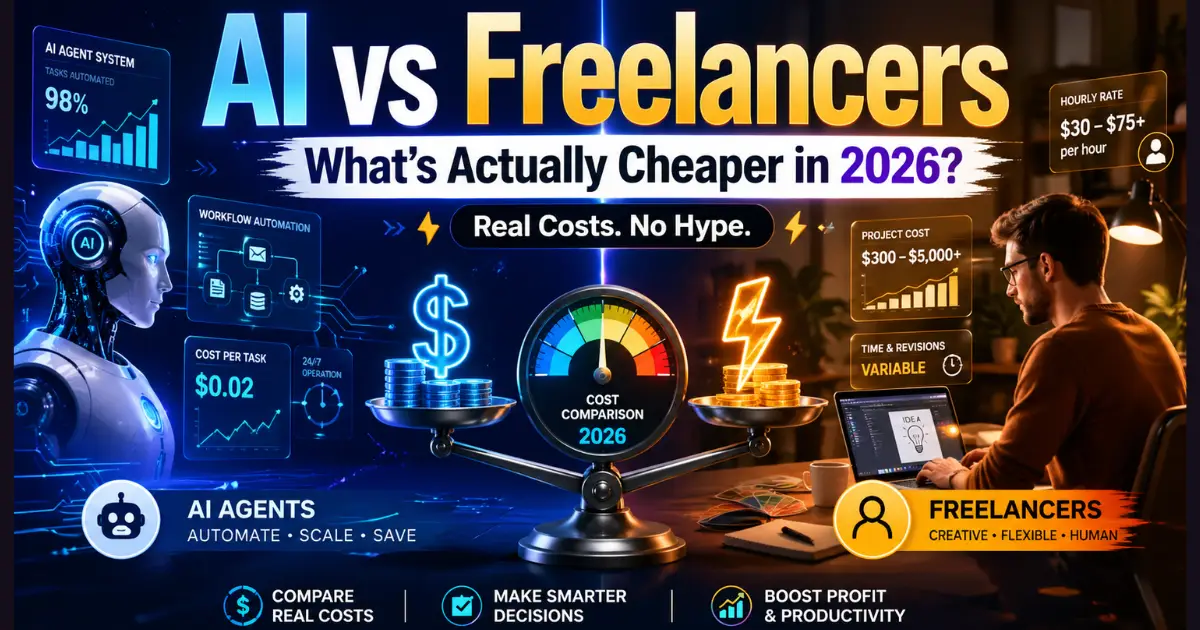
You’ve probably already pulled up Upwork, looked at a writer’s hourly rate, and thought — wait, can’t an AI just do this? Honestly, it’s a fair question, and I don’t blame anyone for asking it. But here’s the thing: most of the comparisons floating around online either treat AI agents like some magic cost-eraser that makes freelancers obsolete, or they swing the other way and dismiss AI entirely as “not ready yet.” Neither take is particularly useful.
The reality is messier — and more interesting — than either camp admits. AI agents have gotten dramatically better in the past 18 months. Freelancer rates have gone up. And the decision of which to use, and when, is now a genuinely meaningful business call rather than a theoretical one. In this guide, I’m going to walk through the actual cost math, the real performance differences, and a practical framework for figuring out what makes sense for your specific situation in 2026.
Key Takeaways
- AI agents are autonomous software systems that can execute multi-step business tasks independently — they’re meaningfully different from chatbots or basic automation scripts.
- For high-volume, repeatable tasks like content drafts, data research, and customer support, AI agents can cost 60–80% less per output unit than equivalent freelancers on major platforms.
- Freelancers still have a decisive edge in work requiring creative judgment, nuanced communication, cultural sensitivity, and strategic thinking — areas where AI output regularly needs substantial human revision.
- The true cost of AI agents includes platform subscriptions, compute fees, prompt engineering time, and quality review hours — factors that narrow the apparent cost gap by 20–40%.
- A hybrid model — AI handling volume tasks, freelancers handling judgment-heavy work — delivers the strongest cost-to-quality ratio for most SMBs in 2026.
- The choice should be made task-by-task, not as a sweeping organizational policy; a simple audit can surface agent-ready work within a few days.
- Businesses running AI agent pilots now are building compounding operational advantages as the cost curve keeps tilting toward automation.
What Is an AI Agent and Why Is It Different from a Chatbot or Script?
An AI agent is an autonomous software system that can receive a goal, plan a sequence of steps, use external tools, and execute multi-step tasks without continuous human input — and that distinction matters a lot more than most people realize when they’re comparing it to hiring a freelancer.
Here’s a way I like to explain it: a basic chatbot answers one question at a time. A simple automation script follows a fixed if-then sequence — it doesn’t adapt when something unexpected happens. An AI agent, by contrast, actually reasons about what to do next. It picks the right tool, handles exceptions, loops back when something doesn’t work, and iterates toward a defined outcome. Think of it less like a vending machine and more like a junior employee who can independently complete a defined project — not perfectly, but without you hand-holding every step.
In practical 2026 terms, the most common agent types businesses are deploying include content pipeline agents (research → draft → SEO edit → format for CMS), coding agents (write → test → debug → push), customer support agents (classify ticket → pull from knowledge base → respond → escalate if needed), and data research agents (scrape → clean → analyze → output structured report). None of these were reliably usable for most businesses two years ago. Now they are.
What Does Hiring a Freelancer Actually Cost in 2026?
A freelancer in 2026 is a self-employed professional hired on a project or hourly basis through platforms like Upwork, Fiverr Pro, Toptal, or Contra or directly through referrals and independent contracts. The market has shifted noticeably though: a lot of the best freelancers are now “AI-augmented,” meaning they’re using tools like Claude or GPT-based assistants to work faster. That’s actually raised the floor of what you can expect quality-wise, but it’s also pushed rates up because these folks deliver more per hour.
Here’s a realistic snapshot of where rates sit right now:
| Task Category | Typical Hourly Rate (2026) | Typical Project Rate |
|---|---|---|
| Content Writing | $35 – $85/hr | $150 – $600/article |
| Graphic Design | $40 – $120/hr | $200 – $1,500/project |
| Web Development | $60 – $180/hr | $1,500 – $15,000/project |
| Data Research/Analysis | $30 – $90/hr | $100 – $800/project |
| Customer Support | $15 – $35/hr | $500 – $2,000/month |
| Social Media Management | $25 – $75/hr | $800 – $3,000/month |
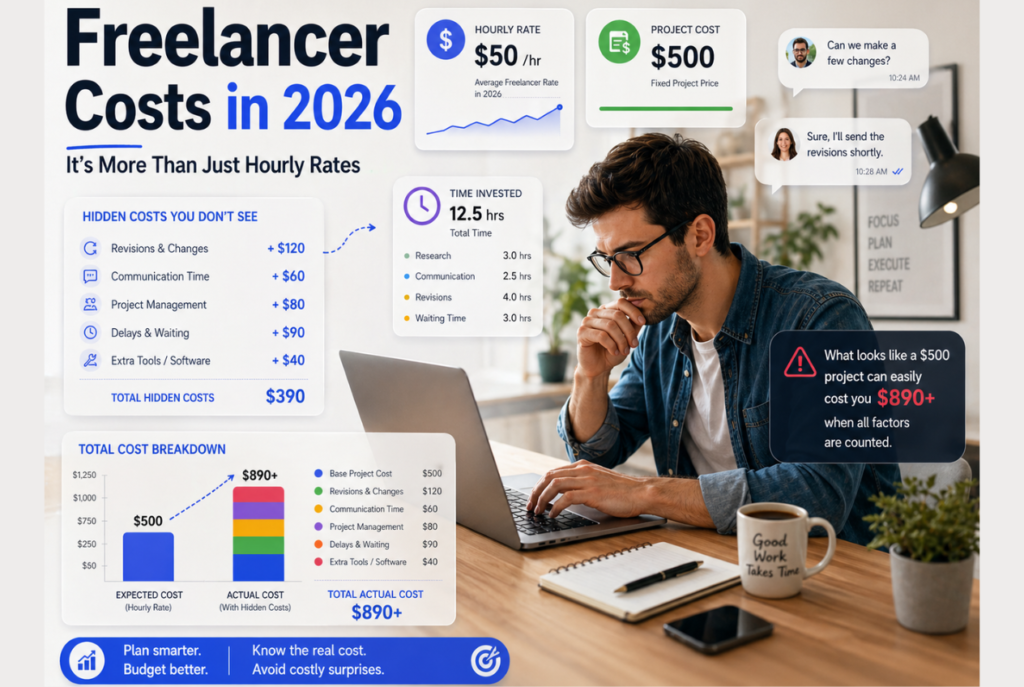
And those are just the stated rates. Once you factor in Upwork’s 5% client-side fee, onboarding time, revision cycles, and the occasional missed deadline — from what I’ve seen, total cost typically runs 15–25% higher than the number on the profile. That’s not a knock on freelancers; it’s just the reality of how projects actually unfold. Freelancer.com’s 2025 data puts average project overruns at 15–25% above initial estimates — Source: Freelancer.com Project Report, 2025.
Why This Comparison Actually Matters Right Now
Honestly, this question has been asked for the past three or four years, but it only started having a real answer in 2025. Before that, AI tools produced content that needed so much editing it barely saved time. The math didn’t work. Context windows were small. Tool-use was clunky. Most SMBs who tried “replacing” freelancers with AI came back to freelancers within a few months.
That’s changed. AI agents went from producing passable first drafts in 2023 to executing complex, multi-step workflows with minimal intervention in 2025–2026. Context retention improved dramatically. Tool-use became reliable enough to build production workflows around. Meanwhile, skilled freelancer rates kept climbing — the median hourly rate for a content writer on Upwork rose 22% between 2023 and 2025 — Source: Upwork Freelancer Income Report, 2025. That convergence is what makes 2026 the first year where the comparison is genuinely meaningful for most businesses.
IBM’s 2024 AI Adoption Report found that over 77% of businesses were already using or actively exploring AI tools — Source: IBM Global AI Adoption Index, 2024. That’s not a fringe trend anymore. And McKinsey’s 2025 research found that companies using AI-human collaboration models saw productivity gains of up to 40% — Source: McKinsey Global Institute, 2025. For a business currently spending $3,000–$8,000/month on freelancers, switching even 40% of those tasks to AI agents could mean $15,000–$40,000 in annual savings. But only if you pick the right tasks. That’s the whole game.
The Real Cost Breakdown: AI Agents vs. Freelancers by Task Type
The per-task cost difference between AI agents and freelancers varies a lot depending on category — and the math only clearly favors AI under specific conditions. Let me model this out for a business running 20 tasks per month.
| Task Category | Freelancer Cost/Task | AI Agent Cost/Task | Est. Monthly Saving |
|---|---|---|---|
| Content drafts (1,000 words) | $180 | $18 – $35 | ~$2,900 |
| Data research reports | $120 | $10 – $25 | ~$2,200 |
| Customer support responses | $8–$15/ticket | $0.50 – $2/ticket | ~$260 |
| Social media posts (5 per batch) | $85 | $12 – $20 | ~$1,300 |
| Graphic design (social assets) | $75/asset | $5 – $12 (AI-generated) | ~$1,260 |
| Web dev (small tasks/bug fixes) | $150 | $20 – $45 | ~$2,100 |
On paper, that’s roughly $10,000 in monthly savings. In practice? You’ll spend some of that back. Figure 30–60 minutes of human review per AI task — if internal labor costs you $40/hour, that’s $400–$800/month back on the ledger. Still a significant saving, but not the headline number.
What Do AI Agent Platforms Actually Cost?
The true cost of an AI agent workflow includes platform subscription fees, compute costs, prompt engineering time, and quality review hours — factors that can reduce the apparent cost advantage by 20–40% compared to headline platform pricing. That’s not a reason to avoid AI agents; it’s just something you need to factor into your actual projection rather than discovering it after the fact.
Most mid-range AI agent platforms — no-code builders, API-based frameworks — run $50–$500/month in subscription costs, plus usage-based compute that scales with volume. At 20 tasks/month, a realistic all-in cost typically lands between $200–$600/month. Compare that to $2,000–$5,000/month for equivalent freelancer spend, and the economics still look solid — just not as dramatic as the raw comparison suggests.
How Do AI Agents and Freelancers Actually Compare? A Realistic 5-Dimension Look
AI agents and freelancers differ across five measurable dimensions, and no single winner emerges across all five. This is where I think a lot of the online debate goes wrong — people pick a winner and then cherry-pick the dimensions that support it.
Cost Per Output Unit
AI agents win clearly on per-unit cost at volume. A 1,000-word content draft that costs $180 from a mid-market writer costs $18–$35 via an AI agent pipeline. At low volumes — say, one or two tasks a month — the setup overhead erases the cost advantage entirely. At 10+ recurring tasks per month, AI becomes materially cheaper. The breakeven point is worth calculating for your specific situation.
Turnaround Time
This one isn’t close. A freelancer producing a research report typically needs 24–72 hours. An AI agent completes the equivalent in 3–8 minutes. For time-sensitive workflows — daily social content, overnight data processing, real-time customer support — this difference isn’t just nice to have, it’s operationally transformative.
Quality Consistency
Here’s where it gets more nuanced. AI agents produce consistent, bounded output. A skilled freelancer produces variable output with a higher potential ceiling. If you run an AI agent through 50 blog introductions, you’ll get 50 similar-quality outputs — predictable, serviceable, probably requiring light editing. A top-tier freelance writer might give you 5 genuinely exceptional pieces and 45 solid ones, or might deliver inconsistently depending on their workload and whether your brief was clear. If predictability matters more than occasional brilliance, AI has the edge.
Scalability
AI agents scale elastically — 10 tasks costs roughly the same per-unit as 500 tasks. Freelancers are bottlenecked by time, availability, and capacity. Scaling from 20 to 200 tasks/month with freelancers means finding, vetting, onboarding, and managing multiple new contractors. With an AI agent, you adjust a parameter and run the workflow again.
Collaboration and Strategic Judgment
Freelancers win this one decisively, and it’s not even close — at least not yet. A freelance strategist can push back on a brief, read the room in a client call, pick up on qualitative signals, and synthesize context that no current AI agent can reliably replicate. For strategy work, nuanced client communication, cultural sensitivity, and open-ended creative development, human judgment remains irreplaceable. This isn’t going to change meaningfully in the next 12–18 months.
When Should You Use AI Agents and When Should You Hire a Freelancer?
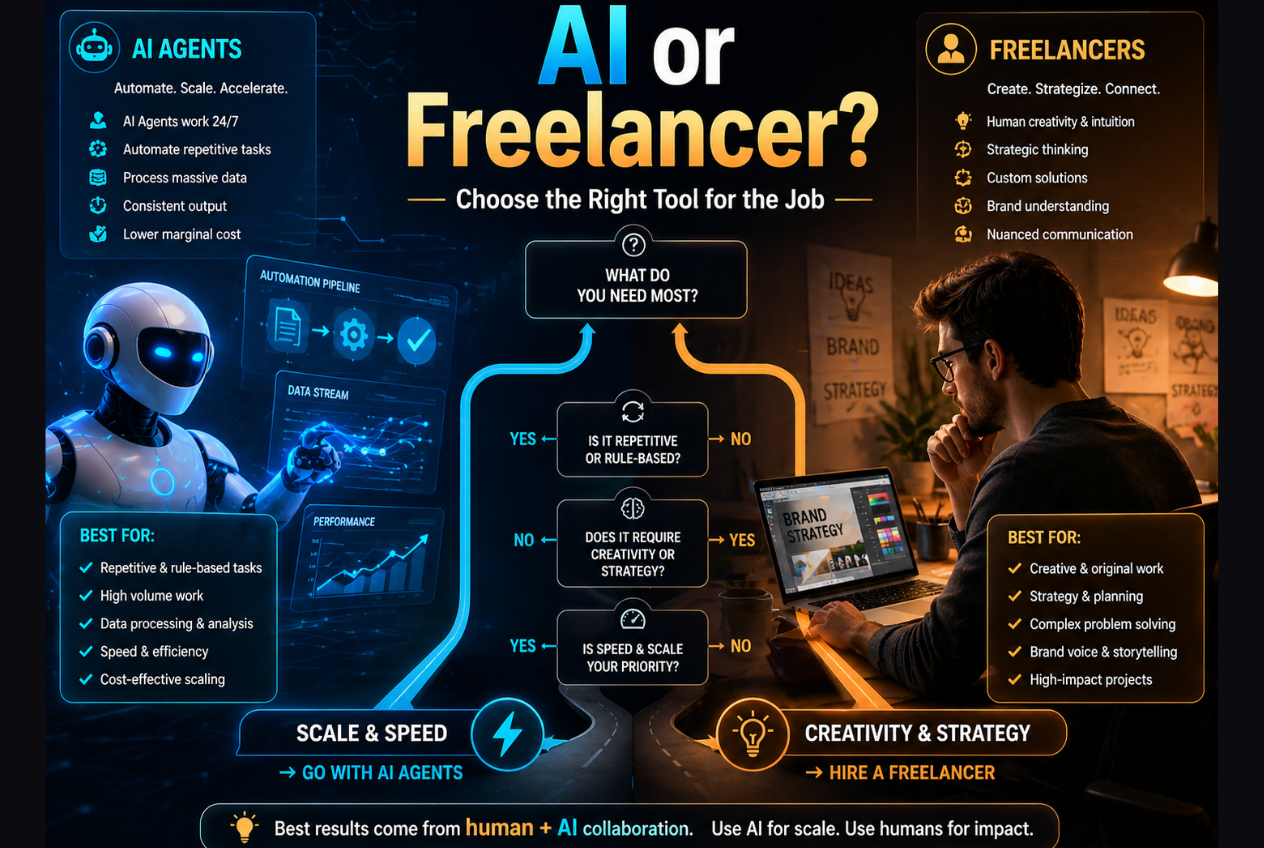
The smartest businesses in 2026 don’t choose between AI agents and freelancers as a blanket policy. They assign tasks to each based on what the task actually requires. The question isn’t “which is better?” — it’s “which is better for this specific task, at this specific volume, with these quality requirements?“
Use AI Agents When:
- The task is high-volume and repeatable — content production, data extraction, support ticket responses, social captions, product descriptions
- The output has clear, measurable quality criteria — formatting rules, factual accuracy checks, keyword targets, response templates
- The task needs to run 24/7 or at unpredictable hours — overnight processing, international support queues, real-time monitoring
- Speed matters more than creative originality — internal reports, news summaries, first-draft research
- You need elastic capacity for unpredictable demand spikes — campaign launches, seasonal surges, product launches
Hire a Freelancer When:
- The work requires genuine creative judgment — brand voice development, original design, emotionally resonant copywriting
- Stakeholder relationships are involved — client-facing communication, discovery interviews, strategic presentations
- The task carries cultural sensitivity — localized content, community management, tone-sensitive messaging
- The brief is ambiguous or will evolve — strategy work, positioning projects, campaign concepting
- You need one-off, high-complexity output — a custom website, a deep technical audit, a research report that requires actual domain expertise
Which AI Agent Platforms and Freelancer Marketplaces Are Worth Using in 2026?
The honest answer is: it depends on your technical comfort level and what you’re actually trying to automate. No-code platforms have improved significantly, and non-technical founders can now build functional agent workflows without writing a single line of code. That wasn’t really true two years ago.
AI Agent Platforms Worth Knowing
- Relevance AI — Purpose-built no-code agent builder with strong templates for content and research pipelines; probably the most accessible starting point for non-technical teams
- Make (formerly Integromat) — No-code automation with increasingly agent-like multi-step logic; excellent for connecting existing business tools
- LangGraph / LangChain — Developer-grade frameworks for custom agent builds; high flexibility, but requires technical setup and maintenance
- Claude API (Anthropic) — High-reasoning capability for complex content and analysis tasks; works well as the reasoning backbone in custom pipelines
- OpenAI Assistants API — Strong ecosystem integration with function-calling and tool-use; broad adoption means lots of community resources
Freelancer Platforms Still Worth Using
- Upwork — Largest talent pool, best for development and writing; the review system is actually useful for vetting
- Toptal — Pre-vetted senior talent with significantly higher cost; worth it when the project is high-stakes and you can’t afford a bad hire
- Fiverr Pro — Vetted creative specialists; faster turnaround, more predictable scope for defined deliverables
- Contra — Zero-commission structure; portfolio-first approach works well for creative professionals
- Deel — Not really a marketplace, but essential for handling contracts, payments, and compliance when working with international contractors at any scale
What About AI-Augmented Freelancers?
This is actually one of the more interesting developments of the past 12 months. AI-augmented freelancers — professionals who use AI tools as part of their workflow — are becoming a genuinely compelling middle option. A writer who uses Claude to accelerate research and generate structural outlines can deliver faster, at lower cost, while still applying the human judgment that makes the final output worth reading.
From what I’ve seen, these freelancers tend to offer better turnaround times and more consistent quality than their non-AI-using counterparts, while still clearing the creativity bar that pure AI output struggles to meet. When you’re interviewing freelancers now, it’s completely reasonable to ask how they use AI in their process — and a good answer to that question is actually a positive signal.
How to Audit Your Freelancer Spend and Find AI-Ready Tasks (3 Steps)
A task audit is the fastest way to figure out which of your current freelancer expenses can realistically shift to AI agents — without having to guess or rely on someone else’s generic framework.
Step 1 – Map your current freelancer spend. Go back 90 days. List every recurring freelance task: what it was, how long it took, what it cost, and how you knew whether it was good or not. Don’t overthink the format — a spreadsheet or Notion doc works fine. What you’re looking for is patterns.
Step 2 – Score each task on two dimensions: repeatability and judgment requirement. Tasks that are high-repeatability and low-judgment are agent-ready. Tasks that are low-repeatability and high-judgment should stay with freelancers. The middle bucket — moderately repeatable, moderate judgment — is your AI-augmented freelancer territory.
Step 3 – Run a 30-day parallel pilot. Don’t replace anyone yet. Pick one agent-ready workflow, set up the AI, and run it alongside your existing freelancer for a month. Track output quality, review time, and total cost including your internal labor. After 30 days, the data will tell you what no projection model can.
Most businesses I’ve worked with discover that 30–50% of their freelancer task volume is genuinely agent-ready once they do this exercise. That’s a real number, not a theoretical ceiling — and it’s where the meaningful savings actually live.
Are AI Agents a Threat to Freelancers or Just a Tool They Use?

Honestly, both — but it depends heavily on what the freelancer does. The ones at most risk are those whose core value proposition is volume: entry-level content writers producing generic blog posts, data entry contractors, templated graphic designers. AI is eating that work, and it’s not coming back.
But specialists people with deep domain expertise, strong client relationships, and genuine strategic capability — are not only surviving but thriving. They’re using AI to amplify their output and taking on more complex, higher-value work than they could before. HubSpot’s 2025 research found that AI-assisted marketing teams see 25% higher ROI compared to teams not using AI tools — Source: HubSpot State of Marketing, 2025. And Upwork’s 2025 Future of Work Report found that 61% of top-rated freelancers now incorporate AI tools into their regular workflow — Source: Upwork Future of Work Report, 2025.
What’s happening is a bifurcation: commodity freelance work is being absorbed by automation, while premium freelance work is commanding higher rates than ever. For business owners, the implication is clear — the middle tier of your freelancer spend is where the substitution opportunity is greatest. The high end is still worth every dollar.
If you’re a freelancer reading this and feeling uneasy about that trend — that’s a fair reaction. The good news is there are real, practical steps you can take. This guide on how to become AI-proof in your career in 2026 is worth reading alongside this one.
What Does a Smart Hybrid Workflow Actually Look Like?
A hybrid model — deploying AI agents for throughput-heavy, well-defined tasks while retaining freelancers for high-judgment, relationship-dependent work — consistently delivers the strongest cost-to-quality ratio for small and mid-sized businesses in 2026.
Here’s what a concrete example looks like in practice. Say you’re running content marketing for a SaaS company:
- AI agent handles the first draft of each blog post using your keyword brief, internal documentation, and a standardized outline template
- Freelance editor (3–4 hours/month) reviews and rewrites the opening hook, strengthens the argument structure, and applies brand voice
- AI agent handles SEO formatting, meta description generation, and internal link suggestions
- Freelance strategist (one call per month) reviews the content calendar, identifies topic gaps, and advises on positioning
The result: you’re publishing more content at lower total cost, with human judgment applied at the points where it actually moves the needle. That’s not a compromise — it’s a smarter allocation of both AI and human resources.
Conclusion: The Answer Isn’t One or the Other
Look, the “AI agents vs freelancers” framing is useful for making a comparison, but it’s slightly misleading as a decision framework. In practice, you’re not choosing one or the other — you’re figuring out which tasks belong to which resource.
AI agents and freelancers aren’t rivals. They occupy genuinely different roles in a well-built operation. AI handles the volume, the repetition, the overnight processing — freeing up your freelancer budget for the work that actually requires human judgment, creativity, and relationship. The businesses winning in 2026 aren’t the ones who went all-in on one camp. They’re the ones who looked at their task list honestly and made deliberate choices.
Start with the 3-step audit. Pick one workflow to pilot. Give it 30 days. The data will make the decision for you.
FAQs: AI Agents vs Freelancers
What are the key differences between AI agents and human freelancers?
AI agents are autonomous software systems that execute predefined or dynamically planned tasks using artificial intelligence — they don’t sleep, don’t need onboarding, and scale without additional cost per unit. Human freelancers are independent professionals who bring creative judgment, contextual reasoning, and relationship skills to their work. The key differences come down to cost at volume (AI wins), creative depth (freelancers win), scalability (AI wins), and strategic adaptability (freelancers win). Neither is categorically better — the right choice depends entirely on the task type, volume, and quality requirements.
Which platforms offer AI agents for creative project tasks?
Several platforms have built AI agent capabilities specifically for creative workflows. Relevance AI offers no-code agent builders with templates for content production, research, and creative pipelines. Make (formerly Integromat) supports multi-step automation workflows that increasingly function like agents. For more technical teams, LangChain and LangGraph offer developer-grade frameworks that can power custom creative agents. The Claude API and OpenAI Assistants API serve as reasoning backbones for custom-built pipelines. For most non-technical users in 2026, Relevance AI is the most accessible starting point.
Can AI agents replace freelancers in digital marketing projects?
Partially — and the specific tasks matter a lot. AI agents can reliably handle high-volume, repeatable digital marketing work: drafting first-pass blog posts, generating social media captions, producing product descriptions, writing email subject line variations, and running A/B test copy generation. Where they still fall short is in campaign strategy, audience insight development, brand voice creation, and culturally nuanced messaging. For digital marketing, the most effective approach in 2026 is a hybrid model: AI agents handling volume output, with freelance strategists and editors providing the judgment layer that turns AI output into high-performing content. If you want to see a real-world test of AI agents handling end-to-end business tasks, this AI agent side hustle case study shows what’s actually possible right now — and where the limits are.
Where can I hire AI-driven virtual assistants instead of freelancers?
Several platforms specialize in AI-driven virtual assistance for business tasks. Relevance AI and similar no-code platforms let you build custom AI agents that function like virtual assistants for specific workflows. For more general task automation, tools like Make, Zapier (with AI steps), and n8n offer AI-assisted virtual assistant functionality. If you want a more done-for-you option, some agencies now offer “AI agent as a service” packages that bundle the setup, maintenance, and output of custom agents. For basic task automation without technical setup, consumer tools like Claude, ChatGPT, and Gemini can function as AI assistants directly without a full agent framework.
What are the cost comparisons between using AI agents versus freelancers?
For high-volume, repeatable tasks, AI agents typically cost 60–80% less per output unit than equivalent freelancers on major platforms. As a rough benchmark: a 1,000-word content draft costs $150–$200 from a mid-market freelance writer and $18–$35 via an AI agent pipeline. Customer support responses cost $8–$15 per ticket with freelance support staff versus $0.50–$2 per ticket with an AI agent. However, the true cost of an AI workflow includes platform subscriptions ($50–$500/month), compute costs, and internal review time — which can reduce the apparent saving by 20–40%. For one-off, complex, or creatively demanding projects, freelancers often deliver better ROI because the cost of AI output that requires heavy human revision can approach or exceed the freelancer cost anyway.
Written by Ryan Carter: Ryan Carter is an AI Automation Expert with 10+ years of experience in workflow systems, cost optimization, and scalable digital operations. Ryan has worked with over 200 SMBs to design hybrid AI-and-human operating models across content, support, and data functions.
Reviewed by: The Editorial Team verified for pricing accuracy, platform references, and statistical sources as of Q2 2026.
Disclaimer: This article is based on practical analysis and real-world use cases involving AI tools, automation workflows, and freelance service models. Costs, capabilities, and performance of both AI systems and human services can vary significantly depending on use case and market conditions. Readers are encouraged to independently verify current pricing and tool capabilities before making decisions. This content was initially drafted with AI assistance and has been carefully reviewed, edited, and fact-checked by human editors and subject matter experts to ensure accuracy, clarity, and editorial integrity.