
By Arjun Mehta, an AI monetization strategist with 8+ years of experience specializing in digital income systems, workflow automation, and practical AI-powered business models.
Summarize this blog post with: ChatGPT | Perplexity | Claude | Grok
You’ve probably seen those reels. Someone holding a phone, sitting in a cafe, claiming they made ₹1 lakh last month using “just ChatGPT.” And honestly? Part of you wants to believe it. But another part — the skeptical part — wonders what they’re not showing you.
Here’s the thing: the core idea isn’t wrong. You can make money with AI in India, and for real this time, without quitting your job or investing a single rupee upfront. But the process looks nothing like those 60-second reels suggest. What’s missing from most of that content is the actual sequence — which skill to pick, which platform converts, how long it genuinely takes, and what kills most people’s momentum before they even reach ₹10,000.
This guide is that sequence. Phase by phase, tool by tool, with honest timelines.
For a broader look at monetization models beyond freelancing, check out our guide on realistic ways to make money with AI in 2026 — including which methods are actually producing results and which ones are mostly hype.
Key Takeaways
- AI tools like ChatGPT, Canva AI, and Claude let people with zero capital offer professional-grade services — ₹1 lakh is genuinely achievable within 6–9 months for someone who’s consistent.
- This is not passive income. It’s active, skills-based freelancing where AI acts as your productivity multiplier.
- Niche selection is the single highest-leverage decision you’ll make — generalist AI freelancers take 2–3x longer to land clients than specialists.
- You don’t need paid tools to earn your first ₹10,000. A free stack (ChatGPT, Canva, Gamma, Google Gemini) is more than enough.
- Getting from ₹50K to ₹1 lakh isn’t about taking on more work — it’s about building systems so the same hours produce more output.
- The most common reason people get stuck at zero isn’t their tools. It’s jumping into outreach without portfolio proof or a clear service offer.
- Indian freelancers pricing in USD have a real structural advantage — a $50 Fiverr project translates to roughly ₹4,100–₹4,200 INR.
What Does “Make Money With AI in India” Actually Mean?
Let’s clear this up before anything else, because the confusion here is what causes most people to waste months chasing the wrong thing.
Earning income with AI tools means offering AI-assisted freelance services — content writing, graphic design, video scripting, chatbot setup, automation — to paying clients who need these outcomes delivered faster and more affordably than traditional methods allow.
It does not mean prompting ChatGPT and selling the raw output. Clients can do that themselves. What they’re paying for is your judgment, your positioning of the AI, your ability to take a messy brief and turn it into something that actually works for their business.
From what I’ve seen, the people who succeed with AI freelancing early on are the ones who understand this distinction intuitively. They use AI to accelerate their work — not replace the thinking behind it. An AI content writer using ChatGPT and Claude can produce a polished 1,000-word article in under an hour. Without AI, that same article might take three. That efficiency gap is the income opportunity.
AI-assisted freelancing involves using tools like ChatGPT, Canva AI, or Claude to complete client deliverables faster and at higher quality than manual methods, allowing a single freelancer to take on more volume without proportionally increasing their hours.
Also worth noting: this isn’t a passive income model. At least not at first. Passive income comes later, after you’ve built systems, audiences, and recurring demand. If you start with that expectation, you’ll be disappointed within the first month.
If you’re reading this partly because you’re worried about where your current job is heading, it’s worth pairing this roadmap with our guide on how to stay relevant as AI changes the job market — the two strategies complement each other well.
Why Is AI Freelancing One of the Best Income Opportunities in India Right Now?
Honestly, the timing is unusually good — and I don’t say that lightly.
AI tools have collapsed the barrier to entry for freelancing in India to near-zero. You’ve got free-tier access to ChatGPT, Google Gemini, Canva, and Gamma. You’ve got global clients a Fiverr account away. And you’ve got a currency advantage that makes even modest earnings in USD feel significant in INR.
India had over 59 million freelancers in 2023 — Source: NASSCOM Freelancing Report, 2023. That’s a massive pool. But here’s what’s interesting: most of them aren’t yet using AI tools systematically in their service delivery. That gap is opportunity.
Small businesses are hungry for AI implementation but don’t want to learn the tools themselves. A 2025 survey by Thryv found that small business AI adoption jumped from 39% to 55% in just one year — Source: Thryv AI & Small Business Survey, 2025. They want results. They don’t want to spend six months figuring out how Zapier connects to ChatGPT. That’s where you come in.
The currency arbitrage angle is real too. A $50 project on Fiverr — completely normal pricing for a short blog post or a set of social captions — translates to roughly ₹4,100–₹4,200 INR. Three such projects a week puts you at ₹50,000 a month. That math works in ways it simply doesn’t for domestic pricing.
Which AI Income Niches Generate Real Money for Beginners?
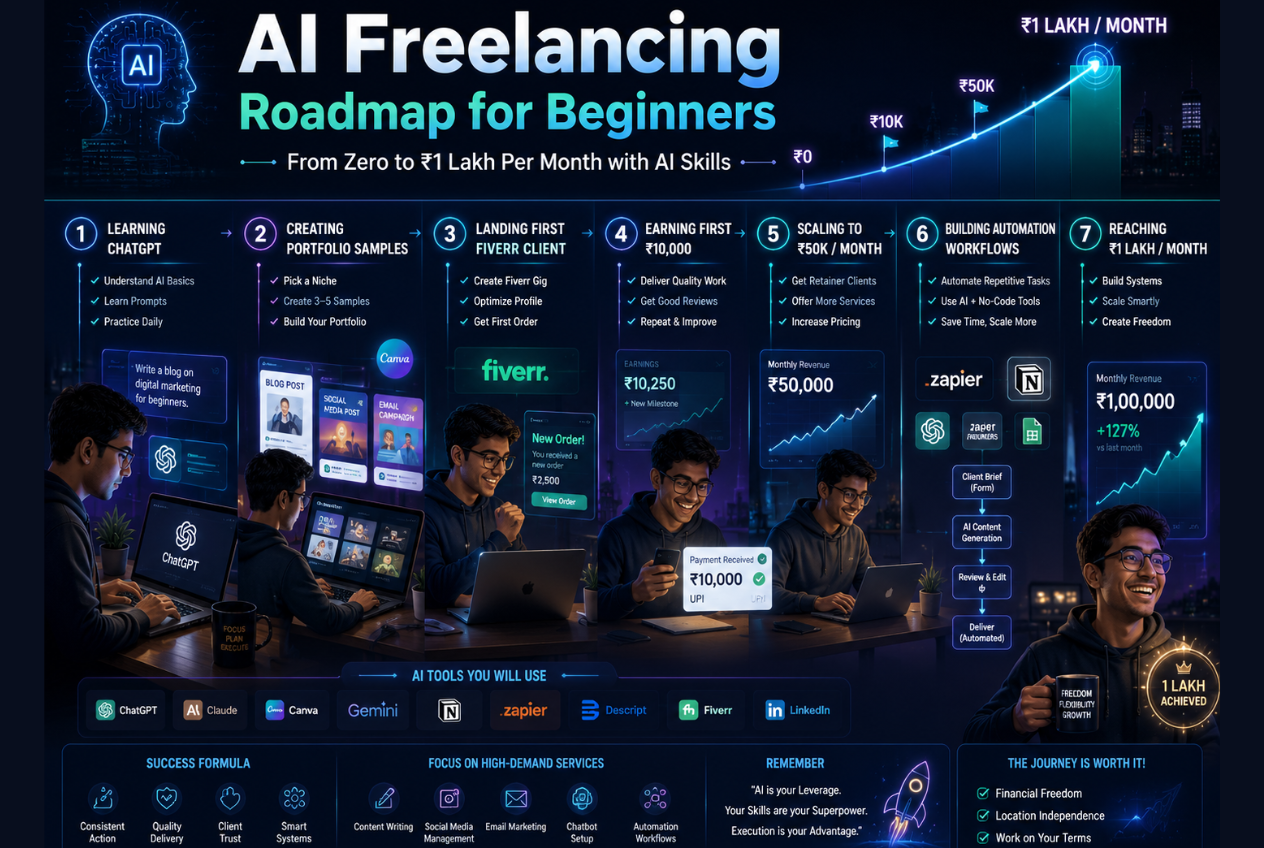
The most accessible AI income niches for Indian beginners include AI content writing, social media graphics, short-form video scripts, chatbot setup for local businesses, and email marketing — none of which require upfront investment beyond a free account.
Here’s a breakdown of the five niches I’ve seen produce the fastest results for people starting from zero:
| Niche | Time to First Client | Price Range | Tools |
|---|---|---|---|
| AI Content Writing | 2 – 4 weeks | ₹1,500 – ₹5,000/article | ChatGPT, Claude |
| AI Social Media Graphics | 1 – 3 weeks | ₹500 – ₹2,000/post | Canva AI, Adobe Firefly |
| Short-Form Video Scripts | 3 – 5 weeks | ₹1,000 – ₹3,500/script | ChatGPT, Descript |
| AI Chatbot Setup | 4 – 6 weeks | ₹5,000 – ₹15,000/setup | Tidio, Chatbase |
| AI Email Copywriting | 2 – 4 weeks | ₹2,000 – ₹8,000/campaign | Claude, Mailchimp AI |
If you’re choosing between these, AI content writing as a service has the lowest skill floor and the fastest feedback loop. The catch? It’s also the most crowded. So if you go that route, specialize further. “I write blogs for Ayurveda brands” will close faster than “I do AI content writing.” Every time.
Don’t take our word for it on the demand — search AI content writing on Fiverr right now and you’ll find thousands of active gigs, many with 100+ reviews and consistent orders. The market is real.
Reality Check: Niche selection isn’t a detail you can figure out later. Generalist AI freelancers take 2–3x longer to land their first client — Source: Fiverr Freelancer Insights Report, 2024. Pick one thing, go deep on it, and resist the urge to add more services until you’ve actually landed a client.
How Do You Land Your First AI Freelancing Client With No Portfolio?
This is the part most guides skip over, and it’s exactly where most beginners get stuck.
Building a client pipeline with no prior work requires creating portfolio proof — not waiting for someone to give you a chance, but manufacturing evidence of your quality through spec work.
The Spec Work Method
Pick a real business in your niche. A local restaurant, a coaching institute, a D2C skincare brand — something you can actually find on Instagram or Google. Now create 2–3 pieces of content as if you were already their freelancer. Write three blog posts. Design five social posts. Build a sample email sequence.
You’re not lying about having worked with them. You’re demonstrating what your output looks like at no risk to them. This is how most experienced freelancers started. It works.
Choosing the Right Platform
Platform choice depends heavily on your niche:
- Fiverr works best for beginners because inbound demand exists — you don’t need to hunt for clients.
- LinkedIn works better for B2B services — automation, content strategy, chatbot consulting. Warm outreach here converts well once you have a clear offer.
- Instagram is useful if your niche is visual — design, social media management, video editing.
- WhatsApp outreach to local businesses is underrated. If you’re offering chatbot setup or automation, texting a local salon or clinic directly gets a faster “yes” than most platforms.
Pricing Your First Clients
Price at 40–50% below market rate for your first three clients. I know that feels uncomfortable. But your goal right now isn’t maximum income — it’s testimonials, case studies, and the confidence of knowing you can deliver. Once you have those, your rate conversation changes completely.
Pricing AI-assisted services means anchoring to the value delivered, not the hours worked or tools used. If a monthly social media package saves a business owner 8 hours of work, that’s worth ₹8,000–₹12,000 regardless of whether it took you 2 hours or 6.
Once you have a few stable clients, use the retainer pricing model for freelancers — it’s the fastest way to convert unpredictable monthly income into something you can actually plan around.
If you’re not confident about writing your own gig title, tags, and description, there are experienced Fiverr sellers who specialize in Fiverr gig setup and optimization — it’s a one-time investment that can significantly improve your early visibility.
How Do You Scale AI Income From ₹50,000 to ₹1 Lakh Without Burning Out?
Most people who hit ₹30,000–₹40,000 try to scale by just… doing more. More clients, more projects, longer hours. That hits a ceiling fast.
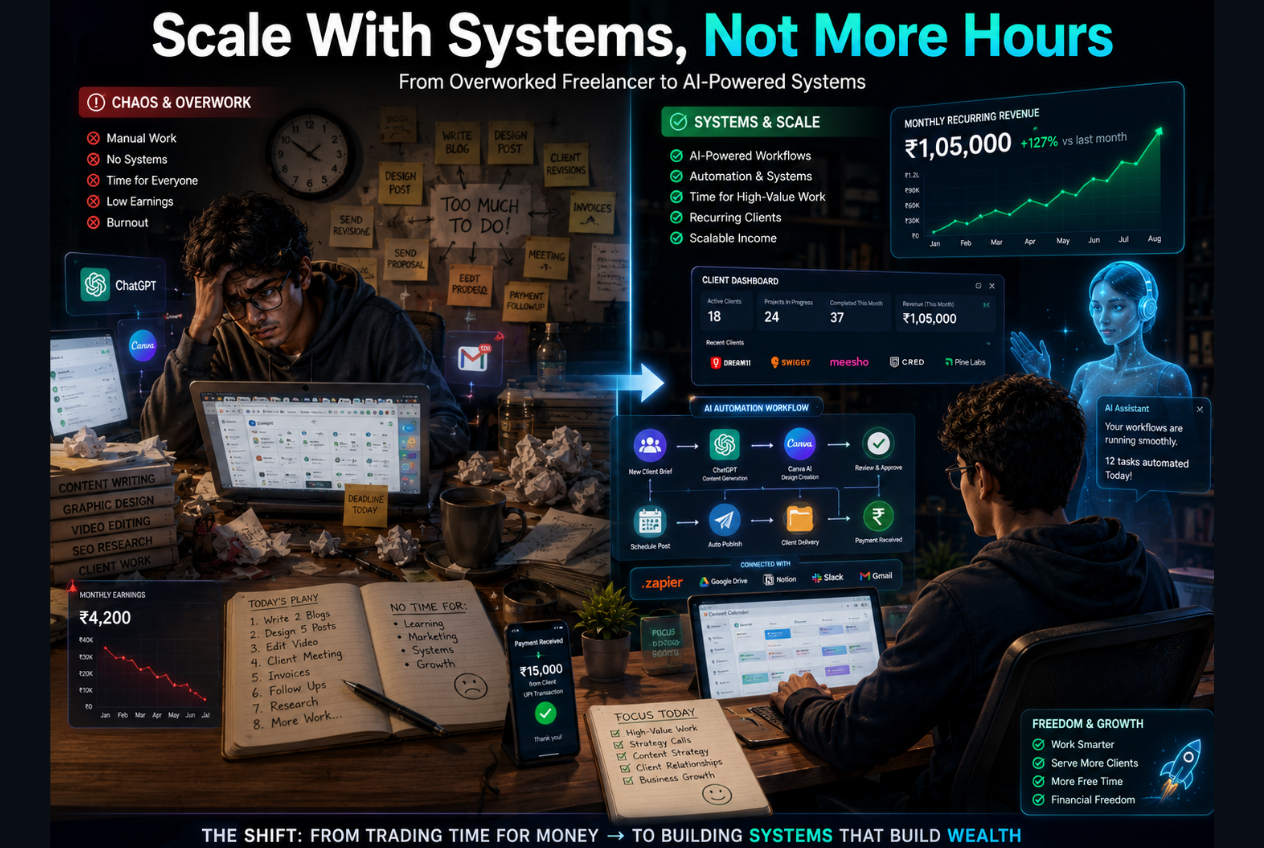
Scaling from ₹50,000 to ₹1 lakh isn’t about more work — it’s about building repeatable systems that let you deliver the same quality in half the time, then filling that freed capacity with higher-value clients.
Building Automation Workflows
Here’s a workflow a content writer I know built after hitting ₹40K:
- Client fills a Google Form with their content brief
- Zapier passes that form data to a ChatGPT API call that generates a structured outline
- Outline lands automatically in a shared Notion workspace
- Writer reviews, edits, and delivers — instead of starting from scratch
That single workflow cut per-article time by roughly 50%. Same quality, twice the volume per hour.
Upselling to Existing Clients
Getting ₹5,000/month from a client you already have is ten times easier than landing a new one. So upsell deliberately:
- Content client → add a monthly social media repurposing package
- Design client → add a brand kit refresh using Midjourney + Canva AI
- Chatbot client → add monthly maintenance and prompt updates
Five clients, each paying ₹4,000/month in upsells. That’s ₹20,000 added to your income without acquiring a single new account.
Shifting to Retainers
One-off projects are mentally exhausting. You’re always selling. Retainers — monthly packages at a fixed rate — change the entire dynamic. Three to five retainer clients at ₹15,000–₹20,000 each and you’re at ₹1 lakh without the monthly hustle of finding new work.
Which AI Tools Do You Actually Need to Start Earning?
Here’s my honest take: most AI tool lists are just affiliate link compilations. You don’t need 15 subscriptions. You need the right four or five.
The best AI tools for freelancers are the ones that directly improve the speed or quality of your billable work — not the ones with the most features or the best marketing.
Here’s the practical breakdown:
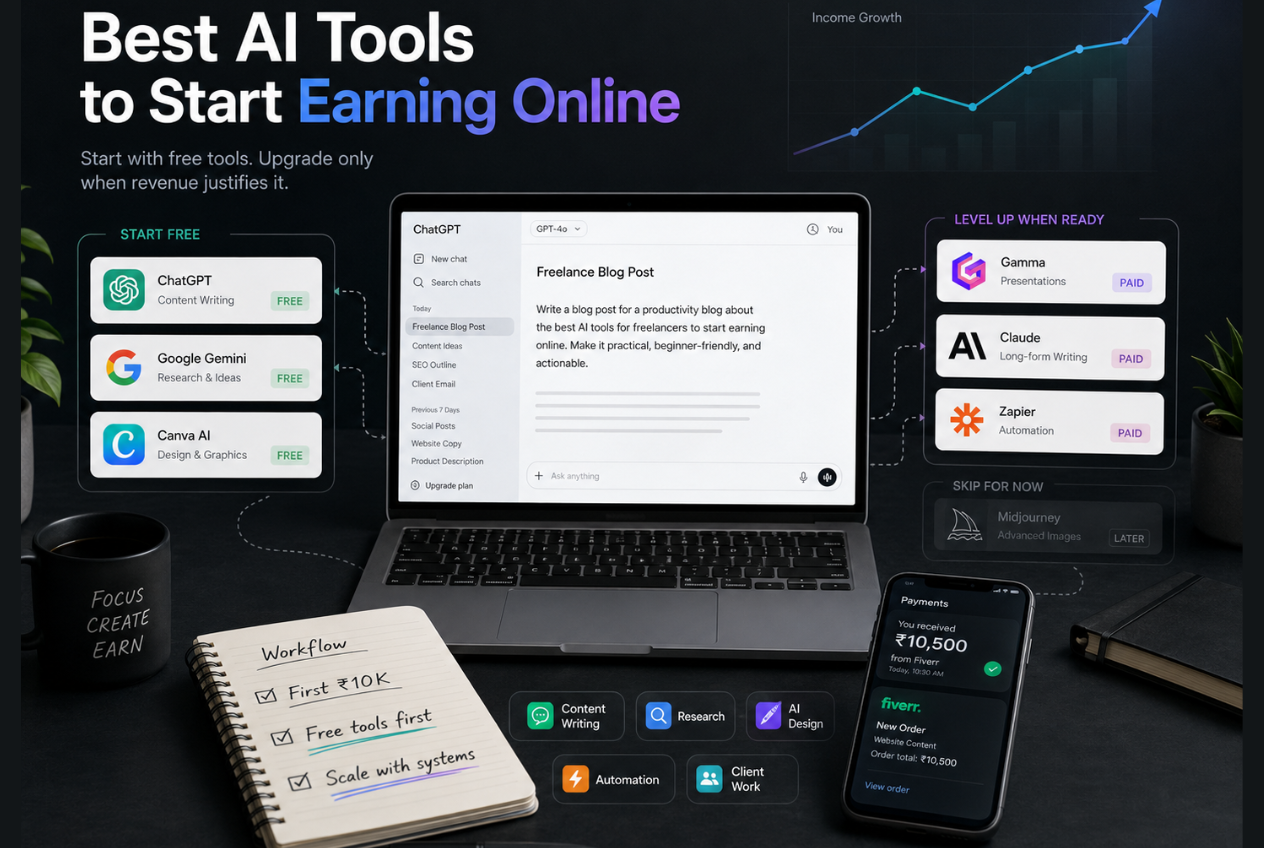
Free Tier — Enough to Earn Your First ₹10,000
- ChatGPT (Free): Content drafts, outlines, email templates, brainstorming
- Google Gemini (Free): Long-document research, competitor analysis
- Canva (Free): Graphics, presentations, carousels, client decks
- Gamma (Free): AI-generated slide decks — genuinely impressive for client pitches
Adobe reports that 86% of creators now use generative AI tools in their workflows — Source: Adobe Creators’ Toolkit Report, 2025. Most of them started with free tiers.
Worth Paying for After Your First ₹10K
- ChatGPT Plus (₹1,650/month): GPT-4o access, image generation, faster outputs
- Claude Pro (₹1,650/month): Better for nuanced long-form writing — honestly my preference for articles over 1,500 words
- Midjourney (~₹830/month): Only if your niche is image generation
- Descript (~₹1,250/month): Non-negotiable if you’re in video editing or scripting
Skip Until After ₹1 Lakh
Jasper, Copy.ai, Writesonic — expensive for capabilities you already have in ChatGPT. ElevenLabs paid tiers — only worth it if voiceover is a core service, not a nice-to-have.
Use ChatGPT prompts for freelance services to squeeze maximum output from the free tier. And if design is your chosen niche, Canva AI for social media freelancers alone can run a ₹20,000/month service without any paid subscription.
Beyond service-specific tools, the right productivity stack makes a real difference in how much you can deliver per hour — see our tested list of AI productivity tools that actually improve your workflow before you decide what to add to your setup.
What’s a Realistic Timeline for AI Income Growth in India?
Let’s be honest about something: the people on social media showing “₹5 lakh in 30 days” almost always had existing audiences, sales skills, and business networks before they touched an AI tool. For someone starting fresh, the timeline looks different — and that’s okay.
A realistic path from ₹0 to ₹1 lakh with AI freelancing takes approximately 6–9 months, assuming 10–15 focused hours per week, with first earnings typically appearing in Month 2 or 3.
| Month | Focus | Realistic Income |
|---|---|---|
| Month 1 | Niche + tools + portfolio samples | ₹0 — this is your investment month |
| Month 2 – 3 | First outreach, first paid clients | ₹5,000 – ₹10,000 |
| Month 3 – 4 | Refine offer, raise rates, second client | ₹15,000 – ₹25,000 |
| Month 4 – 6 | Retainer clients + first upsells | ₹30,000 – ₹50,000 |
| Month 6 – 9 | Automation workflows, scale capacity | ₹75,000 – ₹1,00,000 |
Research on AI implementation consistently finds that unrealistic expectations are one of the biggest causes of early abandonment — Source: TechRadar, 2026. The people who succeed are rarely the ones who expected it to be fast. They’re the ones who kept going past Month 2 when the momentum hadn’t arrived yet.
AI rewards consistency over intensity. Showing up for 10 hours every week for six months outperforms three frantic 60-hour weeks and then burning out.
What Mistakes Keep Most AI Freelancers Stuck at Zero?
From what I’ve seen, the mistakes that stall people are almost never about tools. They’re about decisions made before the first client conversation even happens.
Most beginners who fail to earn their first ₹10,000 make one of four predictable mistakes — none of them involve which AI tool they chose.
Over-tooling is the most common. People spend ₹3,000–₹5,000/month on subscriptions before earning a rupee. Tools don’t generate income. Clients do. Start free.
Skipping niche selection. “I’ll do anything” sounds flexible. To a client, it reads as “I’m not a specialist.” Specificity is what gets you hired. A social media manager who works exclusively with D2C beauty brands will close faster and charge more than someone who “does social media.”
Underpricing out of desperation. Charging ₹200 for a 1,000-word article doesn’t signal affordability — it signals poor quality. And mathematically, reaching ₹1 lakh at that rate requires producing 500 articles a month. Price for the outcome.
Automating before validating. Build Zapier workflows after you’ve done the work manually 20 times and you know exactly what the process looks like. Automation before validation means you’re systematizing the wrong thing efficiently.
What Should You Build After You Hit ₹1 Lakh?
After reaching ₹1 lakh, the most leveraged next step is productizing your service — turning your repeatable workflow into something that scales beyond your available hours.
Three paths make sense at this stage:
Path 1: AI Micro-Agency. Hire 1–2 virtual assistants to handle execution while you manage clients and strategy. Before making that leap, understand how to start an AI agency in India — the pricing, contracts, and team structure look very different from solo freelancing.
Path 2: Digital Products. Package what you know. A prompt pack for a specific niche (“50 ChatGPT prompts for D2C skincare brands”) can sell for ₹499–₹1,999 and reach hundreds of buyers without any additional service work. Notion dashboards, SOP bundles, workflow templates — these compound.
Path 3: Micro-Course. You just earned ₹1 lakh doing something. That’s your case study. A focused 2-hour course documenting your exact process can generate ₹20,000–₹50,000 in its first month if you market it to the same audience reading this article.
Before scaling any of these, sort out freelancing income tax rules in India. Income above ₹2.5 lakh annually requires ITR filing. GST registration kicks in above ₹20 lakh. It’s boring, but it matters.
Once you’ve hit ₹1 lakh and have repeatable workflows in place, the next evolution is automation-first income — read how one creator built a fully automated side hustle using AI agents to see what that looks like in practice.
Conclusion: The ₹1 Lakh Milestone Is Proof of a System, Not a Stroke of Luck
Here’s what I want you to take away from all of this: the roadmap to make money with AI in India isn’t complicated. It’s uncomfortable, which is different.
Month 1 is uncomfortable because you’re building a portfolio no one has seen yet. Month 3 is uncomfortable because your second client takes longer than you expected. Month 5 is uncomfortable because the retainer you pitched is taking time to close.
But none of that is a sign that the system is broken. It’s just what the early phase of any real income-building process feels like.
The creators and AI freelancers in India who are consistently earning ₹1 lakh and beyond aren’t the most technically skilled or the ones with the fanciest tool stack. They’re the most focused, the most specific in their positioning, and the most consistent in their execution.
You don’t need capital. You don’t need a degree. You need one niche, one free tool to start, one portfolio piece to show, and one pitch sent this week. That’s the actual starting point.
Build one sample piece today. Send one pitch this week. The ₹1 lakh milestone is twelve weeks of that, compounded.
Frequently Asked Questions
Do I need any technical skills or a degree to start making money with AI tools in India?
No — and this is one of the most persistent myths that stops people before they start. The highest-earning AI income niches for beginners (content writing, social media graphics, email marketing) require zero coding knowledge and no formal degree. You’re not building AI tools; you’re using them to deliver services clients already pay for.
What you do need is basic digital literacy — the ability to navigate a browser, send emails, and communicate clearly with clients. Everything else is learnable in 2–4 weeks of consistent practice with free tools like ChatGPT and Canva AI.
That said, if you want to pursue higher-earning niches like AI automation setup or chatbot development, some familiarity with tools like Zapier or Make is helpful. But even those are no-code platforms. Start with what you’re comfortable with, and build from there.
How much money do I need to invest upfront before I can start earning?
Technically, ₹0. The free tiers of ChatGPT, Google Gemini, Canva, and Gamma are genuinely sufficient to complete client work and land your first paying projects.
The only real upfront costs are optional — a Fiverr seller account is free, LinkedIn is free, and cold email outreach costs nothing. If you want a custom domain for a portfolio site, that’s roughly ₹800–₹1,500/year, but even that can be replaced with a free Notion page.
The honest caveat: once you’re consistently earning ₹10,000–₹15,000/month, upgrading to ChatGPT Plus or Claude Pro (around ₹1,650/month each) starts making financial sense. Better output quality means faster delivery and fewer revisions. But that’s a reinvestment decision you make after validating demand — not before.
Is AI freelancing sustainable long-term, or will the market get too saturated?
This is the right question to ask. Generic AI content services — “I’ll write blogs using ChatGPT” — are already getting crowded and prices in that tier are under pressure. That’s real.
But niche-specific, outcome-focused AI services are nowhere near saturated. A freelancer who automates client onboarding for D2C brands, or builds AI content systems for Ayurveda coaches, operates in a much smaller competitive pool with much higher pricing power.
Small business AI adoption in India is still early — a 2025 survey found SMB adoption jumped from 39% to 55% in a single year — Source: Thryv AI & Small Business Survey, 2025. That growth means demand for AI implementation help is expanding faster than supply right now.
Long story short: generic AI freelancers will get squeezed. Specialists who solve specific, valuable problems will not.
If you’re worried about the ceiling on AI freelancing income, it’s worth understanding whether AI agents are replacing freelancers or simply changing what clients are willing to pay for — the cost breakdown might surprise you.
Can I do this alongside a full-time job or college — or does it require full-time commitment?
You can absolutely start this alongside a job or college — in fact, that’s the recommended approach. Leaving a stable income before you’ve validated your first client is unnecessary risk.
The realistic time investment at the start is 10–15 hours per week: roughly 1–2 hours on weekdays for skill-building and outreach, and a larger block on weekends for actual client work. At that pace, the first ₹10,000 typically arrives in Month 2 or 3.
At 5–7 hours per week, expect 12+ months to reach ₹1 lakh rather than 6–9. That’s still a viable path — it just requires a longer runway and consistent effort.
Do clients care that you’re using AI tools — will it hurt my credibility or pricing?
Most clients care about the output, not the method. If you deliver a well-written blog post or a working automation on time and within budget, the vast majority don’t ask what tools produced it.
The smarter framing is to position around the outcome, not the tool. “I run an AI-assisted content process that cuts turnaround time by 50% without sacrificing quality” is a stronger pitch than “I use ChatGPT.” On pricing: using AI doesn’t mean you should charge less. It means you can handle more volume at the same quality — which is a reason to earn more per month, not to discount.
For anyone wondering about the legality of using ChatGPT for paid client projects — OpenAI’s usage policy explicitly permits commercial use, including in freelance and agency contexts, as long as you’re not reselling access to the API itself.
What’s the best platform to find AI freelancing clients in India — Fiverr, Upwork, or somewhere else?
There’s no universally best platform — it depends on your niche and how comfortable you are with inbound versus outbound work.
Fiverr is the easiest entry point for beginners — clients find you through search and you don’t need a network. Upwork has higher average project values but needs strong testimonials to compete effectively. LinkedIn is underused by Indian freelancers and works very well for B2B services like automation and content strategy. WhatsApp outreach to local businesses is the fastest path to first income in Tier 2 and Tier 3 cities — most small business owners are reachable this way and aren’t being actively pitched by competitors.
Fiverr’s official freelance market trends guide shows which service categories are seeing the highest buyer demand — worth checking before you choose your gig title and tags.
The practical advice: pick one platform, commit to it for 60 days, then expand. Split attention too early and you build weak presence everywhere instead of strong presence somewhere.
Written by Arjun Mehta: Arjun Mehta is an AI Monetization Strategist with 8+ years of experience in digital income systems, workflow automation, and practical AI-powered business models. Arjun has worked with over 2,000 Indian freelancers on building sustainable income across Fiverr, Upwork, and LinkedIn.
Reviewed by: Remote Autopilot Editorial Team — Specialists in AI workflows, remote business systems, SEO content strategy, and automation-based digital growth.
Disclaimer: This article is based on practical experimentation, industry research, and real-world use cases involving AI tools and digital income strategies. Results can vary depending on skill level, niche selection, execution, and market conditions. AI platforms, pricing, and features evolve rapidly, so readers should independently verify current information before making financial or business decisions. This content was initially drafted with AI assistance and has been carefully reviewed, refined, and fact-checked by human editors and subject matter experts to ensure accuracy, clarity, originality, and editorial integrity.