
By Alexander Reed | Technology Content Writer
Summarize this blog post with: ChatGPT | Perplexity | Claude | Grok
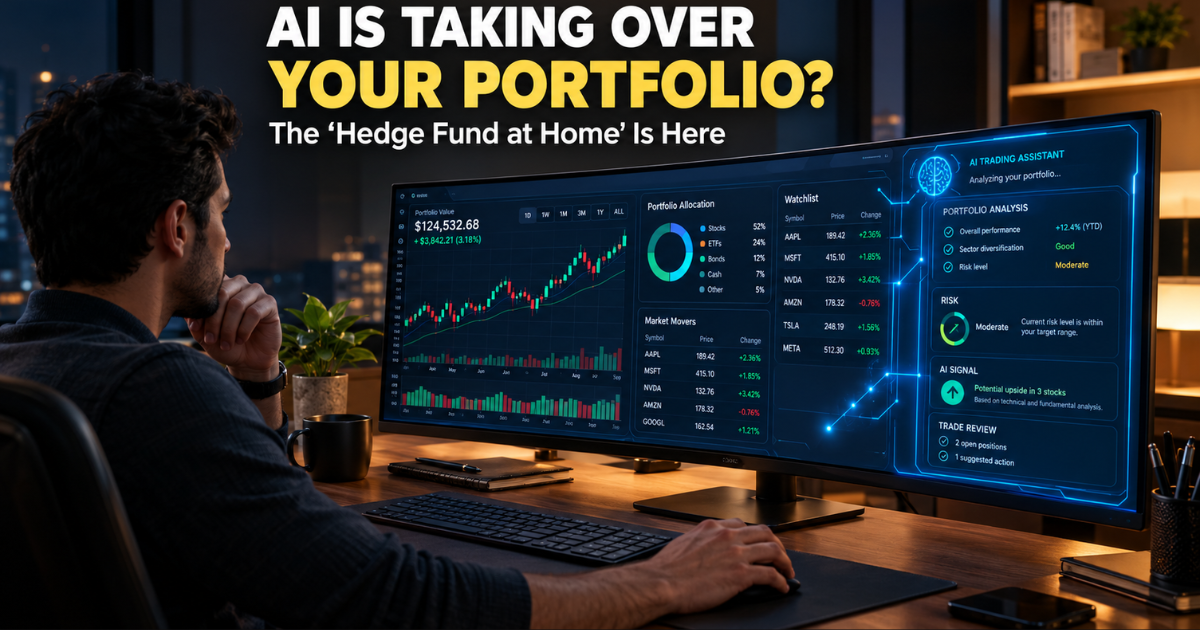
Retail investors are quietly handing more control of their stock portfolios to AI. What started as asking a chatbot to summarize an earnings report has moved, for some people, toward tools that screen stocks, monitor news, rebalance allocations, and even execute trades. The marketing calls it a “hedge fund at home.” In practice, it’s more complicated—and riskier—than the ads suggest.
I’ve watched this shift up close. AI can process filings, news, and price data faster than any individual ever could. It can surface patterns and enforce rules without emotional interference. But speed and automation do not equal better returns or lower risk. The investors who seem to fare best treat AI as a powerful research and monitoring assistant, not an unsupervised portfolio manager. Here’s how the technology is actually being used, where the “hedge fund at home” idea holds up, where it breaks down, and how much control most people should realistically give it.
Key Takeaways
- AI-powered retail investing covers research, screening, monitoring, analysis, and, in some cases, automated execution.
- Most retail users still treat AI as a supplement rather than a full replacement for human judgment.
- Efficiency gains are real; guaranteed outperformance is not.
- Risks rise sharply once systems move from recommendations to unsupervised trades.
- Hybrid approaches—AI insights plus human oversight—remain the more durable model for the majority of individual investors.
What Is AI-Powered Retail Investing?
AI-powered retail investing means using artificial intelligence to help with investment research, portfolio analysis, trading signals, monitoring, or automated execution. It ranges from a generative AI assistant explaining a 10-K in plain language to systems that continuously evaluate conditions and place trades according to predefined or adaptive rules.
There is a meaningful difference between older robo-advisors and newer AI-driven tools. Traditional robo-advisors largely follow fixed, human-written rules for allocation and rebalancing. AI systems can incorporate machine learning that updates based on new data, sentiment signals, or changing market patterns. That adaptive quality is why the experience feels different from the set-it-and-forget-it products of the 2010s.
In practice, most retail investors currently sit somewhere in the middle of the spectrum. A 2026 study of more than 2,000 retail investors found that 47% reported using generative AI to process financial information or inform investment decisions. Researchers also examined more than 400,000 queries to a major brokerage’s GenAI chatbot. — Source: Journal of Accounting and Economics, 2026.
People start with screening and high-level company assessments. Over time, many shift toward monitoring company-specific news and interpreting developments. Fully autonomous trading remains far less common.
Why AI Is Changing How Retail Investors Manage Portfolios
Accessibility is the biggest driver. Digital brokerages, AI assistants, and consumer platforms have lowered the barrier to tools that once required institutional resources. An individual can now ask an AI system to organize quarterly results for a watchlist of 50 companies, flag unusual options activity, or track sentiment shifts in near real time.
The World Economic Forum’s 2024 Global Retail Investor Outlook, which surveyed 13,000 investors across 13 countries, identified AI-driven platforms and technology as important forces reshaping retail participation. — Source: World Economic Forum, 2025.
Interest varies by investor type. State Street’s 2025 research found that 33% of self-directed investors were interested in using AI for financial and investment decisions, compared with 46% of hybrid investors and 27% of advised-only investors. — Source: State Street Investment Management, 2025.
Here’s the central tension: many people trust AI to process information long before they trust it to control capital. Summarizing a filing feels reversible. An automated sell order that hits during a flash move does not.
How Retail Investors Actually Use AI for Stock Trading
Most activity falls into a handful of practical categories rather than full portfolio handover.
Research and explanation. Investors ask AI to translate dense filings, earnings transcripts, and analyst commentary into clearer language, then verify the numbers themselves.
Screening and idea generation. Tools filter for companies meeting specific financial, technical, or sentiment criteria.
Monitoring and alerts. Systems track news, price action, or allocation drift and surface items that need attention.
Portfolio analysis. AI can highlight concentration risk, sector exposure, or rebalancing needs.
Limited automation. Some platforms execute predefined rules—rebalancing when an allocation drifts beyond a threshold, or adjusting stops based on volatility.
Fully autonomous agents that decide and trade with minimal human input exist but remain the minority use case. The risk profile changes dramatically at that point: an automated mistake can compound faster than a human can intervene.
The Spectrum of AI Control Over a Portfolio
Control exists on a continuum. Understanding where a given tool sits helps set expectations and safeguards.
| Level | What AI Does | Human Control | Relative Risk |
|---|---|---|---|
| 1 | Research assistant | Full | Lower |
| 2 | Generates ideas and analysis | High | Lower |
| 3 | Monitors portfolio and news | High | Moderate |
| 4 | Recommends portfolio actions | Medium | Moderate |
| 5 | Executes predefined trades | Limited | Higher |
| 6 | Makes highly autonomous decisions | Low | Highest |
The practical rule is straightforward: the more authority the system receives, the stronger the verification, position limits, and override mechanisms need to be.
Benefits That Actually Matter
AI’s clearest advantages are speed, consistency, and the ability to handle volume. It can organize lengthy documents, apply the same screening criteria across dozens of names, monitor developments overnight, and reduce the repetitive parts of research.
A 2026 survey found that 74% of GenAI users believed the technology improved their financial-information processing, and 80% planned to continue using it. — Source: Journal of Accounting and Economics, 2026.
Those efficiency gains are real. They are not the same as superior investment performance. A system that processes flawed assumptions or incomplete data simply does so more quickly.
This kind of large-scale screening is exactly why these 10 AI companies keep appearing in billionaire portfolios — institutional-grade analysis, now available to any retail investor with an AI tool, tends to converge on the same handful of dominant names.
The Biggest Risks of Letting AI Trade Stocks
The core problem is that generative and adaptive models can produce confident-sounding outputs from incomplete, outdated, biased, or misunderstood information. Automation does not remove market risk; it can amplify operational and model risk.
Common issues include:
- Hallucinated or misread figures in filings or news.
- Overfitting—strategies that look excellent on historical data but fail in live, changing markets.
- Black-box decision-making that makes it hard to understand why a trade was triggered.
- Data lag or regime shifts (geopolitical shocks, sudden liquidity changes) that historical patterns do not capture well.
- Concentration risk if multiple AI systems converge on similar signals.
- Cybersecurity and operational exposure once systems have brokerage access.
- Execution timing errors during volatile periods.
Professional disclosures increasingly list AI-specific risks: data quality, transparency, operational failure, inaccurate outputs, and potential losses. Regulators have already acted on misleading claims. In 2024 the SEC charged two investment advisers over AI-related misrepresentations and imposed $400,000 in combined civil penalties. In a separate case involving Rimar Capital, the agency said the firm falsely described an AI-driven platform and raised nearly $4 million from 45 investors. — Source: U.S. Securities and Exchange Commission, 2024.
These episodes illustrate “AI washing”—using the AI label to imply sophistication that the underlying process may not deliver.
Why Many Retail Investors Remain Cautious
Enthusiasm for information processing often coexists with reluctance to hand over execution authority. A 2026 study found that among surveyed retail investors, 54% identified reliability and accuracy as concerns about GenAI for investing, 50% cited data privacy, and 46% cited response quality. — Source: Journal of Accounting and Economics, 2026.
Past experience with automated tools during volatile markets has also left a mark. When an algorithm sells into a sharp move with little explanation, the psychological cost is higher than when an investor understands the thesis and chooses to hold or adjust. Most people therefore prefer hybrid setups: AI handles routine monitoring and rebalancing suggestions; the human retains final say on material decisions.
Can AI Really Deliver a “Hedge Fund at Home”?
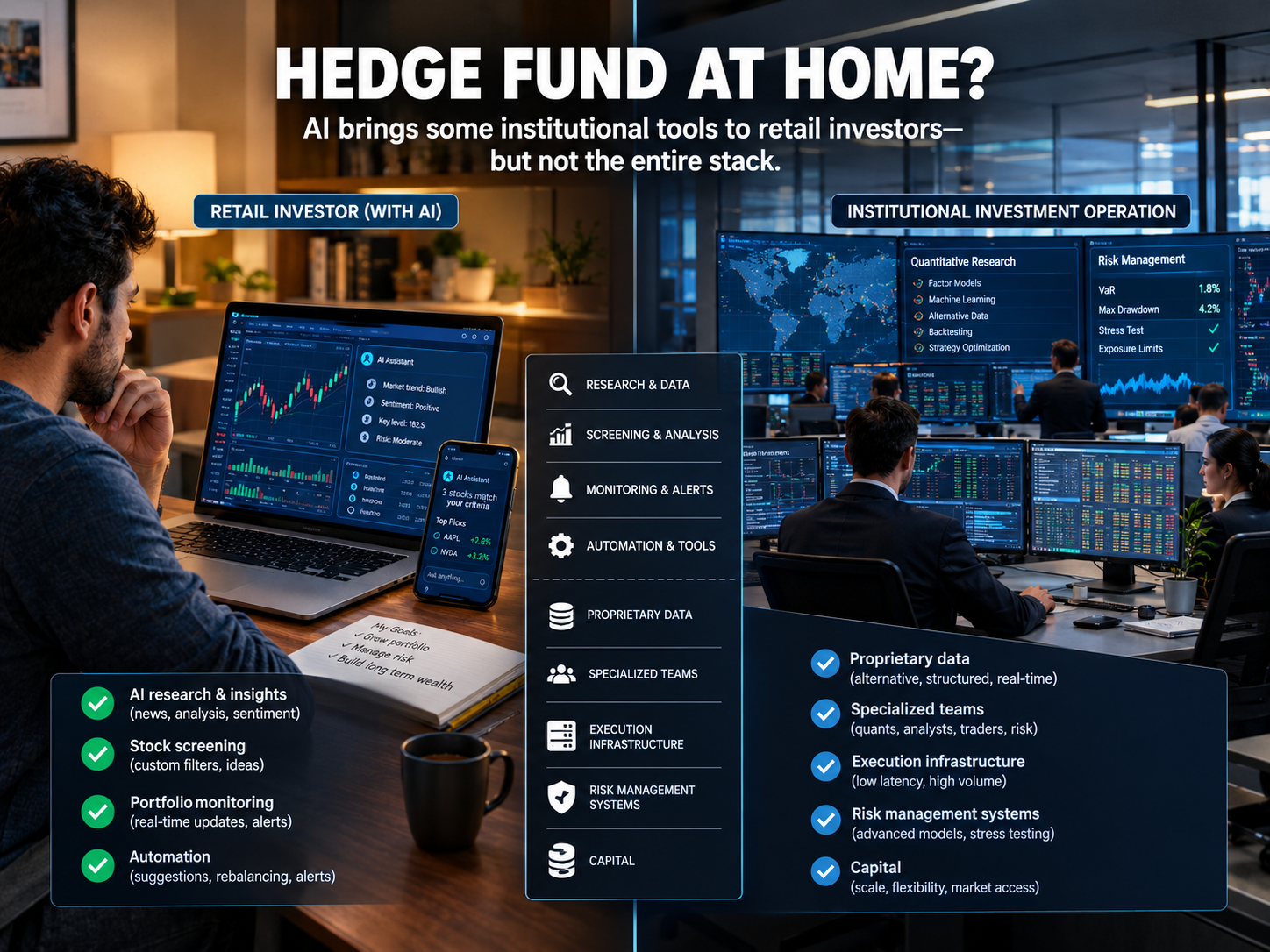
It can deliver pieces of the workflow—multi-factor screening, dynamic risk controls, continuous monitoring, structured research processes—that were once far more expensive and inaccessible. Capital requirements can be minimal, and the interface can fit on a phone.
It does not replicate the full institutional stack: proprietary datasets, specialized research teams, sophisticated execution infrastructure, dedicated risk systems, and deep capital buffers. Access to tools is not the same as the expertise, data quality, and risk management discipline that professional firms bring. The more accurate description is “hedge-fund-style capabilities at retail scale,” not “institutional hedge fund in a laptop.”
Notably, some of the same AI companies driving this retail tool boom are also core holdings for major institutional investors, as seen in Berkshire Hathaway’s AI stock portfolio and Warren Buffett’s AI investments and holdings.
Safer Ways to Use AI Without Surrendering Control
A practical progression works better than jumping straight to automation:
- Start with research and explanation. Verify every material number against primary sources.
- Move to analysis and monitoring. Let AI surface questions, risks, and developments that deserve attention.
- Test strategies in simulation or with paper capital.
- Automate only narrowly defined, well-understood rules (for example, rebalancing within clear bands).
- Require human approval for material trades or changes in risk exposure.
- Maintain records of what the system recommended, what you accepted or rejected, and why.
Treat AI output as one input into a decision process, not as proof that a trade is correct. Position sizing, diversification limits, maximum acceptable loss, and clear override rules should be set before any system has authority to act.
Beginners, in particular, should favor tools that provide some explanation of reasoning and start with a small, dedicated allocation rather than an entire portfolio. Free or low-cost features from major brokerages can be enough to experiment without subscription pressure.
Looking Ahead
AI investing tools will keep improving at research, monitoring, and routine automation. Hybrid human-AI models are likely to remain the dominant practical approach for most retail investors. The technology can reduce friction and surface information faster; it still cannot eliminate uncertainty, bad data, or the need for judgment about risk tolerance and time horizon.
The investors who extract the most durable value will be the ones who know precisely which decisions to automate and which ones to keep under direct control.
Conclusion
AI is rewiring retail investing by making sophisticated research, screening, monitoring, and limited automation more accessible. The “hedge fund at home” idea captures a real expansion of capability, but it overstates the outcome if people expect institutional-quality results without institutional discipline. Efficiency is not performance. Automation is not risk removal.
Use AI-powered retail investing as a co-pilot first. Verify outputs, start narrow, set hard limits, and only expand authority after you understand the system’s failure modes. Your portfolio remains your responsibility. Better tools work best when paired with better judgment—not less of it.
FAQs
FAQ 1: Is AI portfolio management the same as a traditional robo-advisor?
No. Traditional robo-advisors typically follow fixed rules set in advance. Many newer AI tools incorporate adaptive models that update based on new data, sentiment, or changing patterns. The practical difference is greater flexibility—and greater opacity—around how decisions are reached.
FAQ 2: Can AI guarantee better returns than a human investor?
No. AI can process more information faster and enforce rules without emotion, but it remains subject to data quality, model limitations, market regime changes, and execution risk. Historical backtests often overstate live performance.
FAQ 3: How much control should a typical retail investor give an AI system?
Most people benefit from keeping final authority over material trades and major allocation shifts. AI is strongest as a research, monitoring, and routine-rebalancing assistant. Full unsupervised execution raises the stakes significantly.
FAQ 4: Are AI investing tools safe for beginners?
They can be if the beginner starts with research and monitoring features, uses small allocations, chooses platforms that offer some transparency, and verifies key numbers independently. Handing an entire portfolio to an opaque automated system is a higher-risk approach for anyone still learning markets.
FAQ 5: What should I do if an AI tool makes a recommendation I don’t understand?
Treat the lack of clear reasoning as a red flag. Ask for the underlying data or logic, cross-check primary sources, and do not act until you can explain the decision in your own words. Unexplained trades are harder to stick with—or reverse—during drawdowns.
Author & Editorial Information
Written by Alexander Reed: Alexander Reed is a technology content writer covering artificial intelligence, financial technology, digital tools, and emerging technology trends for general readers. His work focuses on explaining new technologies and their practical applications in a clear, accessible, and easy-to-understand way.
Reviewed by: Technology Content Editors & Financial Technology Specialists.
Disclaimer: This article is based on publicly available information, general research, market developments, technology reports, and other sources available at the time of publication. AI-powered investing tools and trading platforms can change frequently, and their features, capabilities, limitations, and results may vary. Information presented in this article is for general informational purposes only and should not be considered financial, investment, or trading advice. Readers should conduct their own research and consult a qualified financial professional before making investment decisions. This content was initially drafted with AI assistance and has been reviewed, edited, refined, and fact-checked by human editors to improve accuracy, clarity, originality, and editorial quality.