
By Aarav Sharma | Sports Technology Writer
Summarize this blog post with: ChatGPT | Perplexity | Claude | Grok
You’ve been there. A massive LBW appeal, the crowd goes wild, the umpire raises the finger — and then the captain immediately signals for a review. Three seconds later, Hawk-Eye shows the ball clipping leg stump by a whisker, and the decision gets overturned. And somewhere in that moment, the thought crosses your mind: why do we even need the umpire anymore?
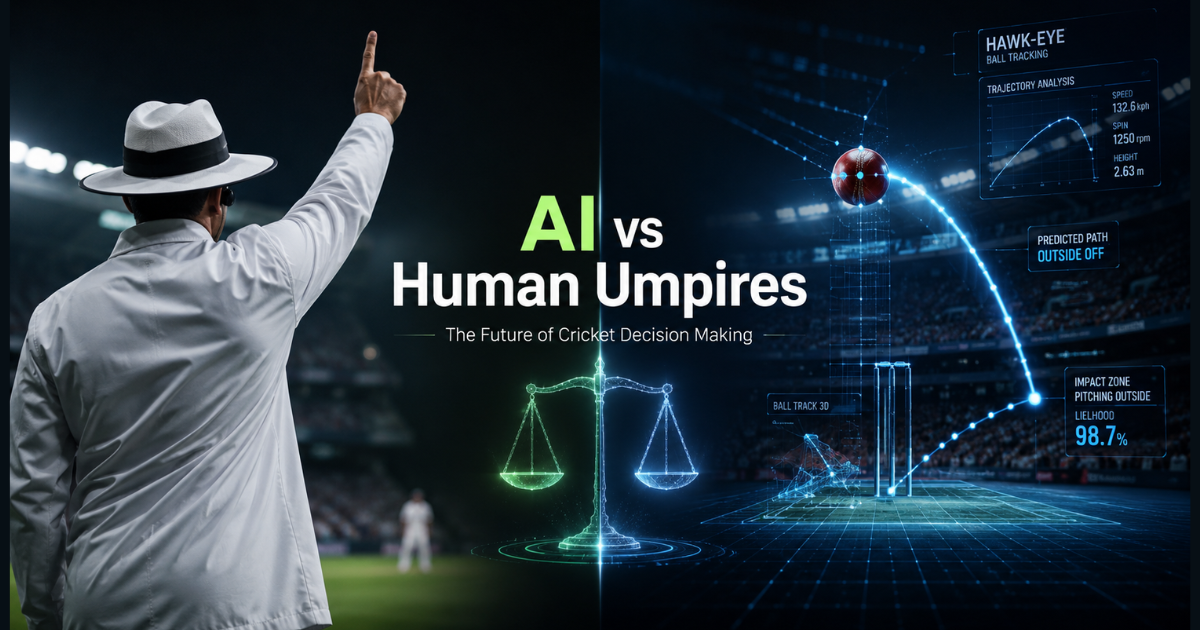
Honestly, it’s a fair question. But here’s the thing — it’s also a bit of a misleading one. AI and tracking tech are already deeply embedded in how cricket decisions get made. The more interesting debate isn’t whether AI can replace human umpires. It’s whether it should, and what we’d actually lose in the process. That’s what this guide is about.
Key Takeaways
- Cricket umpires do a lot more than make decisions on deliveries — they manage player behaviour, read situations, apply context, and maintain the authority the game needs. AI can’t do all of that yet.
- AI is already working inside cricket officiating through Hawk-Eye, UltraEdge, HotSpot, and automated no-ball systems — so the question isn’t whether AI belongs here. It already does.
- On purely data-driven calls like no-balls and LBW trajectory, AI accuracy exceeds 95% — which is genuinely better than the human average under pressure.
- The hard calls — intent, obstruction, game management — still need a human being with contextual understanding that no current algorithm can replicate.
- No international cricket board has committed to full AI officiating at the elite level. The direction is clearly toward AI as a support tool, not a standalone replacement.
- Tennis and football have already tried versions of AI officiating — and while tennis worked out well, football’s VAR experience is a cautionary tale worth studying.
- The most likely future is the “augmented umpire” — a human official with real-time AI data flowing to them, combining precision and judgment in one package.
So, What Does a Cricket Umpire Actually Do?
Cricket umpiring involves far more than decision-making on individual deliveries — umpires are responsible for managing player conduct, enforcing the Laws of the Game, assessing player intent, and exercising contextual judgment in situations that no current AI system is trained to handle. That’s not an opinion, it’s just the reality of the job.
Think about what an on-field umpire handles in a single over. There’s the obvious stuff — LBW decisions, catching edges, no-balls, wides. But there’s also ball condition monitoring, light assessments, watching for short runs, handling aggressive appealing, and making split-second run-out calls from 22 yards away. Every one of those decisions is filtered through context: who’s batting, what’s the pitch doing, what’s the match situation, has this bowler been warned before?
The spirit of cricket and the Laws of the Game actually codify a lot of this contextual nuance, and if you read through them, you start to appreciate just how many clauses involve phrases like “in the umpire’s opinion.” That’s not vagueness — that’s intentional. Cricket has always understood that some decisions require human wisdom, not just human eyes.
The point is this: a no-ball call is binary. Obstruction of the field is not. And that distinction is basically the entire AI replacement debate in one sentence.
Just like in content creation, where AI vs human creativity and decision-making remains a debated topic, cricket umpiring also sits in a hybrid zone of automation and human intuition.
Why Getting Decisions Right Actually Matters
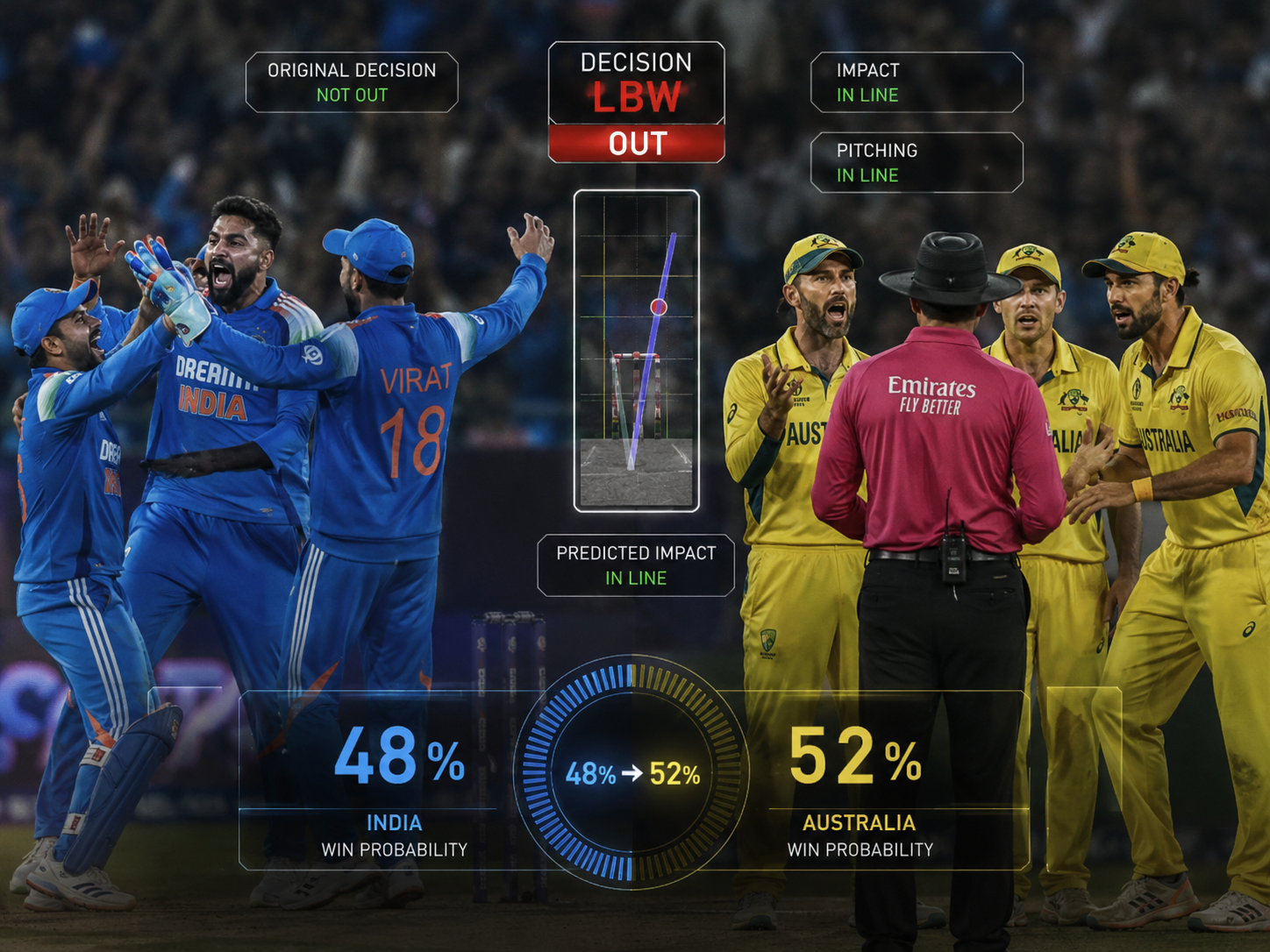
Incorrect umpiring decisions affect match outcomes, player careers, team standings, and — increasingly — massive amounts of money. This isn’t abstract.
The 2019 Cricket World Cup final is the most obvious recent example most fans remember. The overthrows controversy — where the ball deflected off Ben Stokes’ bat for a boundary that many argued shouldn’t have been six runs — remains debated to this day. But from a pure umpiring standpoint, that game exposed how the weight of a single judgment call can define a tournament.
Here’s a stat that puts things in perspective: elite international umpires make correct decisions on roughly 93% of all calls — Source: International Journal of Sports Science & Coaching, 2019. That sounds great until you do the maths. In a five-day Test match, there are thousands of deliveries. A 7% error rate across that volume adds up to a lot of incorrect decisions. And in IPL or World Cup cricket, where every ball can swing win probability dramatically, those errors carry real consequences.
The DRS itself was cricket’s first honest admission that human umpires aren’t infallible — and once you accept that, the AI conversation becomes a lot more rational.
What AI and Cricket Tech Are Actually Already Doing
This is the part most people get wrong in this debate. The Decision Review System in cricket combines Hawk-Eye ball-tracking, UltraEdge audio spike detection, and HotSpot thermal imaging to assist on-field umpires — meaning AI-assisted officiating is already embedded in international cricket, not a future possibility.
From what I’ve seen covering cricket tech, the public perception tends to lag about five years behind what’s actually deployed at elite level. Let me break down what’s live right now:
Hawk-Eye uses six to eight high-speed cameras to reconstruct a ball’s three-dimensional path and predict whether it would have hit the stumps on an LBW decision. Hawk-Eye ball-tracking technology has become so trusted that players generally accept its rulings — even when the “umpire’s call” margin creates frustration. The system is genuinely sophisticated and has been refined over two decades of deployment.
UltraEdge (the modern evolution of Snickometer) analyses audio-frequency data synchronised with video frames to detect faint bat-ball contact. It can pick up edges in packed stadiums that no human ear — and no standard TV microphone — would catch.
HotSpot uses infrared imaging to detect friction marks on bat or pad. It’s less universally deployed than Hawk-Eye or UltraEdge (partly due to cost) but adds another layer of evidence in caught-behind decisions.
And then there’s automated no-ball detection — this one is significant. The ICC has trialled computer vision systems that track the bowler’s front foot in real time, and the results have been impressive. Automated no-ball detection, trialled by the ICC in international and domestic cricket, uses computer vision to track the bowler’s front foot in real time and alert the third umpire with greater than 95% accuracy — a significant improvement over human observation. For context on IPL technology and broadcast innovations, the league has been the primary testing ground for this, and IPL 2026 editions have already incorporated semi-automated no-ball alert systems in match protocols.
One more worth mentioning: Smart Replay Systems that give third umpires multiple synchronised camera feeds simultaneously, cutting the time between referral and decision. It’s less glamorous than Hawk-Eye but arguably more impactful for match flow.
The debate mirrors broader shifts across industries, including the economic impact of AI replacing human roles, where efficiency often competes with trust and human oversight.
The Honest Case For AI Taking Over More Umpiring
Look, I’ll give this argument its full due because it deserves it.
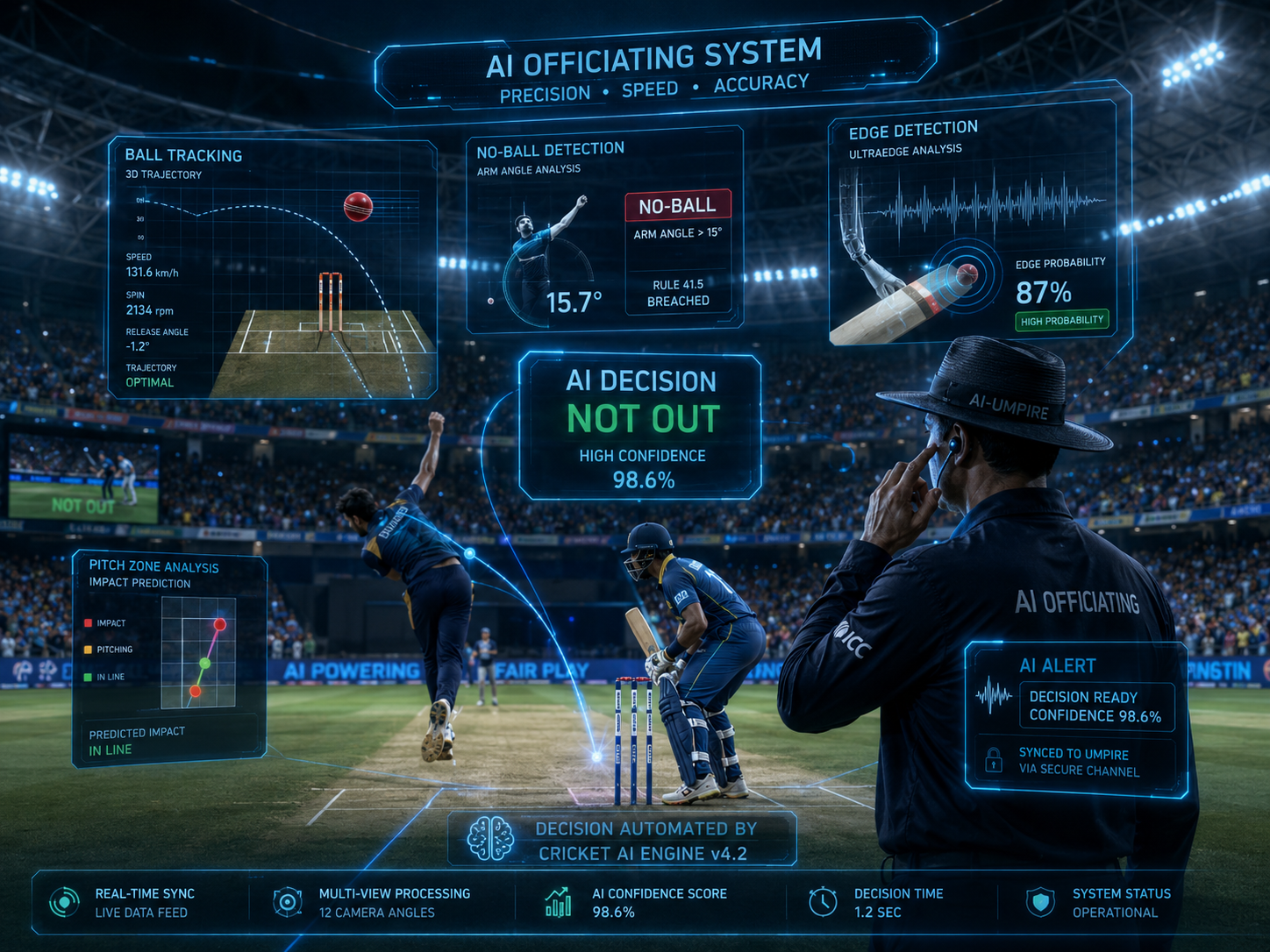
AI systems offer three things that human umpires structurally cannot match: perfect consistency, zero fatigue, and reaction times measured in milliseconds. An AI doesn’t have a bad day. It doesn’t feel the pressure of 80,000 people screaming at it. It doesn’t subconsciously lean toward the home team’s appeal after three days of a hostile Test atmosphere. These aren’t hypothetical advantages — they’re real, documented limitations of human cognition under pressure.
For a broader look at how AI is changing professional sports, the consistency argument holds across every sport where AI officiating has been deployed. Humans are variable. Algorithms aren’t — or at least, not in the same ways.
There’s also the multi-stream processing argument. An on-field umpire can focus on one or maybe two things at once. AI can simultaneously process ball velocity, seam position, pitch mapping data, foot position, and crowd noise levels — all in the time it takes the ball to travel 22 yards. Machine learning in sports analytics has been demonstrating for years that AI-assisted decision systems outperform individual human observers when the task involves rapid synthesis of multiple data inputs.
The accuracy data on specific call types is also hard to argue with. On front-foot no-balls in particular, human umpires miss a meaningful percentage — estimates vary, but from what’s been reported around ICC trials, the gap between human and automated detection is significant enough to matter. AI accuracy rates on these calls consistently exceed 95% — Source: Hawk-Eye Innovations Ltd., 2022. Honestly, there’s no good reason a human eye should be the primary mechanism for that call when a camera-based system does it better.
Why Full AI Replacement Still Isn’t Ready — And May Never Be
While AI outperforms human umpires on binary, data-measurable calls, it currently lacks the ability to assess player intent, respond to unique in-game scenarios, or apply the contextual reasoning required for decisions rooted in the spirit of cricket. And this isn’t a temporary technical gap that’ll close in five years. Some of it is genuinely fundamental.
Here’s a good example. Imagine a fielder appears to obstruct a batsman while they’re running between wickets. Was it deliberate? Was the fielder trying to field the ball and got in the way accidentally? The answer changes the entire ruling — obstruction of the field versus simply being in the wrong place. An AI system would need to assess intent. And intent is not a data point you can extract from a camera feed.
Or think about when a bowler delivers a ball that the umpire has to call as a dead ball because something unusual happened before it reached the batsman. These edge cases — and cricket’s Laws are full of them — require the umpire to apply the spirit of a rule to a situation the rulebook didn’t explicitly anticipate. Understanding the spirit of cricket and the Laws of the Game reveals just how many judgement-dependent situations exist.
This is what people in AI circles call the “last-mile problem” — the decisions that are hardest to get right are precisely the ones that require the most human wisdom. And those decisions often happen at the most critical moments in a match. The stakes are highest exactly where AI is weakest.
Beyond the technical limitations, there’s also the authority dimension. An umpire doesn’t just make decisions — they maintain order. They manage an aggressive pace bowler who won’t accept a wide call. They handle a batsman who’s slow-walking between overs. They de-escalate tensions before they become incidents. From what I’ve seen in this space, the cricket community tends to underweight how much game management actually matters — and there’s no algorithm for that.
AI systems already demonstrate strong performance in real-time analysis tasks, similar to what we see in other industries like AI tools powering modern automation systems.
AI vs. Human Umpires: Where Each One Actually Wins
Rather than a simple “which is better,” here’s an honest breakdown across the dimensions that actually matter:
| Dimension | AI Systems | Human Umpires |
|---|---|---|
| Accuracy on binary calls (no-balls, LBW trajectory) | 95%+ — data-driven and consistent | ~93% overall, lower under pressure |
| Consistency across conditions | Uniform — unaffected by fatigue, crowd, match pressure | Variable — can deteriorate across a long day |
| Contextual and intent-based judgment | Poor — lacks ability to assess intent or novel situations | Strong — reads situations with experience and wisdom |
| Cost and infrastructure | High — cameras, servers, tech support required | Lower — scalable to grassroots without infrastructure |
| Player and fan acceptance | Mixed — technology is trusted, but feels impersonal | Generally high — authority, tradition, emotional resonance |
| Adaptability to new situations | Poor — requires retraining when rules change | Strong — applies reasoning flexibility to new scenarios |
| Game management and authority | None | Essential — de-escalation, pacing, player management |
The pattern here is pretty clear. AI wins on precision, volume, and consistency. Humans win on everything that involves judgment, authority, and reading a room. Neither dominates across the board — which is basically the whole argument for a hybrid model.
What Tennis and Football Teach Cricket About AI Officiating
Automated officiating in tennis offers cricket’s most instructive parallel. Automated officiating in tennis — specifically Hawk-Eye Live — has replaced human line judges at major ATP and WTA tournaments since around 2020. From what players and tournament organisers have reported, acceptance has genuinely improved over time. And the reason it worked is worth understanding: every call being automated was binary. In or out. That’s it. No intent to assess, no context to interpret. The technology excelled precisely because the task matched its capabilities.
Football’s VAR story is a very different lesson. VAR in football shows how a well-intentioned technology intervention created almost as many problems as it solved. Offside decisions became debates about millimetres and camera angles. “Clear and obvious errors” became increasingly subjective. Game flow suffered. Fan frustration — with both the technology and the human interpretations of it — actually increased in some leagues. — Source: UEFA Technical Report, 2023.
Cricket should take this distinction seriously. The binary calls — front-foot no-balls, run-outs with LED stumps, clear edges in catches — are the tennis equivalent. They can and should be automated with confidence. The judgment calls — obstruction, dangerous play, spirit of the game decisions — are the VAR equivalent. And cricket doesn’t want a VAR situation.
Interestingly, DRS error rates in international cricket have dropped to under 2% in elite matches as the system has matured — Source: NeenOpal Cricket Analytics Report, 2024. That’s a genuine success story worth building on.
What the “Augmented Umpire” Model Actually Looks Like
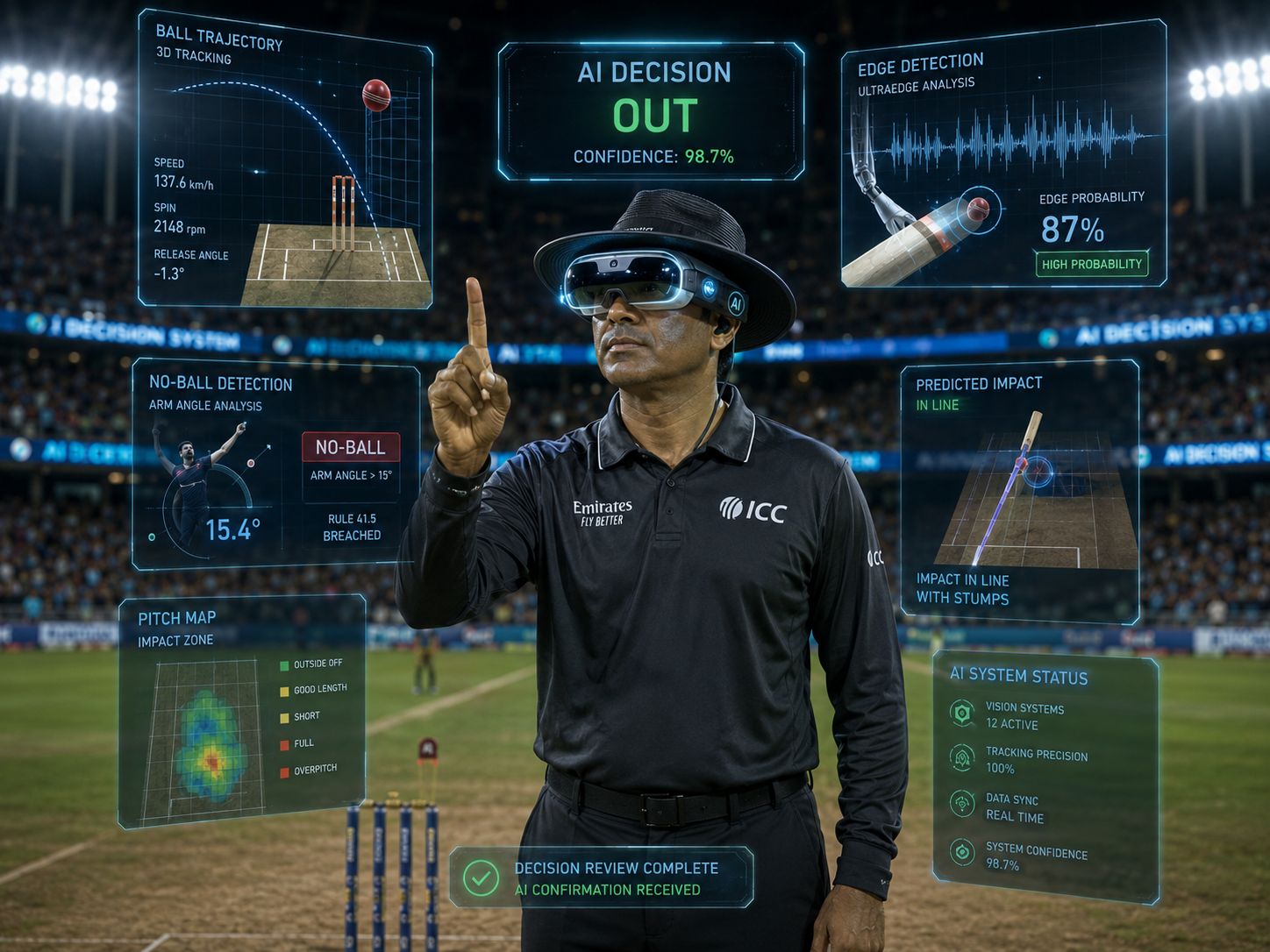
Here’s where I think the most interesting part of this conversation is happening right now. The augmented umpire model positions AI as a real-time advisory system for human officials, delivering instant data — ball trajectory, edge probability, foot position, previous decision patterns — directly to the on-field umpire through an earpiece or wristband display. The human umpire retains final authority. The AI eliminates the category of errors caused by physical limitations, not judgment limitations.
At the international level, think about what this looks like in practice: the bowler delivers, a front-foot camera immediately flags whether it’s a no-ball and alerts the third umpire, an edge detection system gives a probability score on any caught-behind appeal, and Hawk-Eye modelling is available in the umpire’s earpiece before they signal. The umpire still makes the call. They just make it with dramatically better information.
At the grassroots level, the picture looks different but is also moving fast. Smartphone-based versions of cricket analytics and player performance data tools are already bringing basic analytics to amateur leagues. Some of these are beginning to include basic officiating aids — simple ball-tracking apps, sensor-based run-out timers. The technology democratisation story in cricket officiating is in its early chapters. — Source: ICC Digital Strategy Document, 2023.
The Ethical Side Nobody Talks About Enough
Full AI replacement of cricket umpires raises legitimate ethical questions around employment, cultural heritage, and algorithmic accountability — and honestly, these don’t get enough airtime in the technical discussion.
On the employment side: professional umpiring is a career pathway, particularly in cricket nations where the sport is the dominant cultural institution. The ICC Elite Panel represents the top of a pipeline that includes hundreds of professional and semi-professional officials globally. Removing that pathway has real consequences for real people — and that deserves to be part of the conversation, not a footnote.
On the cultural side: the human umpire is embedded in cricket’s identity in a way that’s hard to quantify but easy to feel. The deliberate pause before a decision. The authority of a white coat raising a single finger. The drama of a review overturning that decision. Some of cricket’s best storytelling involves umpires — the great Dickie Bird, the era of “Slow Death” David Shepherd rocking on his heels at the Nelson score. You don’t get that from an algorithm.
And on the bias side: AI systems trained on historical data risk encoding the biases present in that data. If training datasets over-represent certain conditions, venues, or playing styles, the system may perform less reliably in underrepresented contexts. This is a particular concern for associate nations and women’s cricket, where the volume of broadcast-quality data is significantly lower than men’s international cricket. An accuracy gap that advantages well-documented formats and disadvantages less-documented ones is a fairness problem, full stop.
Where Is This All Actually Heading?
The ICC’s technology and innovation strategy points clearly toward expanded AI integration rather than full human replacement, and from everything publicly available, automated no-ball detection is the most likely next technology to be made permanent at the international level. A realistic outlook for the next decade: universal automated no-balls becoming standard by 2026–27, AI-assisted edge detection advisory tools available to on-field umpires by 2028, and potential smart-wearable data delivery systems for officials by 2030.
The future of AI in sports across multiple disciplines consistently follows the same adoption curve: automation starts at the measurable, objective margins and expands gradually as player and fan trust develops. Cricket’s pace of adoption will likely track closer to tennis than football — because cricket has a deep cultural respect for officiating authority that the sport won’t sacrifice lightly.
One thing I’d watch closely: the grassroots AI officiating gap. International cricket has the budget for Hawk-Eye and smart replay systems. Associate member nations often don’t. If the ICC’s technology roadmap doesn’t include affordable, scalable officiating tech for developing cricket nations, there’s a real risk that AI simply widens the resource gap between elite and emerging cricket rather than benefiting the sport as a whole.
Conclusion: The White Coat Isn’t Going Anywhere — But It’s Getting Smarter
The question “Can AI replace cricket umpires?” has always been slightly the wrong question. The more honest version is: where can AI make umpiring more accurate, and where does human judgment remain irreplaceable? Answer those two questions clearly, and you have a roadmap.
For binary, measurable, physical calls — no-balls, run-outs, LBW trajectory — AI is already better and should be trusted with more authority. For contextual, intent-based, spirit-of-the-game decisions — there’s no algorithm that comes close to a seasoned official with thirty years of experience reading a cricket match.
The augmented umpire isn’t a compromise between two competing visions. It’s the most honest answer to what both technology and human judgment can actually deliver. The white coat will survive this technological transition. It’ll just know more than it ever has before — and that’s genuinely good for cricket.
Frequently Asked Questions
Q1: Can AI fully replace cricket umpires in international matches right now?
No — AI cannot fully replace cricket umpires in international matches at the current stage of technology. While AI systems like Hawk-Eye, UltraEdge, and automated no-ball detection handle specific, measurable decisions with high accuracy, they lack the contextual judgment, intent assessment, and game management capabilities that on-field umpires provide. The ICC’s current position is to use AI as a decision-support tool, with human umpires retaining final authority on the field.
Q2: What is the Decision Review System (DRS) and how does AI power it?
The Decision Review System is a technology-assisted review process in cricket that allows teams to challenge on-field umpiring decisions. DRS combines Hawk-Eye ball-tracking for LBW trajectory prediction, UltraEdge audio-visual spike detection for edges, and HotSpot thermal imaging for bat-pad contact — all underpinned by computer vision and predictive algorithms. It does not replace the on-field umpire but allows a third umpire to review decisions using AI-generated evidence.
Q3: How accurate is Hawk-Eye in cricket LBW decisions compared to human umpires?
Hawk-Eye’s ball-tracking system reconstructs a ball’s three-dimensional path using multiple high-speed cameras and predicts LBW outcomes with high consistency. Human umpires at elite international level make correct decisions approximately 93% of the time overall. AI-assisted systems, including automated no-ball detection, consistently achieve accuracy rates above 95% on the specific call types they’re designed for — representing a meaningful improvement on human performance for those measurable, binary decisions.
Q4: Why do cricket fans get frustrated with “umpire’s call” in DRS reviews?
“Umpire’s call” applies when Hawk-Eye’s ball-tracking shows the ball hitting the stumps within a margin of uncertainty — meaning the original on-field decision is upheld even during a review. Fans find this frustrating because the technology appears to show a clear outcome while still deferring to the human umpire. The margin exists to account for the inherent measurement uncertainty in ball-tracking predictions; not every trajectory is calculated with equal precision, and the “umpire’s call” zone is specifically designed to reflect that uncertainty honestly rather than overstate the system’s reliability.
Q5: What is the “augmented umpire” model in cricket, and when might it become standard?
The augmented umpire model refers to a system where human on-field officials receive real-time AI-generated data — including ball trajectory predictions, edge probabilities, and foot position alerts — through earpieces or wearable displays, while retaining final decision-making authority. Based on the ICC’s current technology roadmap and the pace of trials in IPL and international cricket, a version of this model could become standard at the elite level within five to eight years, likely beginning with universal automated no-ball detection as the first permanently adopted component.
Written by Aarav Sharma: Aarav Sharma is a sports technology writer specializing in sports analytics, AI-assisted systems, latest technologies, and emerging innovations shaping the future. His work focuses on simplifying complex technology trends into engaging, research-driven insights for cricket fans, sports enthusiasts, and digital audiences.
Reviewed by: Editorial Research Team & Subject Matter Experts focused on sports technology reporting, AI-driven analysis, online publishing standards, and high-quality editorial content creation.
Disclaimer: This article is intended for informational and educational purposes only. The technologies, AI systems, tracking tools, and decision-review technologies discussed in this article may evolve over time as sports organizations, broadcasters, and governing bodies continue to adopt new innovations. Opinions and analysis presented are based on publicly available research, industry discussions, and evolving trends within cricket technology and sports broadcasting. Readers are encouraged to independently verify the latest developments, official regulations, and technology updates from relevant cricket authorities and organizations. This content was initially drafted with AI assistance and has been carefully reviewed, refined, and fact-checked by human editors to ensure clarity, originality, accuracy, and editorial quality.