

By Ethan Parker | Technology and Business Writer
Summarize this blog post with: ChatGPT | Perplexity | Claude | Grok
You’ve probably already heard that the world’s smartest money is flowing into AI. You’ve probably already looked up a name or two. But here’s the thing — most investors are asking the wrong question. They’re asking which AI stocks exist. The more useful question is which specific companies keep showing up, quarter after quarter, across the portfolios of the world’s most disciplined investors — and what that repeated pattern actually signals about where the AI economy is heading.
This guide breaks down the 10 AI companies that billionaires keep buying, profiles the investors doing the buying, and explains what their collective conviction reveals. More importantly, it gives you a practical framework for using this information without making the classic mistake of blindly copying trades you don’t fully understand.
Key Takeaways
- Billionaire 13F filings are public documents that reveal which AI companies institutional investors have repeatedly purchased across multiple quarters — a valuable, though imperfect, research signal.
- The same 10 AI companies recur across high-profile portfolios because they share common traits: dominant market position, defensible moats, and direct exposure to AI infrastructure or monetization.
- Nvidia, Microsoft, and Alphabet appear most consistently in billionaire AI holdings due to their combined control over AI compute, cloud infrastructure, and model deployment.
- Most billionaire AI bets cluster around three layers: compute infrastructure, foundation models, and enterprise AI applications.
- Tracking smart-money AI picks is a starting point for research, not a substitute for it — billionaires operate with time horizons, position sizes, and risk tolerances that differ dramatically from retail investors.
- Free tools like SEC EDGAR, WhaleWisdom, and Dataroma let any investor monitor institutional AI portfolio movements without paying for a Bloomberg Terminal.
- The next wave of billionaire AI bets is beginning to shift toward power infrastructure and AI agents — names that don’t necessarily look like “tech companies” at first glance.
What Billionaire AI Investing Actually Means (And Why the Pattern Matters)
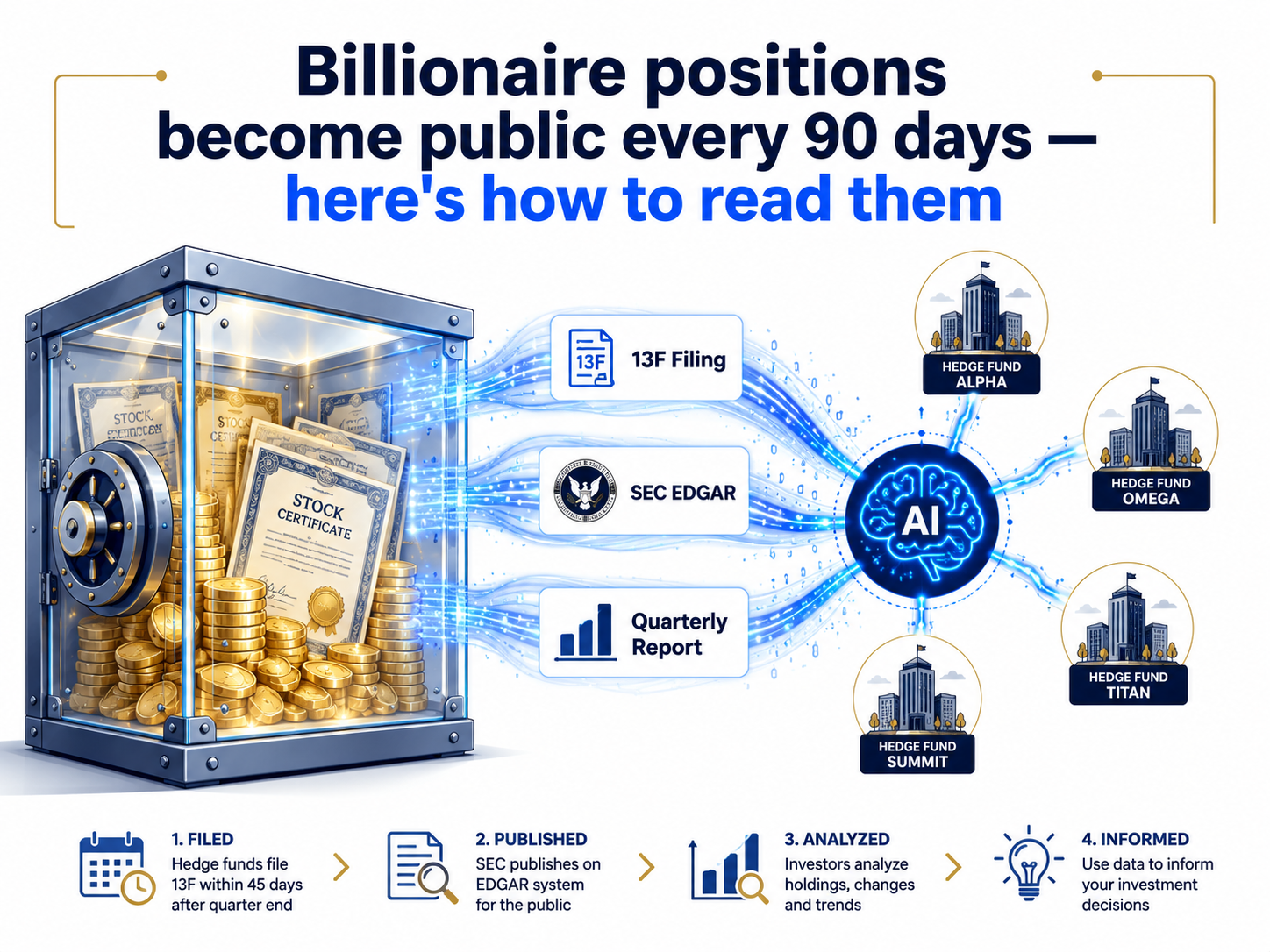
Billionaire AI investing, at its core, is the practice of tracking which AI companies the world’s wealthiest and most sophisticated investors choose to hold — and hold repeatedly — in their portfolios. It’s less about celebrity speculation and more about reading institutional conviction signals that the average investor doesn’t have easy access to.
Here’s how that works mechanically. In the U.S., any institutional investment manager controlling more than $100 million in assets is required to file a 13F report with the SEC every quarter, disclosing their equity holdings. These filings become public within 45 days of each quarter’s end. So while you can’t call Ken Griffin’s research team, you can read exactly what Citadel owned three months ago — and compare that to what they owned six, nine, and twelve months before that.
When a company appears once in a notable portfolio, that’s interesting. When it appears in dozens of portfolios simultaneously, across multiple consecutive quarters, that’s a different signal entirely. That convergence suggests multiple independent research teams — each with access to proprietary data, management relationships, and sector expertise — arrived at the same conclusion: this company has a durable, long-term advantage in the AI economy.
More than $6.5 trillion in institutional assets are reported through 13F filings annually — Source: SEC, 2025. That’s an enormous amount of capital moving according to theses developed by some of the most resourced investment operations in the world.
That said, 13F data isn’t perfect intelligence. It’s always historical. Billionaires may hedge with options or derivatives that don’t show up in standard filings. And a position that’s 0.3% of a $50 billion fund is financially trivial for the manager — but could represent a significant concentration risk for a retail investor copying the trade. More on that in a moment.
Why Do AI Companies in Billionaire Portfolios Attract So Much Attention?
The short answer is that these filings offer a rare window into research that most people simply can’t replicate on their own.
Think about what goes into a major institutional AI investment. Analysts with sector specializations spend months evaluating competitive positioning. Portfolio managers talk directly to executive teams. Research desks build detailed financial models. When that process — repeated across dozens of independent firms — keeps arriving at the same set of companies, the overlap is meaningful.
From what I’ve seen, the companies that appear most consistently aren’t there because they’re popular in the media. They’re there because they pass a rigorous filter that most AI stocks fail: direct monetization of AI, at scale, with a moat that’s genuinely difficult to replicate.
That’s the filter worth understanding. Not every AI company that gets press coverage passes it. In fact, most don’t.
The other reason this matters is timing. Billionaires with multi-year investment horizons often accumulate positions before a thesis becomes obvious to the broader market. Investors who identified AI chip demand early — and held through Nvidia’s volatile periods in 2022 — captured most of the subsequent appreciation. The 13F trail left breadcrumbs that were visible, in retrospect, to anyone reading filings carefully.
The 10 AI Companies That Keep Appearing in Billionaire Portfolios
The companies on this list aren’t randomly distributed across the AI ecosystem. They cluster at the most structurally important layers — the infrastructure that AI depends on, the models that define its capabilities, and the platforms that monetize it at scale.
| Company | AI Layer | Primary Moat | Billionaire Conviction |
|---|---|---|---|
| Nvidia | Compute Infrastructure | GPU near-monopoly + CUDA ecosystem | Very High |
| Microsoft | Cloud + Models | Azure AI + OpenAI partnership | Very High |
| Alphabet | Models + Cloud | DeepMind + TPUs + Search data | High |
| Meta | Models + Applications | Open-source Llama + ad platform | High |
| Amazon | Cloud + Models | AWS + Bedrock + Anthropic stake | High |
| Broadcom | Infrastructure (ASIC) | Custom AI chip design for hyperscalers | High |
| TSMC | Infrastructure (Fab) | Only manufacturer of leading-edge chips | High |
| AMD | Compute Infrastructure | Nvidia challenger for cloud GPU workloads | Medium-High |
| Palantir | Enterprise Applications | Government contracts + AIP platform | Medium-High |
| Oracle | Cloud Infrastructure | GPU-dense datacenter buildout + RPO growth | Medium |
Let’s look at each one — not just what they do, but why elite capital keeps returning to them.
1. Nvidia — The Most Consistent Billionaire AI Bet
Nvidia is the most widely held AI company among billionaire investors, and the reason isn’t complicated once you understand what AI training actually requires. Training large language models demands enormous amounts of parallel computation, and Nvidia’s H100 and H200 GPUs remain the dominant hardware for that workload — by a significant margin.
What makes Nvidia genuinely difficult to displace isn’t just the hardware. It’s CUDA, the software ecosystem that Nvidia built over nearly two decades. Virtually every AI researcher and engineer learned to work with CUDA. Switching to a competing GPU platform means rewriting code, retraining teams, and accepting performance uncertainty. That switching cost is Nvidia’s real moat.
David Tepper, Ken Griffin’s Citadel, and Druckenmiller’s family office have all held Nvidia across multiple consecutive quarters. Nvidia’s data center revenue grew over 400% year-over-year at the peak of AI infrastructure expansion — Source: Nvidia Earnings Reports, 2024–2025.
The legitimate risk here is competition — AMD’s MI300X is gaining traction, and hyperscalers are investing in custom silicon — but Nvidia has maintained its lead longer and more decisively than most skeptics expected.
2. Microsoft — The AI Company Hiding in Plain Sight
Microsoft’s AI positioning is subtler than Nvidia’s, which is partly why it’s so durable. The OpenAI partnership isn’t just a strategic bet on a single model provider — it gives Microsoft exclusive cloud deployment rights for OpenAI’s models through Azure, meaning every enterprise customer running ChatGPT-style applications is, in many cases, running them on Microsoft infrastructure.
Azure AI revenue grew 33% year-over-year in Q1 2025 — Source: Microsoft Q1 2025 Earnings — and AI Copilot integration across Office 365 creates a recurring monetization channel reaching over 400 million commercial users — Source: Microsoft, 2025. That’s not future potential. That’s current revenue at scale.
Multiple sovereign wealth funds and institutional managers have held Microsoft as a core AI position, in part because it doesn’t require a binary bet on any single AI model or application succeeding. It captures value across the AI stack without the concentration risk of pure-play AI companies.
3. Alphabet — The Underappreciated AI Powerhouse
Alphabet gets less AI credit than it probably deserves, partly because the market spent two years worried about ChatGPT disrupting Google Search. In practice, Search has proven more resilient than the bears predicted, and meanwhile Alphabet has built one of the strongest AI research and infrastructure positions in the world through DeepMind.
The TPU advantage is real and often overlooked. Alphabet’s custom Tensor Processing Units give it an internal compute capability that significantly reduces its dependence on external GPU suppliers — a meaningful cost and capacity advantage as AI workloads scale. Ken Griffin’s Citadel and Renaissance Technologies have both maintained significant Alphabet positions across multiple quarters, suggesting institutional confidence that the search disruption narrative overstated the threat.
4. Meta — The Open-Source AI Play
Meta’s AI strategy is genuinely distinctive, and worth understanding on its own terms. By releasing the Llama family of models as open-source, Meta has made itself the default AI foundation for thousands of enterprises and developers who can’t afford to pay OpenAI’s API costs or don’t want a single vendor dependency.
That open-source strategy looks altruistic on the surface. In practice, it’s smart competitive positioning — the more developers build on Llama, the more Meta shapes the ecosystem’s defaults, the harder it becomes for closed-model providers to displace it at the enterprise level.
Meta’s AI-driven ad targeting has already shown direct revenue impact, which matters for investors who care about AI monetization that’s happening now rather than promised for later. Meta serves over 3.4 billion daily active users across its platforms — Source: Meta, 2025 — giving it a distribution advantage that almost no other company can match for AI application deployment.
5. Amazon — The AI Cloud Company Most Investors Undercount
Amazon’s AI story tends to get framed around Alexa or Amazon Go, which misses the point. The real AI play is AWS, which accounts for roughly 67% of Amazon’s total operating income — Source: Amazon 2024 Annual Report — and is becoming the de facto infrastructure for enterprise AI deployment.
The Anthropic investment (up to $4 billion committed, with Claude models running natively on AWS Bedrock) adds a model-layer dimension that makes Amazon’s AI positioning more complete. Enterprises that already run workloads on AWS can now access foundation models from one of the leading AI safety-focused labs without changing infrastructure providers. That’s a meaningful retention and expansion driver.
6. Broadcom — The Quiet AI Infrastructure Giant
Honestly, Broadcom is the company on this list that surprises most people when they first encounter it in institutional filings. It doesn’t carry the AI brand recognition of Nvidia or Microsoft, but it’s quietly become one of the most important infrastructure companies in the AI buildout.
Here’s why: hyperscalers like Google and Meta don’t want to depend entirely on Nvidia for all their compute needs. So they’re building custom AI chips — Google’s TPU, Meta’s MTIA — and Broadcom is the partner that helps design and manufacture those chips. Broadcom’s AI revenue reached $12.2 billion in fiscal 2024, representing 220% year-over-year growth — Source: Broadcom FY2024 Annual Report. Institutional concentration in Broadcom has accelerated noticeably as the custom silicon trend has clarified.
7. TSMC — The Non-Negotiable Foundation
TSMC is the only company in the world that can manufacture the most advanced chips at scale. Nvidia, AMD, Apple, Qualcomm, and virtually every other major chip designer all depend on TSMC’s fabrication facilities. That makes it the irreplaceable foundation of the entire AI hardware ecosystem.
Warren Buffett briefly held TSMC before trimming the position — he cited Taiwan’s geopolitical situation as a concern too large for Berkshire’s risk tolerance. That’s a legitimate concern, and it’s worth taking seriously. But multiple other institutional investors, including Druckenmiller’s family office, have maintained exposure to TSMC on the thesis that its strategic importance makes it effectively irreplaceable regardless of geopolitical risk premium.
If you want to understand Berkshire’s full AI investment thinking — including what Buffett has added and avoided — our breakdown of Berkshire Hathaway’s AI stock portfolio and Warren Buffett’s AI holdings goes deeper on how the world’s most famous value investor is navigating the AI era.
8. AMD — The Nvidia Challenger Worth Watching
AMD deserves its place on this list not because it’s overtaking Nvidia — it isn’t — but because large institutional buyers want diversification across AI compute vendors. Microsoft Azure and Meta have both adopted AMD’s MI300X GPUs for specific workloads, which provides the customer validation that matters for institutional investors.
AMD’s data center segment revenue hit $2.3 billion in Q4 2024, representing 69% year-over-year growth — Source: AMD Q4 2024 Earnings. That’s real momentum. The risk is that Nvidia’s software ecosystem (CUDA) remains the dominant barrier, and AMD’s competitive position depends on convincing engineers to accept slightly more migration friction in exchange for hardware cost advantages.
9. Palantir — The Enterprise AI Application Nobody Wants to Talk About
Palantir sits at a different layer of the AI stack — not building compute or foundation models, but helping large organizations actually deploy AI into operational workflows. Its AI Platform (AIP) is increasingly the infrastructure that U.S. defense and intelligence agencies use to run AI applications in sensitive environments where commercial cloud providers can’t operate.
That government moat is genuinely defensible. The clearances, compliance infrastructure, and operational trust required to work at Palantir’s level in the defense sector represent a barrier that’s measured in years, not quarters. Palantir revenue grew 36% year-over-year in Q1 2025, with U.S. commercial revenue growing 71% — Source: Palantir Q1 2025 Earnings. Several billionaire-linked family offices increased PLTR exposure through 2024 as that commercial AI revenue growth became more visible.
10. Oracle — The Comeback Story Billionaires Noticed First
Oracle is probably the biggest surprise on this list for investors who dismissed it as a legacy database company. The AI boom created an unexpected catalyst: enterprises need GPU-dense data centers to run AI inference workloads, and Oracle Cloud Infrastructure built out that capacity ahead of the demand surge.
Oracle’s remaining performance obligation — contracted future revenue — reached $130 billion in Q3 FY2025 — Source: Oracle Q3 FY2025 Earnings. That’s an extraordinary backlog that reflects genuine, multi-year enterprise commitment to Oracle’s cloud AI infrastructure. Several institutional investors who historically avoided Oracle have quietly added it to portfolios over the past 18 months as this thesis became clearer.
Which Billionaires Are Making the Biggest AI Bets?

The most useful thing to understand about the billionaires tracking AI most aggressively is that they’re not a monolith. They have different philosophies, different risk tolerances, and different time horizons — which means the pattern of their agreement is more significant than any individual name.
Stanley Druckenmiller has called AI potentially the most transformative technology he’s seen in his investing career. His family office, Duquesne Family Office, has held concentrated positions in Nvidia and other AI infrastructure names across consecutive quarters. Druckenmiller’s style is to identify macro-scale structural shifts early and hold through volatility — his AI conviction appears to reflect that pattern rather than tactical trading.
Ken Griffin at Citadel operates with a different approach — enormous breadth across hundreds of positions, with AI holdings distributed across Nvidia, Microsoft, Meta, Alphabet, and others. His AI exposure is less concentrated than Druckenmiller’s but equally persistent across filing periods.
David Tepper made arguably the most aggressive public AI declaration in late 2023, simultaneously adding to positions across Nvidia, Meta, and Amazon and describing it as an “everything AI” allocation. Appaloosa Management’s filings since then have reflected continued conviction rather than a tactical trade.
Cathie Wood at ARK Invest takes the highest-risk approach — concentrated positions in companies she believes can deliver exponential growth, accepting substantial volatility. Her AI framework skews more toward future potential than current monetization, which creates a different risk/reward profile than the other names on this list.
These four investors represent genuinely different frameworks for AI conviction. When the same underlying companies appear across all four — despite those philosophical differences — that convergence is worth paying attention to.
What These Companies Have in Common: The Pattern Behind the Portfolio
In practice, the companies on this list share four characteristics that the hundreds of AI companies not on this list typically lack.
First, direct monetization. Every company here generates meaningful current revenue from AI — not just future optionality. Nvidia sells GPUs. Microsoft sells Azure AI and Copilot subscriptions. Palantir sells AIP contracts. The billionaire-level conviction on this list reflects companies where AI is already showing up in the income statement, not just the product roadmap.
Second, defensible moats. Nvidia has CUDA. TSMC has its fabrication technology lead. Palantir has government clearances and trust relationships. Oracle has contracted RPO. These aren’t advantages that a well-funded competitor can replicate in 18 months.
Third, infrastructure control. AI companies that repeatedly appear across multiple billionaire portfolios tend to control chokepoints — places in the AI stack that everything else depends on. You can’t train a frontier model without Nvidia or TSMC. You can’t scale enterprise AI without cloud infrastructure from Microsoft or Amazon.
Fourth, scale that compounds. Each of these companies benefits from network effects, data advantages, or customer lock-in that makes their position stronger the more AI adoption grows — not weaker, as competition increases.
AI companies that don’t share these four characteristics tend to appear in portfolios occasionally, not repeatedly. That distinction is exactly what “keeps appearing” is measuring.
How to Track Billionaire AI Portfolios Without Paying for Bloomberg
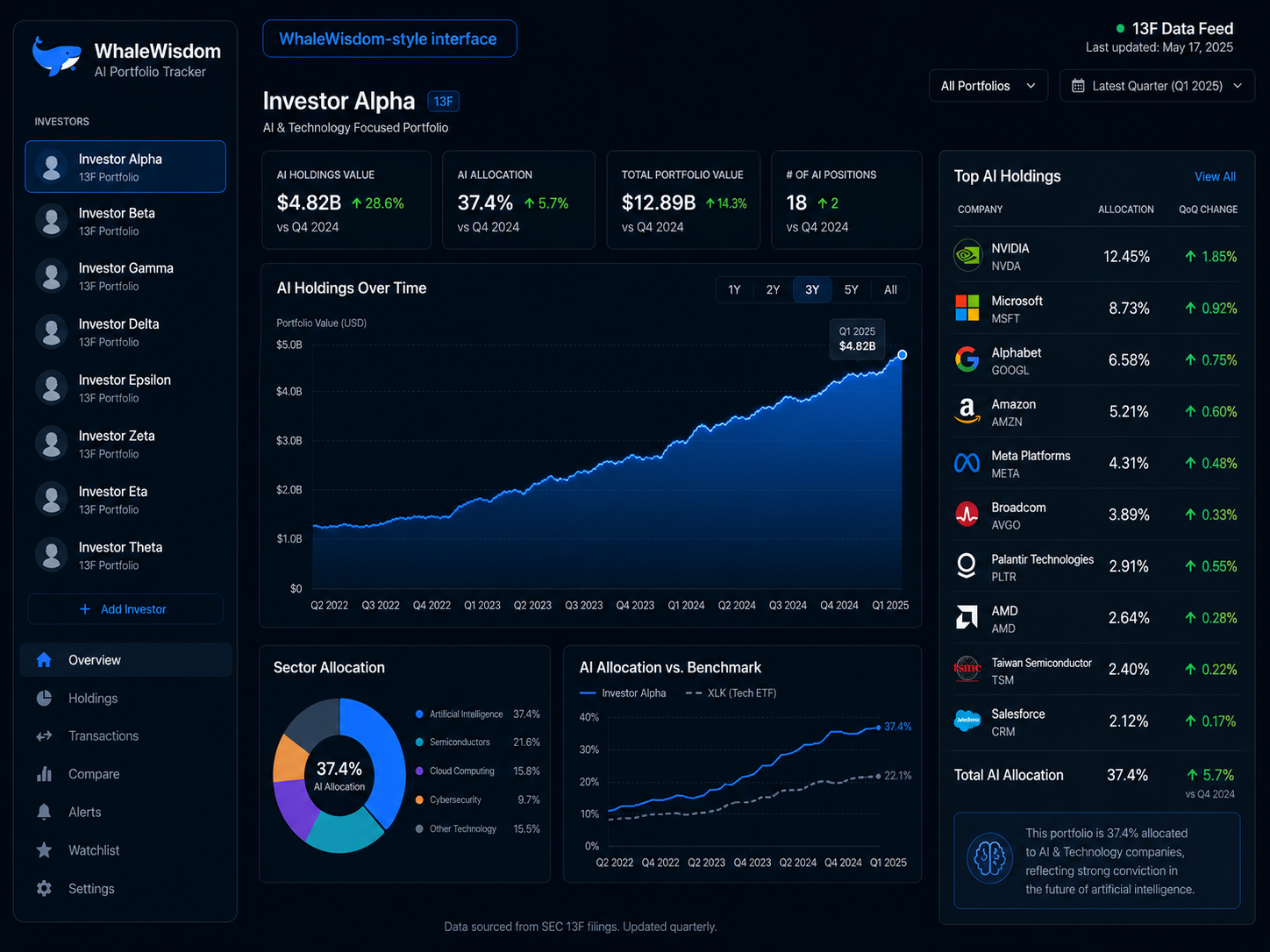
Retail investors can legally and freely monitor billionaire AI portfolio moves using tools that pull directly from SEC filings.
SEC EDGAR is the primary source. Every 13F filing is available free at edgar.sec.gov. Search by the fund manager’s name or CIK number, filter for 13F-HR filings, and you can see every disclosed equity position going back years. It requires some manual work to extract useful patterns, but it’s the authoritative, unfiltered source.
WhaleWisdom and Dataroma aggregate that 13F data and make it more navigable. WhaleWisdom is particularly good for tracking position changes across quarters — you can see not just what a fund holds but whether they’ve been adding, trimming, or holding flat.
Yahoo Finance and earnings transcripts are useful complements. When an institutional holder asks specific questions on an earnings call, it often signals the thesis they’re tracking — more useful context than the raw filing data alone provides.
One thing to be clear about: these tools show you what managers held as of 45 days ago. You’re always working with a lag. The positions visible in a Q1 filing were accumulated during a period when the stock may have been 20% cheaper. Buying based on 13F data after a run-up means you’re not getting the same entry the manager got.
What Are the Real Risks of Following Billionaire AI Picks?
This section matters more than most articles on this topic acknowledge, so let’s be direct about it.
The filing lag is structural, not fixable. A 45-day delay in a fast-moving market means the signal you’re acting on is already stale. Managers can reduce or eliminate a position entirely before their previous quarter’s holding is even disclosed.
Position sizing context is everything. A $300 million position in Nvidia represents about 0.6% of Citadel’s total AUM — a rounding error in terms of portfolio risk. For an individual investor, putting 15% of their portfolio into the same stock based on that signal creates a completely different risk profile. Billionaires diversify differently than retail investors need to.
Private market exposure doesn’t show up. The most sophisticated AI bets — Amazon’s investment in Anthropic, Microsoft’s OpenAI commitment, venture positions in early-stage AI companies — don’t appear in 13F filings at all. What you see is a subset of the total AI conviction, heavily skewed toward public equities.
Valuation matters regardless of who owns it. Buying a stock because billionaires own it, at a valuation that already prices in years of future growth, is a different proposition than buying it at the valuations those billionaires actually paid. The 13F shows the position; it doesn’t tell you the price at which they built it.
The most useful framing: treat this data as a curated research shortlist, not a transaction recommendation. The fact that multiple sophisticated investors have independently concluded a company has durable AI advantages is valuable information. It doesn’t eliminate the need to understand the business yourself.
What’s Coming Next: AI Investment Themes Forming Now
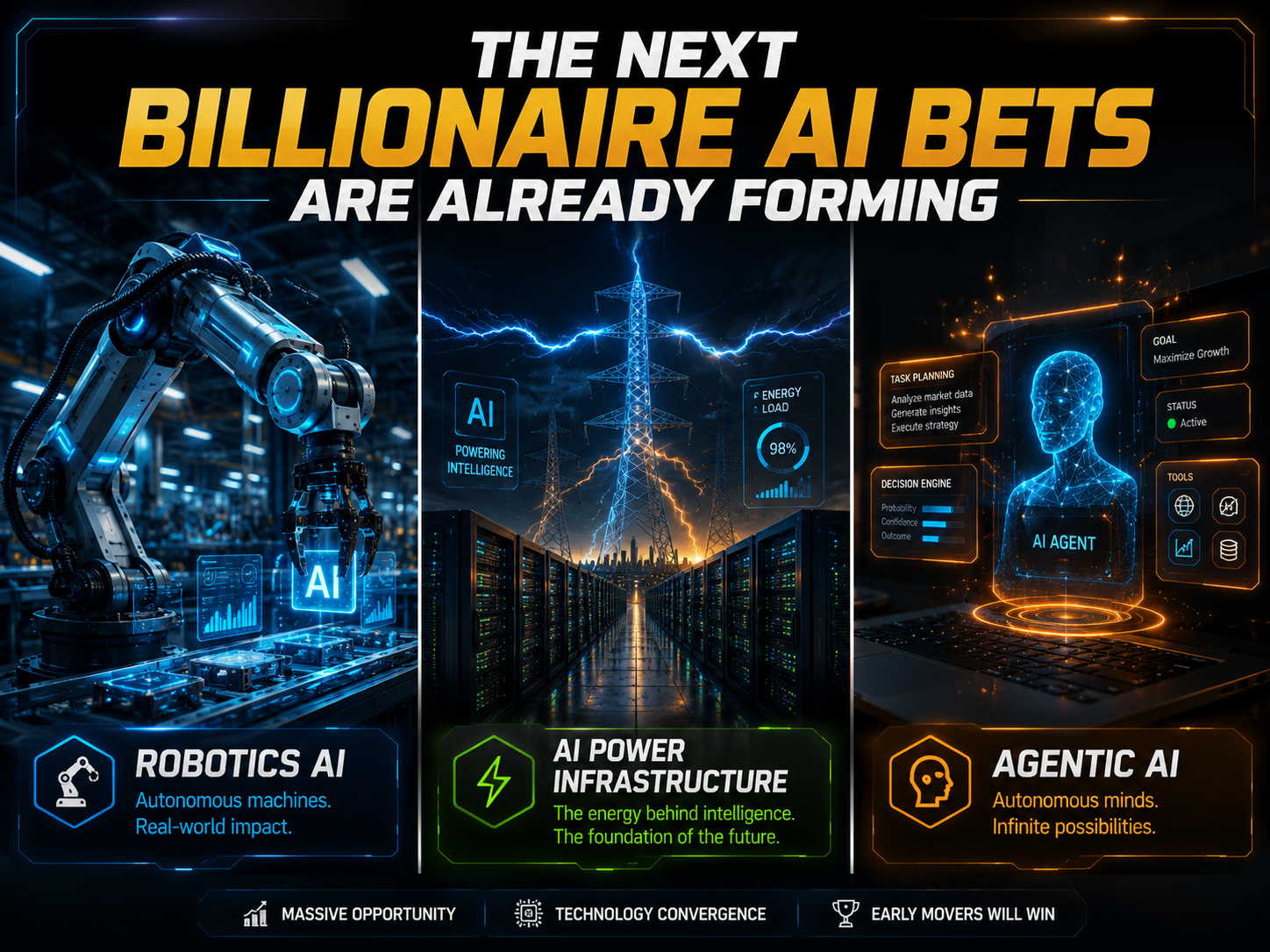
The current billionaire AI portfolio concentration tells you where the conviction has been. Watching what’s newly appearing in filings tells you where conviction is forming.
A few themes worth tracking: CoreWeave (GPU cloud rental infrastructure) went public in early 2025 and immediately attracted institutional interest as an alternative to hyperscaler cloud for AI workloads. Energy infrastructure companies — Vistra, Constellation Energy, and others — are beginning to appear in AI-aware portfolios as investors recognize that power availability is becoming the binding constraint on AI datacenter expansion. AI datacenter power demand may triple by 2030 — Source: International Energy Agency, 2025.
Agentic AI — systems that take sequences of actions rather than just answering questions — represents the next application layer that investors are watching closely. The companies that provide the infrastructure for AI agents to operate safely and reliably at enterprise scale are starting to attract the same kind of early institutional interest that AI infrastructure companies attracted in 2022–2023.
Healthcare AI and robotics are also beginning to appear in forward-looking portfolios. The common thread: billionaires are moving down the AI supply chain, betting on the next bottleneck after compute.
Conclusion: Reading the Signal Correctly
The concentration of billionaire capital in a small cluster of AI companies isn’t coincidence, and it isn’t hype-chasing. It reflects multi-quarter, high-conviction accumulation by some of the world’s most rigorous investors — people who conduct serious due diligence before committing hundreds of millions of dollars to a single position.
The 10 companies covered here keep appearing in billionaire AI portfolios because they control structurally important positions in the AI economy that are genuinely difficult to displace. That’s worth knowing. It’s also worth knowing that “billionaires own it” is a starting point for research, not a conclusion.
Read the 13Fs. Understand why a company appears on this list — not just that it does. And pay attention to what’s forming at the edges of institutional portfolios right now, because the investors who built conviction in Nvidia in 2022 are already three moves ahead on the next chapter of AI infrastructure.
Understanding where billionaire capital is flowing is one part of the picture. Understanding how AI is reshaping the economics of work and business is the other. Our analysis of AI agents vs. freelancers in 2026 tackles that question with the same ground-level specificity.
Frequently Asked Questions
FAQ 1: What AI companies do the world’s richest people invest in?
The most consistently held AI companies in billionaire portfolios include Nvidia, Microsoft, Alphabet, Meta, Amazon, Broadcom, TSMC, AMD, Palantir, and Oracle. These names appear repeatedly across 13F filings from institutional managers including Duquesne Family Office, Citadel, and Appaloosa Management — reflecting multi-quarter conviction rather than tactical positioning.
FAQ 2: Why are billionaires investing heavily in AI?
Billionaires view AI as a structural, multi-decade economic shift rather than a cyclical trend. The companies they repeatedly back share common traits: direct current monetization of AI, defensible competitive moats, strong enterprise or government revenue, and the infrastructure scale required to sustain long-term compounding.
FAQ 3: Which billionaire has the largest exposure to AI stocks?
Based on publicly disclosed 13F filings, Ken Griffin’s Citadel and David Tepper’s Appaloosa Management have shown among the broadest AI equity exposures. Stanley Druckenmiller has been the most publicly vocal about his AI conviction, describing it as potentially the most transformative technology he’s encountered in his investing career.
FAQ 4: Are billionaires investing in AI startups or established companies?
Both — but the split isn’t visible in 13F filings alone. Public equity holdings visible in filings skew heavily toward established companies like Nvidia, Microsoft, and Alphabet. Private market bets on AI startups — Amazon’s stake in Anthropic, Microsoft’s OpenAI investment — exist but don’t appear in standard SEC disclosures.
FAQ 5: How can retail investors learn from billionaire AI portfolios?
Use SEC EDGAR, WhaleWisdom, or Dataroma to review 13F filings quarterly, identify recurring AI positions across multiple independent funds, and use that convergence as a research starting point — while accounting for the 45-day filing lag, position sizing differences, and the fact that private market exposure doesn’t show up in public filings.
FAQ 6: What sectors benefit most from billionaire AI investments?
Semiconductors (Nvidia, AMD, TSMC), cloud infrastructure (Azure, AWS, Google Cloud), enterprise AI software (Palantir), custom chip design (Broadcom), and — increasingly — energy and power infrastructure as AI datacenter electricity demand accelerates.
FAQ 7: What are the biggest risks of investing in AI companies?
The primary risks include valuation multiples that already price in years of future growth, geopolitical exposure in semiconductor supply chains (particularly TSMC’s Taiwan location), potential regulatory intervention across major markets, and the timing risk of acting on 13F data that’s already 45 days old when disclosed. Copying a position without understanding the underlying thesis is arguably the biggest risk of all.
Written by Ethan Parker: Ethan Parker is a technology and business writer covering digital trends, companies, and innovation. His work focuses on making complex topics more accessible through clear, research-driven content that helps readers stay informed about developments in technology, business, and emerging industries.
Reviewed by: Editorial Team & Business Content Review Specialists
Disclaimer: This article is based on publicly available information, company disclosures, market reports, financial news sources, and industry research available at the time of publication. References to companies, investments, stock holdings, or portfolio allocations are provided for informational and educational purposes only. Market conditions, company performance, investment strategies, and institutional holdings can change over time. Readers should independently verify the latest information through official filings, earnings reports, and reputable financial sources before making any investment or financial decisions. Nothing in this article should be interpreted as financial, investment, legal, or tax advice. Past performance does not guarantee future results, and all investments involve risk. This content was initially drafted with AI assistance and has been carefully reviewed, edited, refined, and fact-checked by human editors to ensure accuracy, clarity, originality, and editorial quality.