
By Cameron Brooks | Technology and Business Content Writer
Summarize this blog post with: ChatGPT | Perplexity | Claude | Grok
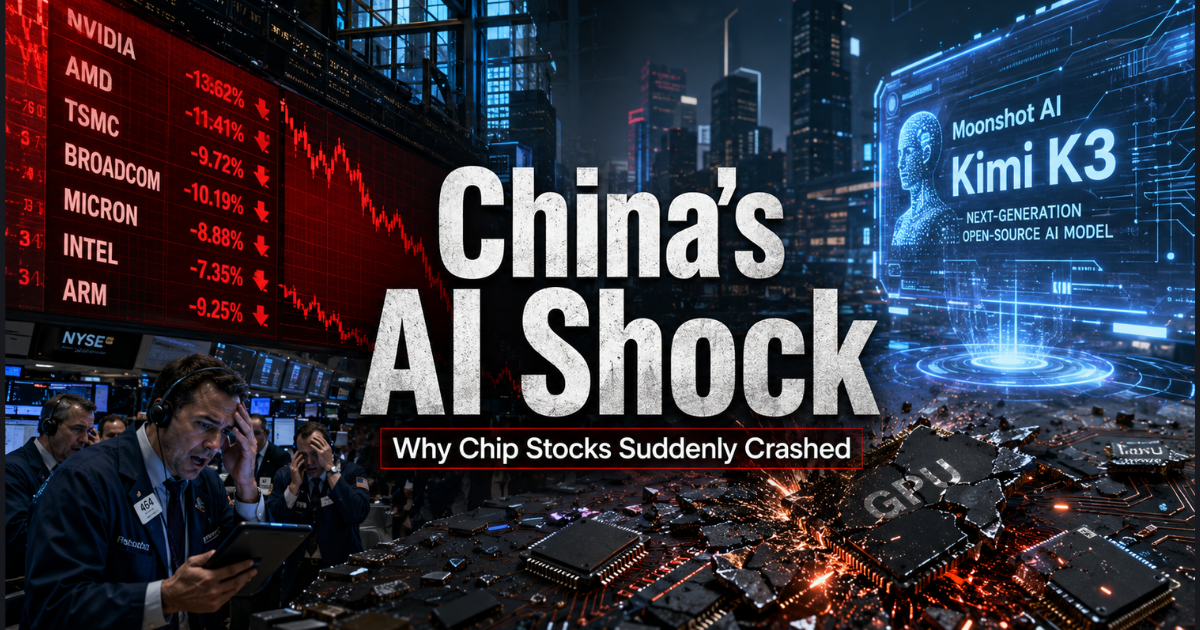
If you’ve had money in chip stocks over the past couple of years, you already know the drill: Nvidia goes up, the market cheers, everyone assumes AI demand is basically limitless. Then this week, a Chinese startup nobody outside the AI industry had heard of a year ago released a model, and suddenly that assumption looked a lot shakier. This is what actually happened with the China’s Moonshot AI chip selloff, why it hurt more than a typical bad trading day, and what I’d actually be watching if I were sitting on chip exposure right now.
Key Takeaways
- Moonshot AI’s Kimi K3 release triggered a sharp semiconductor selloff, pushing the sector into official bear market territory.
- The Philadelphia Semiconductor Index (SOX) posted its worst week since the tariff-driven selloff of April 2025, falling around 11% in five trading days.
- Leveraged and momentum trading positions amplified the drop, turning what might have been an ordinary pullback into something much sharper.
- Some chip names clawed back losses intraday as dip buyers stepped in, which tells you sentiment is shaky, not broken.
- Analysts are genuinely split on whether Kimi K3 is a real threat to chip demand or just more evidence that Chinese AI labs are closing the gap.
- Nothing about this selloff proves AI demand is fading — it’s a valuation and expectations story more than a fundamentals story.
- Big Tech’s next earnings reports, particularly capex guidance, will likely decide whether this turns into a real correction or a buying opportunity.
What Is the Moonshot AI Chip Selloff, Exactly?
The Moonshot AI chip selloff is the sharp drop in semiconductor stocks that followed the release of Kimi K3, a new open-weight AI model from Chinese startup Moonshot AI. Moonshot unveiled the model at the World Artificial Intelligence Conference in Shanghai, and by most accounts it’s a serious piece of engineering — roughly 2.8 trillion parameters, and independent benchmarking from Artificial Analysis reportedly placed it ahead of Anthropic’s Opus 4.8 on certain frontier tests. That’s the first time a Chinese open-weight model has cracked that tier, and it’s not a small deal.
Here’s the thing that actually spooked traders, though — it wasn’t really about how smart the chatbot is. It was about cost. Because Kimi K3 is open-weight, any developer can download it, poke around inside it, and run it on their own hardware. That undercuts the “you need to keep buying more chips to get a better model” story that’s justified a lot of the eye-watering valuations in the sector over the last two years. Traders started calling it a new “DeepSeek moment” almost immediately — a reference back to when a similar release from a different Chinese lab wiped out something like $1 trillion in market value in a single day. Whether that comparison holds up is honestly still up for debate, but the instinct to reach for it tells you how raw that memory still is for chip investors.
Reuters’ report on the global reaction covers how the selloff rippled beyond chip stocks into broader Wall Street sentiment the same day.
Why Does This Actually Matter for the AI Rally?
It matters because semiconductor stocks have become the market’s clearest proxy bet on AI spending continuing at its current, frankly extraordinary pace. When that bet gets questioned, it doesn’t stay contained to chip names. The PHLX Semiconductor index — home to heavyweights like Nvidia, Broadcom, and Micron — dropped into bear-market territory, meaning a decline of 20% or more from its recent peak.
And it didn’t stop at semiconductors. The selloff spread to touch 10 of the 11 sectors in the S&P 500 on the worst day, with only energy finishing green. The Nasdaq slid roughly 1.4%. It even crossed borders — SoftBank, which investors treat as something of an OpenAI proxy given its investment stake, dropped about 9% in Tokyo trading the same session. Chinese AI names like Z.AI and MiniMax got hit even harder. When a story moves markets on three continents in one day, that’s not noise — that’s a genuine repricing of expectations.
It’s worth noting that many of the companies behind this AI infrastructure buildout are the same names that keep showing up in high-net-worth portfolios — if you’re curious which ones, we broke down these 10 AI companies keep appearing in billionaire portfolios.
How Bad Was the Semiconductor Decline, in Real Numbers?
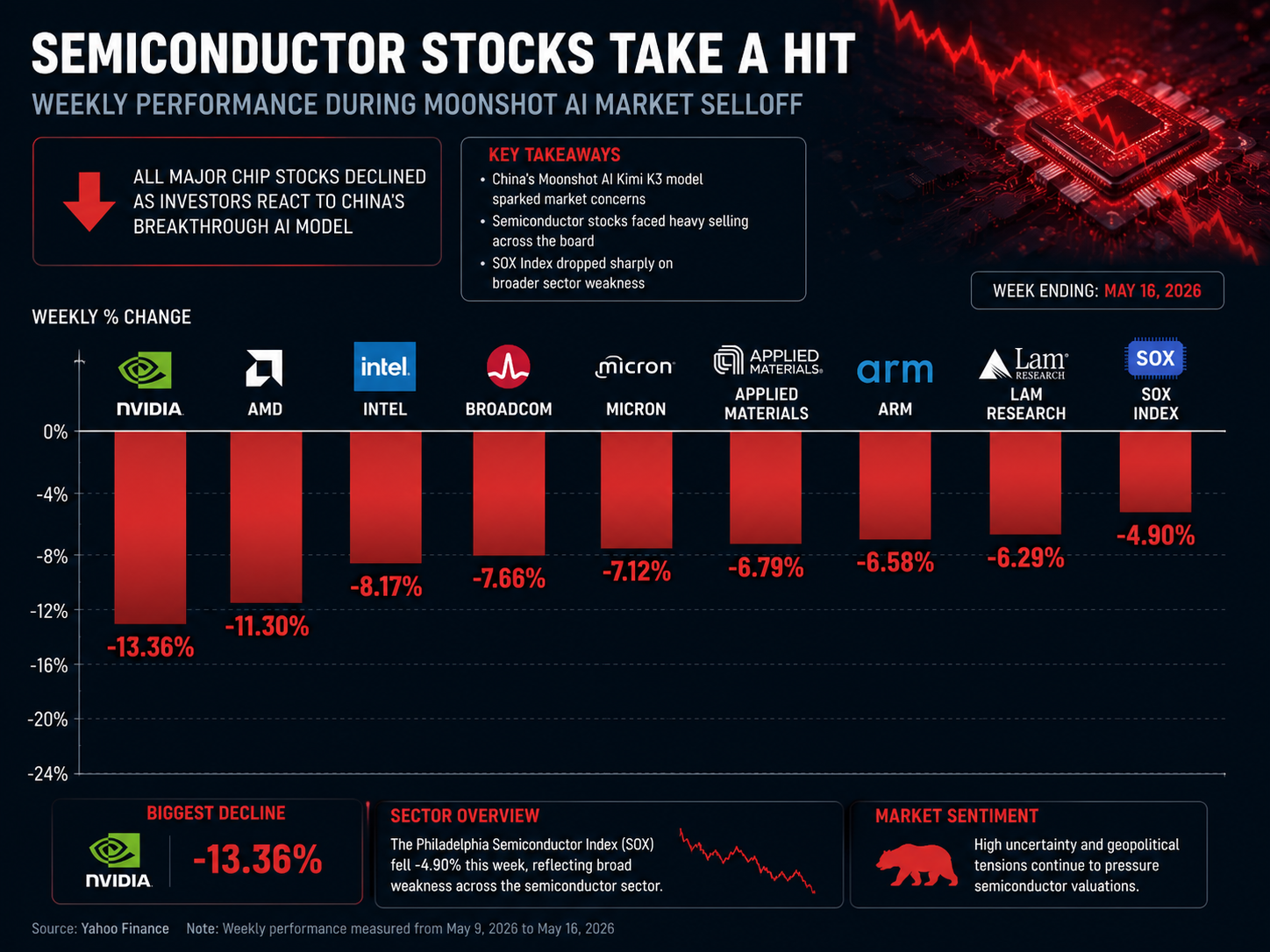
Pretty bad, by recent standards. The SOX index fell as much as 5.7% in a single session and was down around 20% from its late-June record high — enough to meet the technical definition of a bear market — after having surged 105% between its March low and last month’s peak. For the week, it lost about 11%, which market commentators are calling the sector’s worst weekly performance since the tariff-driven meltdown of April 2025. Estimates suggest chip stocks globally shed something in the neighborhood of $3.3 trillion in combined market value since late June.
Semiconductor stock selloffs like this one tend to be sharper than average market corrections because the sector trades on forward-looking growth assumptions rather than current earnings alone — when those assumptions wobble, prices move fast.
Which Stocks Actually Took the Worst of It?
A few names bore the brunt. Marvell Technology, Arm Holdings, and Intel each fell more than 30% from their recent highs. On the day of the Kimi K3 news specifically, Applied Materials, Lam Research, Intel, KLA Corp, and Arm each dropped around 4%, while Micron and Nvidia slid more than 2%. The VanEck Semiconductor ETF (SMH), which a lot of retail investors use as a one-stop proxy for the whole sector, fell over 4% on the day and is down more than 17% for the month.
Did Anything Bounce Back?
Yes, and this part’s worth paying attention to. Several chip names trimmed their intraday losses as the session wore on, which lines up with dip buyers stepping in rather than a full-blown panic. From what I’ve seen in past selloffs like this, that kind of intraday recovery is usually a sign that long-term conviction hasn’t collapsed — it’s more that short-term, leveraged positioning got flushed out. Doesn’t mean the coast is clear, but it’s not the same as a market in freefall.
How Did Leveraged Trades Make This Worse?
This is where a lot of the extra pain came from, honestly. A leveraged trade unwind happens when investors holding borrowed or margin-based positions get forced to sell as prices fall, which speeds up the decline well beyond what normal selling would produce on its own. Picture a fund that used borrowed money to double its exposure to AI infrastructure names — the moment prices cross a certain threshold, it gets a margin call and has to sell into an already falling market, whether it wants to or not. That selling pressure feeds on itself.
Analysts at Bernstein and Morgan Stanley have both pointed out that a good chunk of this year’s chip rally was itself built on heavy momentum and leveraged positioning, which is exactly why the reversal felt so abrupt. In practice, this is the pattern you see in almost every fast, sharp selloff in a hot sector — the initial catalyst does some damage, and then leverage does the rest.
Is Kimi K3 Actually a Threat, or Just Catch-Up?
Wall Street’s split on this, and the disagreement itself tells you something. Morgan Stanley analyst Gary Yu called Kimi K3 the product of steady, compounding progress rather than a shock — his read is that Chinese models are catching up with U.S. leaders on size, performance, and pricing, not suddenly leapfrogging them. Bernstein’s Robin Zhu described the release as “confirmatory” of two trends that have been building all year: that AI capabilities keep advancing quickly, and that Chinese labs are gradually taking share from global leaders.
Rising competition from Chinese AI developers has become a real factor in U.S. semiconductor stock volatility, and that’s not a one-off dynamic tied to this single release — it’s likely to keep showing up every time a lab in Beijing or Hangzhou ships something impressive. If you’re investing in this space long-term, that’s a variable you need to build into your expectations, not something you can treat as a surprise each time it happens.
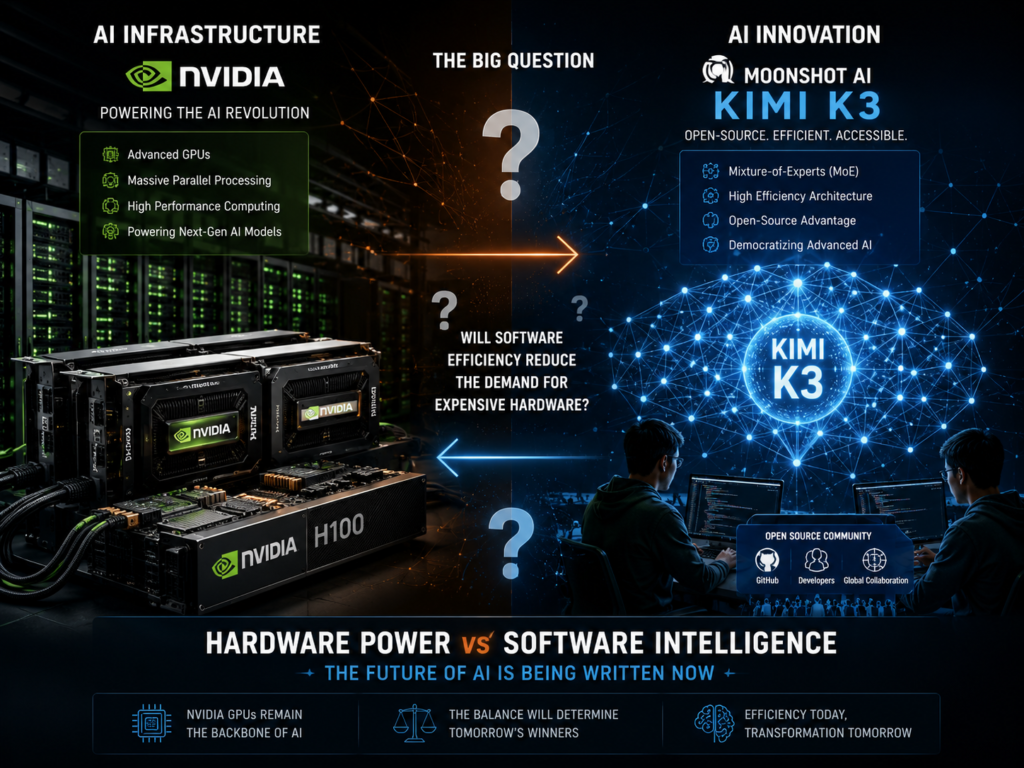
There’s also a more nuanced counterpoint worth raising: open-weight models being cheaper to run doesn’t automatically mean less chip demand overall. Cloud computing made deployment more efficient, and data-center spending kept climbing anyway. If AI gets cheaper to run, more companies adopt it, and that broader adoption can end up needing more compute for inference, even if training gets more efficient. That’s a real trade-off in how you interpret this news — cheaper AI could squeeze near-term chip orders, or it could expand the total market. Nobody knows for certain yet, and I’d be skeptical of anyone who tells you they do.
What Should Investors Actually Watch Next?
The clearest signal is going to come from earnings season. Major hyperscalers and chipmakers report in the coming weeks, and their AI infrastructure spending guidance will do more to settle this debate than any single model release. If Microsoft, Amazon, Alphabet, or Meta reaffirm aggressive AI capex plans, that’s a strong signal the selloff was more about positioning than fundamentals. If they start hedging on spending, that’s a different story entirely.
Beyond earnings, keep an eye on further model releases out of China — Kimi K3 almost certainly won’t be the last one to move this market this year. Broader macro noise matters too: Fed policy signals and the ongoing geopolitical tension in the Middle East (which has already pushed oil prices higher) add another layer of uncertainty that has nothing to do with AI specifically but still shapes how jittery this market stays.
A practical note for anyone actually holding positions here: leverage is what turned this into a sharp move rather than a routine pullback, so if you’re using margin or leveraged ETFs in this sector, this is a good moment to size positions with that volatility in mind rather than assuming the recent calm will hold.
Conclusion
China’s Moonshot AI didn’t single-handedly cause this selloff, but it forced Wall Street to reconsider assumptions that had gone largely unchallenged for two years. The result was a sharp AI stock selloff that pushed semiconductor stocks into bear-market territory, made worse by leveraged positioning that turned a valuation debate into a fast, ugly week. Whether this settles down or turns into something more lasting depends heavily on what hyperscalers say about AI spending in the coming earnings calls — not on any single Chinese model release. For now, the smartest move is watching the data rather than reacting to headlines, and remembering that sharp pullbacks in hot sectors have happened before without ending the underlying trend.
Frequently Asked Questions
FAQ 1: Did China’s Moonshot AI actually cause the chip stock crash, or is that oversimplifying it?
It’s a bit of both, honestly. Kimi K3 was the spark, but the tinder had been piling up for a while — chip valuations were already stretched after a huge run-up, so it didn’t take much to set off heavy selling once the news hit.
FAQ 2: Is Nvidia in real trouble because of this?
Not from what the numbers show so far. Nvidia’s stock took a hit like everything else in the sector, but a cheaper open-weight model out of China doesn’t erase the demand for training and running AI at scale — if anything, cheaper AI tends to get adopted by more companies, which can mean more chips get bought down the road, not fewer.
FAQ 3: What’s the difference between this and the DeepSeek selloff from last year?
The mechanics are pretty similar — a Chinese lab releases something unexpectedly capable, and Wall Street panics about chip demand assumptions. The scale this time looks comparable too, though it’s still too early to say definitively which one did more lasting damage to sentiment.
FAQ 4: Should I be pulling money out of chip stocks right now?
That’s really a personal call based on your risk tolerance and time horizon, and I can’t tell you what to do with your portfolio. What I’d say is that sharp, leverage-driven selloffs like this one have historically been followed by both further declines and full recoveries — there’s no reliable pattern that says which one you’re in until well after the fact.
FAQ 5: Why did some chip stocks bounce back partway through the same trading day?
That’s usually a sign that longer-term investors saw the drop as overdone and started buying, even while shorter-term traders and leveraged positions kept getting flushed out. It’s a mixed signal — not full panic, but not full confidence either.
FAQ 6: Are Chinese AI companies actually catching up to U.S. labs, or is this getting overhyped?
Depends who you ask on Wall Street, and that split is kind of the point. Some analysts see Kimi K3 as proof China’s closing the gap steadily; others see it as one strong release that doesn’t necessarily change the bigger competitive picture. Both views have reasonable evidence behind them right now.
FAQ 7: What would make this selloff turn into something worse?
Weak AI spending guidance from the big cloud players in their upcoming earnings calls would be the clearest red flag. If Microsoft, Amazon, or Meta start pulling back on AI infrastructure spending, that’s a much bigger deal than any single model release.
Written by Cameron Brooks: Cameron Brooks is a technology and business content writer covering digital trends, emerging technologies, and industry developments. His work focuses on explaining technology news and business developments in a clear, accessible way to help readers better understand the evolving digital landscape.
Reviewed by: Editorial Review Team & Technology Research Contributors.
Disclaimer: This article is based on publicly available information, official company announcements, financial news reports, market data, analyst commentary, and industry publications available at the time of publication. Developments related to artificial intelligence, semiconductor companies, financial markets, and technology investments can change rapidly as new information becomes available. This article is intended for informational purposes only and should not be considered financial or investment advice. Readers are encouraged to verify the latest updates through official company statements and trusted financial sources and to conduct their own research before making any investment decisions. This content was initially drafted with AI assistance and has been carefully reviewed, edited, refined, and fact-checked by human editors to ensure accuracy, clarity, originality, and editorial quality.