

By Owen Carter | Technology and Business Content Writer
Summarize this blog post with: ChatGPT | Perplexity | Claude | Grok
Meta and Anthropic drop bombshell news on AI market: two companies that are supposed to be rivals in the AI race are apparently talking about becoming landlord and tenant instead. If that sounds a little odd, it should — Meta builds Llama, Anthropic builds Claude, and yet here they are reportedly hashing out a deal where Meta rents out its own data center capacity to help power Anthropic’s growth.
I’ve been following the AI infrastructure story closely for a while now, and honestly, this one caught my attention more than most. Not because $10 billion is an unusual number in this industry anymore — it barely raises an eyebrow these days — but because of what it implies about Meta’s own AI bet. When a company that has spent years building infrastructure specifically for its own use suddenly needs an outside buyer for the extra capacity, that tells you something about how this market is actually shaping up behind the scenes.
Key Takeaways
- Anthropic has reportedly proposed leasing up to $10 billion in computing power from Meta over a two-year period, according to The New York Times.
- Meta could spend as much as $145 billion on capital expenditures in 2026 — more than double the prior year — and the deal would let it monetize capacity beyond its own AI needs.
- The talks are early and non-binding; either company can walk away before terms are finalized.
- Anthropic already has a compute agreement with Google reportedly worth around $40 billion, plus a separate arrangement with SpaceX for Colossus data center access.
- Meta cut about 8,000 jobs in May 2026 while redirecting spending toward AI infrastructure — a move this deal could help justify to investors.
- If finalized, the arrangement would position Meta as a cloud infrastructure competitor to CoreWeave and Nebius, marking its entry into a new business line.
- Compute scarcity remains a real bottleneck industry-wide, reflected in the usage limits Anthropic already places on its most advanced Claude models.
What Is the Meta-Anthropic Compute Deal, Exactly?
Meta’s ‘AI overbuild’ finds a buyer as Anthropic eyes a $10 billion computing power deal that would let Anthropic lease Meta’s data center capacity over roughly a two-year period. The New York Times first reported the talks on July 17, 2026, and according to that reporting, the conversations began quietly in June after Anthropic approached Meta with the idea.
Here’s the thing to understand about how this would actually work: it’s not that different from renting office space, except instead of square footage, Anthropic would be paying for guaranteed access to racks of Nvidia GPUs, networking gear, and the cooling systems needed to keep it all running. Anthropic would reportedly make monthly payments in exchange for locked-in capacity — a structure that’s pretty standard in cloud leasing, just applied here to two companies that normally compete for the same customers and the same talent pool.
Neither side has confirmed anything publicly, and that matters. These are described as early, non-binding discussions, which means either party could walk away tomorrow if the terms don’t line up. I’d treat this as a live negotiation rather than a done deal until one of the companies actually says otherwise.
Why Does This Deal Matter for the Broader AI Industry?
The interesting part isn’t really the dollar figure — it’s what the arrangement says about how the AI infrastructure market is evolving. Compute has quietly become the bottleneck that determines who can actually ship frontier models, more so than raw talent or clever algorithms at this point.
Meta could spend as much as $145 billion on capital expenditures in 2026, more than double the roughly $72 billion it spent the year before — Source: Reuters, 2026. That’s a staggering jump in spending, and it raises an obvious question: if Meta’s own AI roadmap can absorb all of that new capacity, why would it need to lease any of it out?
In practice, hyperscalers like Microsoft, Google, and Amazon have rented out cloud capacity for years — that’s literally their business model. Meta has historically kept its infrastructure in-house, built for its own products: Llama, Meta AI, ad-ranking systems, and so on. A deal like this would mark a real departure from that pattern, and it’s the kind of shift that tends to ripple through the rest of the industry once one major player makes the move.
Why Is Meta’s Infrastructure Being Called an “Overbuild”?
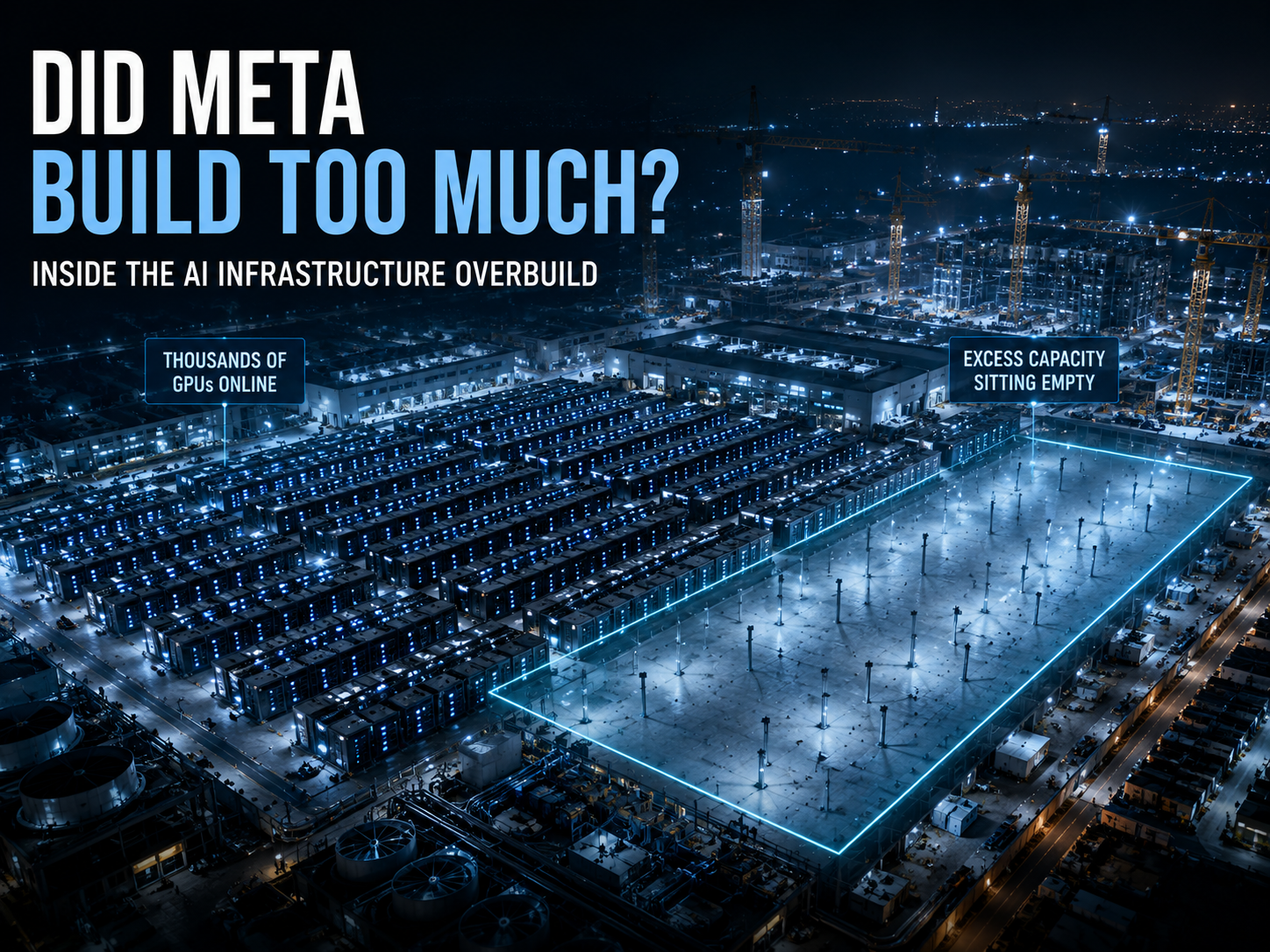
“Overbuild” is a pointed word, and it’s worth unpacking rather than just repeating. It refers to a company constructing more data center capacity than its own products currently need — essentially betting ahead of demand rather than reacting to it.
This didn’t happen by accident. Meta made an aggressive, multi-year bet that AI demand would keep climbing, and it built accordingly. In May 2026, the company cut about 8,000 jobs while simultaneously redirecting billions of dollars toward AI infrastructure — Source: company reports, 2026. Selling excess compute to a company like Anthropic would go a long way toward justifying that reallocation to investors who are scrutinizing every dollar of AI capex right now, and understandably so given the scale involved.
This also isn’t coming out of nowhere from a leadership standpoint. Mark Zuckerberg indicated back in May 2026 that Meta was weighing an entry into the cloud business, and he’d previously noted — as far back as last October — that other companies had approached Meta asking whether they could buy spare compute at a premium. Meta has also reportedly brought on Dave Brown, a former senior AWS executive, which suggests the company is building real operational muscle for this, not just offloading leftover server capacity as an afterthought.
CNBC confirmed that Dave Brown, a longtime former senior executive at Amazon Web Services, is set to join Meta — a hire that lines up with Zuckerberg’s comments back in May that entering cloud computing was “definitely on the table.
What Do We Actually Know About the Deal Terms?
The reported structure has Anthropic paying Meta in monthly installments for guaranteed compute access over a two-year window. The exact dollar figure, duration, and payment mechanics are still being ironed out, and no closing deadline has been set as of publication.
It helps to see this in context against Anthropic’s other known infrastructure commitments:
| Partner | Reported Value | Structure | Status (as of July 2026) |
|---|---|---|---|
| Meta | Up to $10 billion | Two-year lease, monthly payments | Early, non-binding talks |
| ~$40 billion | Ongoing cloud/compute agreement | Active | |
| SpaceX (Colossus) | $1.25 billion/month | Data center GPU access | Active |
Even if the Meta arrangement falls apart, Anthropic isn’t exactly hurting for compute elsewhere — it already has a substantial cloud agreement with Google and a separate arrangement with SpaceX for access to the Colossus data center. That diversification is worth noting: Anthropic doesn’t appear to be putting all its eggs in one basket, which is a reasonably prudent approach given how volatile these negotiations can be.
Why Does Anthropic Need This Much Compute in the First Place?
Anthropic’s growth has apparently outpaced its current infrastructure footprint, and that’s not just a talking point — it shows up in product limitations that customers actually experience. The company already places usage limits on its most advanced Claude models, which is a pretty direct signal that chip access, not model quality, is the constraint right now.
Anthropic’s annual recurring revenue has reportedly climbed to around $47 billion — Source: industry reports, 2026 — and that kind of growth curve requires infrastructure that can keep pace, or you start rationing access to your own product, which nobody wants to do to paying enterprise customers. More compute means fewer usage restrictions for existing customers, and it also means more room to train the next generation of models without waiting years for new facilities to come online.
There’s also a timing angle worth mentioning: Anthropic is reportedly preparing for a possible IPO as early as October 2026. Locking in predictable, large-scale compute access ahead of a public listing is the kind of move that strengthens a growth story for prospective investors — nobody wants to go public with “we might run out of chips” as an open question hanging over the roadshow.
Could This Turn Meta Into a Cloud Computing Competitor?
If this deal closes, it would effectively mark Meta’s entry into the compute-leasing business — a space currently dominated by specialists like CoreWeave and Nebius, both of which built their entire business models around renting AI infrastructure to labs like OpenAI and Anthropic.
That’s not a trivial thing to compete with. CoreWeave and Nebius have a multi-year head start in actually operating cloud services at scale, which is a different discipline than running infrastructure purely for internal use. But Meta’s capital base is enormous, and the Dave Brown hire suggests the company knows it needs real cloud-operations expertise, not just spare server racks and a sales pitch.
From what I’ve seen watching similar transitions play out — Amazon’s internal infrastructure eventually becoming AWS is the textbook example — companies that build infrastructure for themselves first sometimes end up stumbling into a second, highly profitable business almost by accident. Whether Meta follows that same trajectory is genuinely an open question, and I wouldn’t bet the house on it happening quickly even if this deal goes through.
Does This Signal an AI Infrastructure Bubble?

This is where I’d urge some caution about drawing hard conclusions. Some analysts look at Meta needing an outside buyer for its own infrastructure and see a warning sign — evidence that AI compute demand hasn’t caught up to the scale of spending across the industry. That’s a reasonable interpretation, and it’s worth taking seriously rather than dismissing outright.
Critics point out that the pool of buyers circling this kind of excess capacity is narrow — really just Anthropic and OpenAI at the frontier-lab scale — which is a pretty thin market for infrastructure built at this magnitude. On the other hand, supporters of the deal would argue this is just smart capital allocation: build ahead of demand, then monetize whatever isn’t immediately needed rather than letting it sit idle. Both views have merit, and I don’t think there’s enough public information yet to say definitively which one is right.
What does seem clear is that real scarcity exists somewhere in this system — Anthropic’s own usage limits on its most advanced models aren’t just a business decision, they reflect actual capacity constraints. Whether that scarcity is broad-based across the industry or concentrated among a handful of major labs is a fair question, and probably the more interesting one to watch over the next year.
This isn’t the first time a single company’s AI move has sent shockwaves through the market — China’s Moonshot AI recently rattled Wall Street’s chip trade so badly that semiconductor stocks took a sharp hit, a reminder that investor sentiment around AI infrastructure can shift fast on a single headline.
Is the Deal Actually Finalized?
No — as of publication, the Meta-Anthropic compute deal remains in early, non-binding talks. Both companies retain the option to walk away before any terms are locked in, and no firm deadline has been set for reaching an agreement. Some reporting suggests an announcement could come within weeks if both sides land on acceptable terms, but that’s speculative until either company confirms it directly.
What Should Businesses, Developers, and Investors Watch For Next?
If you’re trying to figure out whether this matters for your own AI strategy, here’s where I’d focus attention:
- Official confirmation from either company. Until Meta or Anthropic issues a statement, treat every detail as reported-but-unconfirmed.
- Anthropic’s IPO timeline. Securing predictable compute could be a precursor to going public, so watch whether that October 2026 window firms up or slips.
- Whether other hyperscalers follow Meta’s lead. If Meta successfully launches a compute-leasing business, don’t be surprised if Google, Microsoft, or others quietly expand similar offers to AI labs beyond their existing customer base.
- Usage limits on Claude’s frontier models. If those loosen up over the coming months, that’s a reasonable signal that new compute has actually come online, deal or no deal.
For businesses evaluating AI vendors, compute reliability is now just as important a factor as model quality — an impressive model that gets throttled during peak demand isn’t much use in a production workflow. For developers, more available infrastructure generally translates into fewer rate limits, larger context windows, and faster iteration cycles, though that takes time to filter down even after a deal is signed. And for investors, it’s worth remembering that infrastructure providers — data centers, networking firms, chipmakers — are becoming just as central to the AI story as the model builders themselves.
Conclusion
Meta’s ‘AI overbuild’ finds a buyer as Anthropic eyes a $10 billion computing power deal, and whether or not the two companies actually finalize it, the story itself tells you something important: compute has become the real currency of competitive advantage in AI, and even the biggest players are still figuring out how to balance building for themselves versus renting to their competitors. Two rivals negotiating a landlord-tenant relationship over server racks is a strange sight, but it’s probably a preview of more deals like this to come. I’d keep an eye on this one — how it resolves could say a lot about where the next phase of the AI infrastructure race is headed.
Frequently Asked Questions
FAQ 1: Did Meta and Anthropic officially confirm the $10 billion deal?
No. The talks were first reported by The New York Times, and as of publication neither company has confirmed a finalized agreement.
FAQ 2: What would Anthropic actually get from this deal?
Guaranteed access to Meta’s data center capacity — GPUs, networking, and cooling infrastructure — through monthly lease payments over roughly two years.
FAQ 3: Why does Meta have excess AI infrastructure to lease out?
Meta built ahead of its own internal demand, spending as much as $145 billion in capital expenditures in 2026, and appears to have more capacity than its current AI products require.
FAQ 4: Could this make Meta a cloud computing competitor?
Potentially. A completed deal would mark Meta’s entry into compute leasing, putting it in competition with specialists like CoreWeave and Nebius.
FAQ 5: Does this deal mean there’s an AI infrastructure bubble?
That’s genuinely debated. Some see it as evidence that spending has outpaced demand; others see it as smart monetization of planned-ahead capacity. Both are reasonable positions given what’s publicly known.
Written by Owen Carter: Owen Carter is a technology and business content writer covering digital trends, emerging technologies, and industry news. His work focuses on presenting technology developments and business updates in a clear, accessible way to help readers stay informed about the rapidly evolving digital landscape.
Reviewed by: Editorial Review Team & Technology Content Specialists.
Disclaimer: This article is based on publicly available information, official company announcements, news reports, industry publications, and other reliable sources available at the time of publication. Developments related to artificial intelligence, technology companies, product launches, partnerships, and market trends can evolve rapidly as new information becomes available. Readers are encouraged to verify the latest updates through official company communications and trusted news sources before making business, technology, or investment decisions. This content was initially drafted with AI assistance and has been carefully reviewed, edited, refined, and fact-checked by human editors to ensure accuracy, clarity, originality, and editorial quality.