
By Nathan Walker | Technology and Business Content Writer
Summarize this blog post with: ChatGPT | Perplexity | Claude | Grok
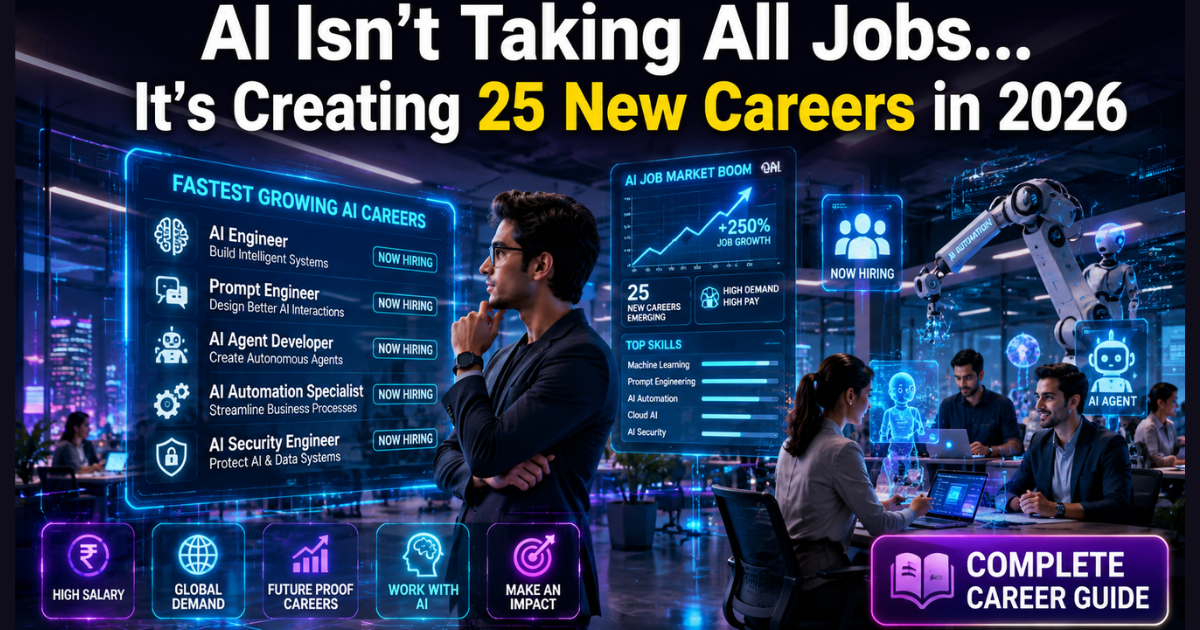
Everyone’s talking about AI wiping out jobs. Fewer people are talking about what it’s actually building. If you’ve spent the last year reading headlines about layoffs and automation, you’ve probably wondered whether there’s a version of this story where you come out ahead. There is — and it’s playing out right now, in job postings most people never bother to read past the title.
I’ve spent a lot of time digging through hiring data, talking to recruiters, and watching which roles actually get filled versus which ones just get posted and quietly disappear. What I’ve found is that AI hiring in 2026 isn’t one trend — it’s several, moving at different speeds, in different industries, for different reasons. This guide walks through the 25 fastest-growing AI jobs right now, what they actually pay, and — more usefully — how you’d realistically go about landing one.
Key Takeaways
- AI hiring trends in 2026 describe a real, measurable shift in job creation, not just speculation — driven by enterprise adoption, new regulation, and companies restructuring roles around AI tools.
- Jobs requiring AI skills are growing roughly eight times faster than the overall job market, with wage premiums now averaging around 62% — Source: PwC Global AI Jobs Barometer, 2026.
- The fastest-growing roles span far more than engineering: governance, data annotation, AI-augmented marketing, healthcare, and even change-management coaching all show up on this list.
- Entry-level hiring is splitting into two tracks — routine junior roles are shrinking, while AI-exposed junior roles increasingly demand judgment and leadership skills usually reserved for senior staff.
- You don’t need a computer science degree for most of these jobs. Portfolios, certifications, and demonstrated project work now carry real weight with employers.
- AI literacy is becoming table stakes across professions that have nothing to do with engineering — marketing, HR, finance, and operations included.
- The smartest move for most people isn’t chasing every AI job trend at once — it’s picking one lane, building real experience in it, and staying there long enough to get good.
What Are AI Hiring Trends, Exactly?
AI hiring trends refer to the measurable shift in job creation, job displacement, and required skills that’s happening as companies fold artificial intelligence into how they actually operate. That’s a mouthful, so here’s the plain version: employers are posting more roles that explicitly require AI skills, reshaping existing job descriptions around AI tools, and in some cases building entire departments — governance, MLOps, AI risk — that didn’t exist three years ago.
A useful distinction that gets lost in most of these lists: AI jobs and AI-enabled jobs are not the same thing. An AI Engineer builds the models. An AI-enabled marketing manager uses tools like ChatGPT or an AI analytics platform to do their existing job better. Both are legitimate parts of the “AI hiring” story, and honestly, the AI-enabled category is where most readers of this article will actually land — not everyone needs to become a machine learning engineer to benefit from this shift.
For example, I’ve seen a mid-size insurance company go from having one generalist “data analyst” title to posting openings for an AI risk analyst, a prompt engineer, and an MLOps specialist within a single hiring cycle. None of those existed on their org chart two years earlier. That’s not a hypothetical — that’s the kind of restructuring happening across insurance, retail, and professional services right now, not just at Big Tech.
Why Does This Actually Matter Right Now?
Because the wage gap between AI-skilled and non-AI-skilled workers is widening faster than most compensation planning accounts for. Jobs requiring specific AI skills are growing roughly eight times faster than the overall jobs market, with the average wage premium for AI skills climbing to about 62% — Source: PwC 2026 Global AI Jobs Barometer. That’s not a rounding error. That’s a structural repricing of labor happening in real time.
There’s also a split researchers are calling the “two-track” labor market, and it’s more useful than the usual “AI is good/bad for jobs” framing. On one track, you’ve got professionalized roles — AI takes over the routine parts, but the humans left doing the work need more judgment, not less. On the other, you’ve got democratized roles — AI makes tasks easier for people who aren’t experts. Professionalized jobs are growing about twice as fast as democratized ones, with roughly 42% faster wage growth — Source: PwC Global AI Jobs Barometer, 2026.
Understanding which side of that split you’re on matters more than ever, and we’ve put together a practical breakdown of how to protect your career if your role looks more exposed than secure in AI Layoffs 2026: The Alarming Truth Behind Companies Cutting Jobs — And How to Protect Your Career.
In practice, this means the safest career bets right now are roles where AI amplifies your judgment rather than replacing the need for it. If you’re an employer, it means treating AI hiring as a workforce architecture decision — not just another line item for recruiting to fill.
Which Jobs Are Actually Growing Fastest Because of AI?
The 25 fastest-growing AI jobs don’t cluster around a single “AI job.” They spread across six distinct categories, and honestly, that’s the part most listicles get wrong — they treat this like it’s all engineering. It isn’t.
| Job Cluster | Example Titles | Primary Skill Focus |
|---|---|---|
| Builders | AI Engineer, MLOps Engineer, AI Agent Developer | Technical / Coding |
| Governance & Trust | AI Auditor, Ethics Officer, Compliance Manager | Regulatory / Compliance |
| Data Foundations | Data Annotator, Pipeline Engineer | Data Quality |
| AI-Augmented Creatives | Prompt Engineer, Content Strategist, SEO Specialist | Creative + AI Literacy |
| Domain Specialists | Clinical AI Specialist, Instructional Designer | Industry Expertise |
| Human-Skills Premium | Change Management Lead, Human-AI Collaboration Coach | Leadership / Coaching |
Builders: The Technical Backbone
- AI Engineer — designs and deploys AI systems that solve concrete business problems, like fraud detection or recommendation engines.
- Machine Learning Engineer — builds the algorithms that let software learn from data instead of following fixed rules.
- MLOps Engineer — essentially the DevOps engineer of AI, keeping models running reliably once they’re in production.
- AI Agent Developer — builds autonomous systems that complete multi-step tasks (scheduling, research, report generation) without constant human input. If you’re not entirely sure what separates an AI agent from a regular chatbot, it’s worth pausing here — we’ve broken down exactly how these systems work and why they’re already changing daily workflows in What Is Agentic AI? The Quiet Revolution Already Reshaping Work and Daily Life.
- Forward-Deployed Engineer — embeds with clients to customize and deploy AI systems on-site.
- Applied Research Scientist — develops new techniques and architectures, usually at labs or large tech companies.
AI Engineer was ranked the number one fastest-growing job title in the United States by LinkedIn’s 2026 Jobs on the Rise report, with postings up 143% year-over-year in 2025 — Source: LinkedIn, 2026. A fintech startup I came across recently hired an AI Engineer purely to build fraud-detection models, then brought on an MLOps Engineer six months later just to keep those models stable in production. That sequencing — build first, then stabilize — is a pattern worth knowing if you’re trying to time a career move.
Governance & Trust: Where Regulation Meets Hiring
- AI Governance Specialist
- AI Ethics Officer
- AI Risk & Compliance Analyst
- AI Auditor
- Responsible AI Program Manager
This cluster exists because regulation is finally catching up to deployment. The EU AI Act’s compliance obligations are phasing in through 2026, and that’s pushing regulated industries — banking, healthcare, insurance — to staff up fast, regardless of whether their engineering teams have grown at all. A bank rolling out an AI credit-scoring tool now needs someone who can document, in plain terms a regulator will accept, exactly how that model reaches its decisions. That’s an AI Auditor’s job, and it barely existed as a title two years ago.
Data Foundations: The Unglamorous Work That Keeps Everything Running
- Data Annotator
- Data Labeling Team Lead
- AI Training Data Specialist
- Data Pipeline Engineer
Nobody puts “Data Annotator” on a vision board, but this is genuinely one of the fastest-growing categories by sheer headcount. Labeled data pipelines underpin model quality at scale, and that work doesn’t disappear just because the model gets more sophisticated — if anything, better models need more carefully labeled data, not less. From what I’ve seen, this is also one of the more accessible entry points into the AI industry if you don’t have a technical background yet.
AI-Augmented Creatives and Marketers
- AI Content Strategist
- Prompt Engineer / Prompt Designer
- AI-Augmented Marketing Analyst
- AI SEO Specialist — optimizing not just for Google, but for how AI tools like ChatGPT, Perplexity, and Google AI Overviews surface and cite content
- AI Video Producer
Here’s the thing about this cluster: it’s not replacing creative professionals so much as changing what “creative work” means day-to-day. A content team I’m familiar with now runs an AI Content Strategist role whose job is overseeing editorial quality across dozens of AI-assisted drafts a week, rather than personally writing every piece. That’s a different skill set — more editorial judgment, less pure production — and it rewards people who already understand good writing, not people who just know how to prompt.
Domain Specialists: Healthcare, Education, and Beyond
- Clinical AI Implementation Specialist
- AI-Enhanced Instructional Designer
- AI Sustainability Analyst
The World Economic Forum projects meaningful AI-driven job growth in healthcare, education, and the green economy — not just in tech — alongside the more obvious engineering gains (Source: World Economic Forum Future of Jobs Report, 2025). Hospitals, in particular, are hiring Clinical AI Implementation Specialists to manage diagnostic tools without displacing clinical staff — the role is about integration and oversight, not automation for its own sake.
Human-Skills Premium Roles
- AI Change Management Lead
- Human-AI Collaboration Coach
These two exist because companies keep discovering the same expensive lesson: rolling out AI tools without rethinking workflows and decision rights just leaves value on the table. Professionalized jobs increasingly demand judgment, empathy, and leadership rather than pure technical output — and someone has to help teams actually adopt these tools well, not just have access to them. If you’re a strong communicator with no coding background, this cluster is worth a serious look.
How Are These Jobs Actually Being Created?
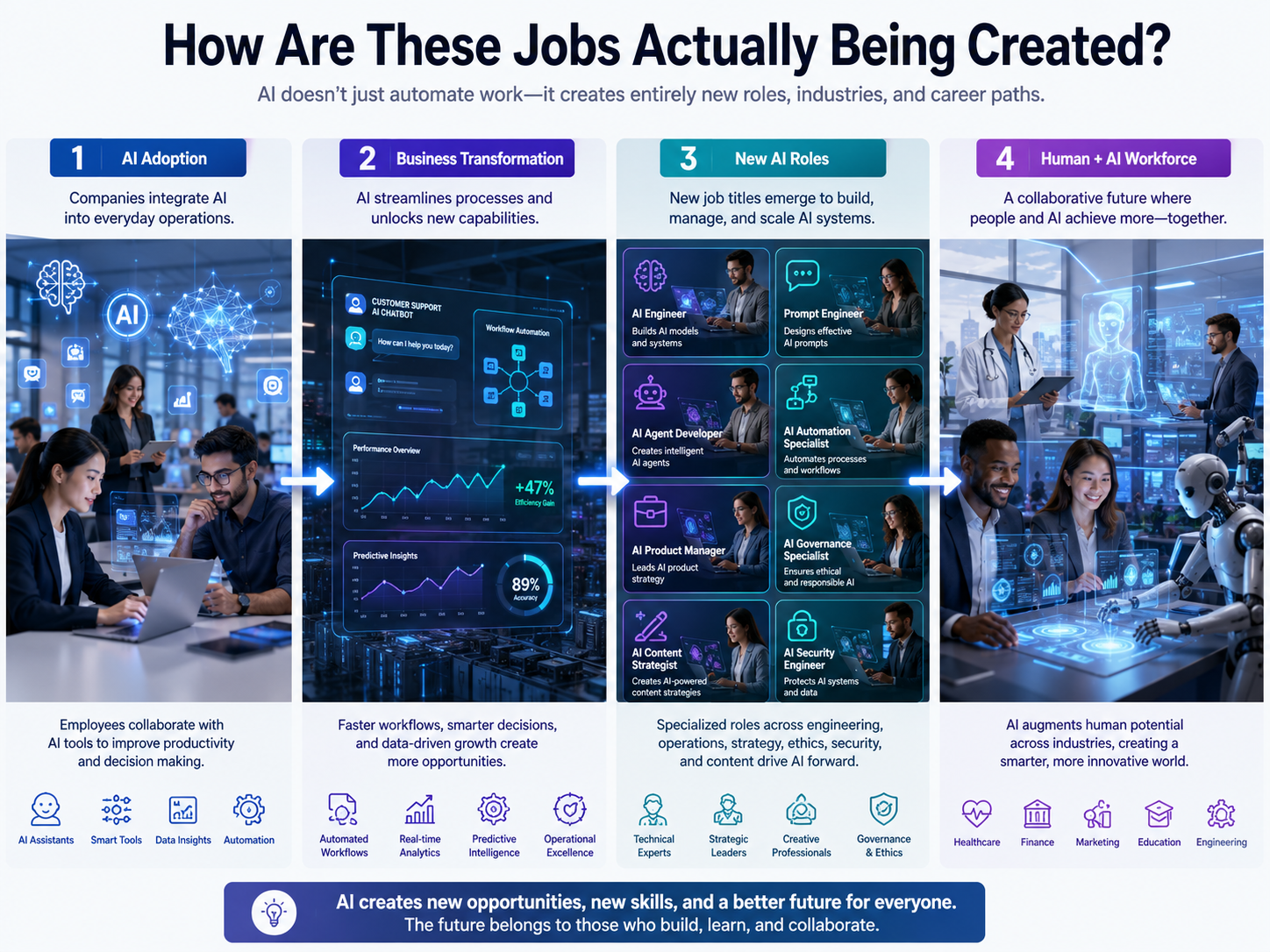
It’s worth understanding the mechanics, because it changes how you’d go about targeting a role. New AI jobs tend to emerge through four overlapping forces. First, automating routine tasks frees up budget that companies reinvest into higher-value roles — money that used to pay for manual data entry now funds an AI Automation Specialist instead. Second, regulation like the EU AI Act forces hiring that wouldn’t otherwise happen on any normal business timeline. Third, running AI at enterprise scale requires ongoing MLOps and infrastructure support that simply didn’t exist when AI was still experimental. Fourth, staffing models are shifting toward flexible augmentation, since AI development scales in phases tied to model releases rather than steady annual headcount cycles — Source: Spectraforce AI Hiring Trends Report, 2026.
How Much Do AI Skills Actually Add to Your Salary?
AI skills currently carry a wage premium of roughly 56% to 62% over comparable non-AI roles, up sharply from about 25% just a year earlier — Source: PwC 2025-2026 AI Jobs Barometer. Professionals with multiple AI competencies see an even bigger gap, reported around 43% above peers with no AI skills at all.
To put that in perspective: two data analysts with similar tenure and similar degrees can end up with a six-figure pay difference over a few years, simply because one built hands-on experience with AI tools and the other didn’t get around to it. That’s not a marginal edge — it’s the kind of gap that compounds over a career.
How Is AI Changing Entry-Level Hiring?
This is where the picture gets genuinely mixed, and I don’t think it’s helpful to pretend otherwise. Routine entry-level work — data entry, basic administrative tasks, first-pass analysis — has declined noticeably since generative AI tools went mainstream. That part of the “AI is killing entry-level jobs” narrative is basically accurate.
But it’s not the whole story. AI-exposed entry-level roles are now about seven times more likely to require traditionally senior-level skills — like judgment and leadership — than the least AI-exposed junior roles, and these professionalized entry-level positions have grown roughly 35% since 2019, even as other entry-level categories dropped about 10% over the same stretch — Source: PwC 2026 Global AI Jobs Barometer. In other words: the easy, repetitive first jobs are disappearing, but harder, more demanding entry points are opening up in their place. That’s a real trade-off, not an unambiguous win, and new grads should go in with realistic expectations about what “entry-level” now means.
Which Industries Outside Big Tech Are Actually Hiring?
AI hiring has moved well past Silicon Valley at this point. Technology, media, and telecommunications currently show the highest share of AI-related job growth, followed by professional services — think consulting and legal work — while healthcare, somewhat surprisingly, sits toward the lower end for now — Source: PwC Global AI Jobs Barometer, 2026. Consulting firms in particular are staffing up AI implementation teams to serve clients in retail, logistics, and manufacturing, rather than keeping all that expertise in-house at tech companies.
What Skills Do Employers Actually Want?
Employers in 2026 are looking for people who combine AI literacy with real business and communication skills — not just technical depth in isolation. Hiring has genuinely shifted toward skills-first evaluation, meaning portfolios, GitHub repositories, and demonstrated automation projects now carry weight that used to belong exclusively to degrees.
Technical skills that show up consistently in job postings:
- Python for development and automation
- SQL for querying and managing data
- Prompt engineering
- REST APIs for connecting AI services
- Working knowledge of large language models (GPT, Claude, and similar)
- Retrieval-augmented generation (RAG) for enterprise use cases
- Cloud platforms (AWS, Azure, Google Cloud)
- Workflow automation tools (no-code and low-code)
Soft skills that matter just as much:
- Critical thinking and problem framing
- Communicating technical ideas to non-technical stakeholders
- Cross-team collaboration
- Adapting quickly as tools change
- Evaluating AI-generated output responsibly rather than accepting it at face value
An AI Product Manager, for example, needs to understand machine learning concepts well enough to make real trade-off decisions, while also explaining those trade-offs clearly to executives and customers who don’t care about the technical details. That combination — not pure coding ability — is what tends to get people promoted in this space.
What Tools Should You Actually Learn?
You don’t need to master every AI tool on the market — that’s a common mistake I see people make early on, trying to learn everything instead of getting genuinely good at a few things.
If you’re targeting engineering roles: Python, Cursor, GitHub Copilot, LangChain, and Hugging Face are the reasonable starting set.
If you’re heading toward marketing or content: ChatGPT, Claude, and Gemini will cover most day-to-day needs.
If automation is your lane: n8n, Zapier, and Make are the platforms that show up most often in job postings, and all three have usable free tiers.
How Do You Actually Prepare for One of These Jobs?
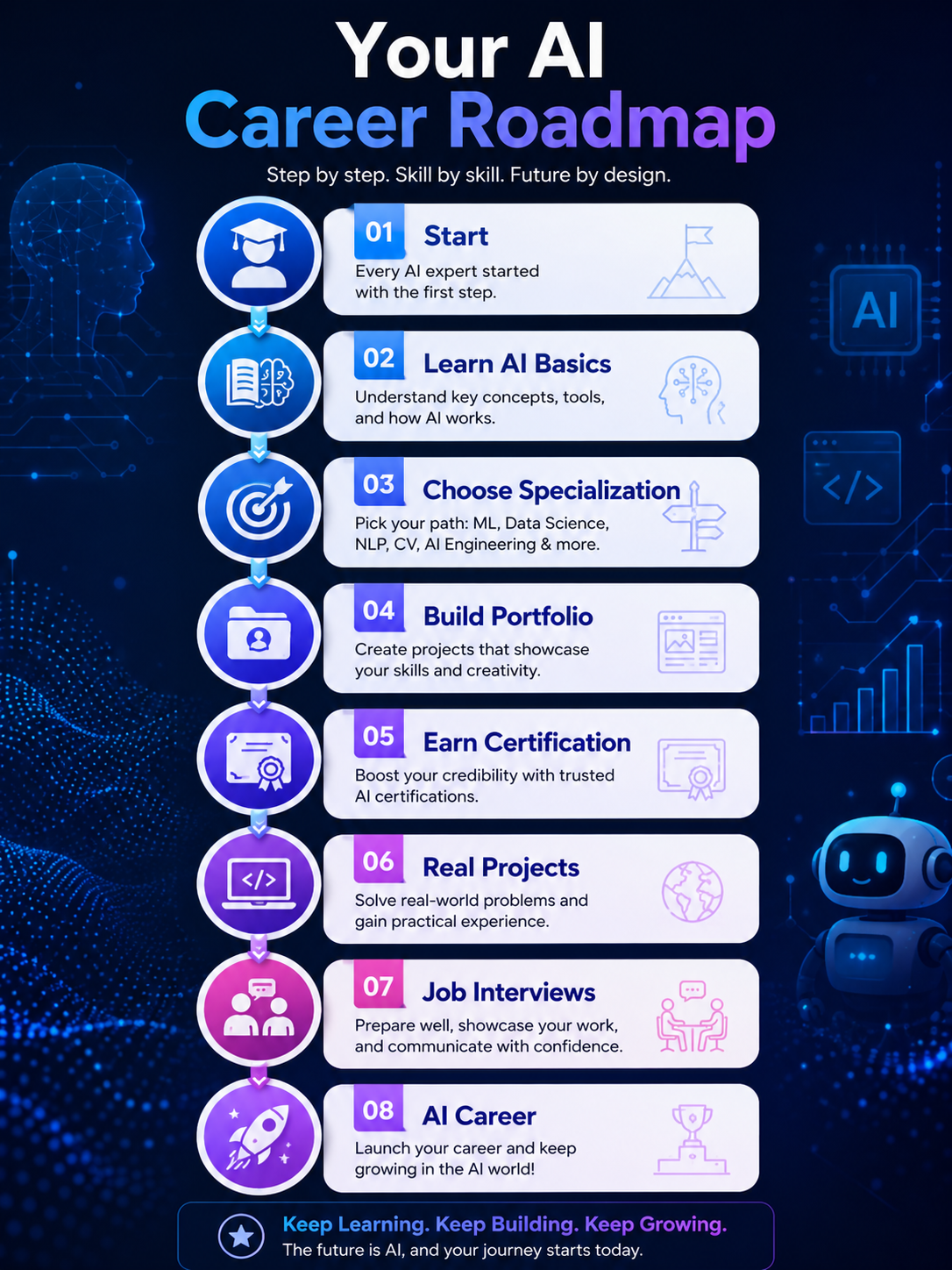
Building toward any of these roles doesn’t require starting from zero, and it doesn’t require quitting your job to go back to school.
Start with the fundamentals. Generative AI basics, prompt engineering, and a working understanding of AI ethics will take you further than most people expect, especially if you’re coming from a non-technical background.
Pick one specialization and stick with it for a while. Trying to become an AI engineer, marketer, and governance specialist simultaneously usually means you end up mediocre at all three. Pick the cluster that overlaps with what you already know.
Build something real. A small automation workflow, a resume analyzer, a customer support chatbot — doesn’t need to be groundbreaking, just needs to prove you can actually build and ship something rather than just talk about AI conceptually.
Get one credible certification, not five. Google, Microsoft, AWS, and DeepLearning.AI all offer respected programs. Certificates won’t replace real project experience, but they signal commitment and give recruiters a shorthand to search for.
Put your work somewhere visible. GitHub, LinkedIn, a blog post walking through a project — a visible portfolio genuinely opens more doors than a polished résumé sitting in an applicant tracking system.
What’s Next for AI Hiring Beyond 2026?
The next phase of this shift looks less like “AI replaces workers” and more like organizations figuring out, sometimes clumsily, how to actually integrate people and AI systems together. A few things worth watching:
Agentic AI — autonomous agents capable of completing complex, multi-step workflows will keep creating demand for developers and workflow designers who can build and supervise them.
AI governance — as more governments introduce AI-specific regulation, compliance and risk expertise becomes less optional and more of a baseline hiring requirement.
Cross-profession AI fluency — the biggest shift might be the least flashy one. AI skills are becoming essential in jobs that have nothing to do with engineering — marketing, HR, accounting, project management. That’s not a prediction; it’s already happening in job postings today.
Conclusion
AI hiring in 2026 isn’t really a story about jobs disappearing — it’s a story about jobs restructuring faster than most people planned for. From AI engineers and MLOps specialists to governance leads and human-AI collaboration coaches, these 25 roles represent where hiring budgets are actually flowing right now, not where pundits speculate they might go eventually. The people and companies moving deliberately — instead of waiting for some imagined moment of certainty — are the ones capturing this wage premium first.
You don’t need to become a machine learning researcher to benefit from any of this. Pick one cluster that overlaps with what you already know, build one real project, and take one concrete step this week. That’s a more realistic path than trying to absorb all 25 roles at once, and honestly, it’s how most of the people I’ve seen actually break into this space.
Frequently Asked Questions
FAQ 1: Is it too late to get into an AI-related career in 2026?
No. Demand is still outpacing supply across most of these categories, and non-technical AI-adjacent roles — governance, AI-augmented marketing, data annotation — remain genuinely accessible to newcomers.
FAQ 2: Do I need a computer science degree to get an AI job?
Not for most roles. Many fast-growing AI jobs prioritize domain expertise and applied AI literacy over formal credentials, especially in governance, content, and customer-facing roles.
FAQ 3: Which AI jobs pay the most in 2026?
AI/ML Engineer, MLOps Engineer, and AI Governance leadership roles tend to carry the highest wage premiums, though pay varies significantly by industry and experience level.
FAQ 4: Are entry-level jobs disappearing because of AI?
Some routine entry-level tasks are shrinking, but new entry points are opening in roles that pair AI tools with judgment and leadership rather than pure repetition.
FAQ 5: Will AI create more jobs than it eliminates?
Most current research points toward transformation rather than net elimination — existing jobs changing shape while new categories in engineering, governance, and automation emerge. The exact balance will vary by industry, and it’s reasonable to treat this as an ongoing trend rather than a settled outcome.
Written by Nathan Walker: Nathan Walker is a technology and business content writer covering AI, workplace trends, and emerging technologies. His work focuses on explaining evolving technology and employment trends in a clear, accessible way, helping readers better understand how innovation is influencing careers, industries, and the future of work.
Reviewed by: Editorial Review Team & Technology Content Specialists.
Disclaimer: This article is based on publicly available information, industry reports, company announcements, labor market data, research publications, and reliable news sources available at the time of publication. Hiring trends, job market conditions, AI capabilities, salary estimates, and employer requirements may change over time as technologies and business needs evolve. This content is intended for informational purposes only and should not be considered career, financial, or legal advice. Readers are encouraged to verify the latest information through official sources and conduct their own research before making career or professional decisions. This content was initially drafted with AI assistance and has been carefully reviewed, edited, refined, and fact-checked by human editors to ensure accuracy, clarity, originality, and editorial quality.