By Evan Turner | Technology and Science Content Writer
Summarize this blog post with: ChatGPT | Perplexity | Claude | Grok
If you’ve spent any time following science news lately, you’ve probably noticed a pattern: headlines keep popping up about mathematicians and computer scientists cracking problems that sat unsolved for decades. What most of those headlines skip over is why any of it matters to someone who isn’t a professional mathematician. In this guide, we’re walking through ten real advances in mathematics and theoretical computer science, explaining what each one actually proves, and — more importantly — connecting the dots to things you already interact with, like your phone’s encryption, your streaming recommendations, and the AI tools flooding your inbox.
Key Takeaways
- These ten advances span geometry, coding theory, computational complexity, group theory, and quantum information — not just one narrow corner of math.
- Theoretical computer science studies the mathematical rules behind computation itself, which is why it underpins everything from cryptography to machine learning.
- Several of these breakthroughs feed directly into post-quantum cryptography, an area companies and governments are actively preparing for right now.
- AI tools are starting to assist mathematical discovery, but peer review and independent verification still decide what counts as a proven result.
- Some of these results are decades in the making, building on work by figures like Yitang Zhang and Alexander Grothendieck, while others are only a couple of years old.
- Understanding the practical stakes of a breakthrough is often more useful for a general reader than following every step of the proof.
What Counts as an Advance in Mathematics and Theoretical Computer Science?
An advance in this field is either a proof that finally settles a question mathematicians have been stuck on, or a new technique that solves a class of problems faster or more efficiently than anything before it. Sometimes that means a “yes” or “no” answer to something open for 40 years. Other times it’s a smarter algorithm that shaves a few decimal points off a complexity bound — which sounds small until you realize it changes what’s computationally possible at scale.
Theoretical computer science, specifically, studies the mathematical foundations behind computation: algorithms, complexity, cryptography, formal verification, and how efficiently problems can be solved at all. It’s a different beast from software engineering. Nobody in this field is shipping an app — they’re figuring out the rules that every app, eventually, has to obey.
Here’s a concrete way to picture it: when Google Maps finds you the fastest route, or your bank keeps your transaction private, or Netflix guesses what you’ll want to watch next, there’s a chain of mathematical theory sitting underneath all of it, often developed decades before anyone thought to build a product around it. Public-key cryptography is the classic example — it was considered borderline useless “pure math” in the 1970s before it became the backbone of every secure website you visit.
Theoretical computer science is the branch of computer science that studies the mathematical foundations of computation, algorithms, computational complexity, and formal systems.
Why Do These Advances Actually Matter?
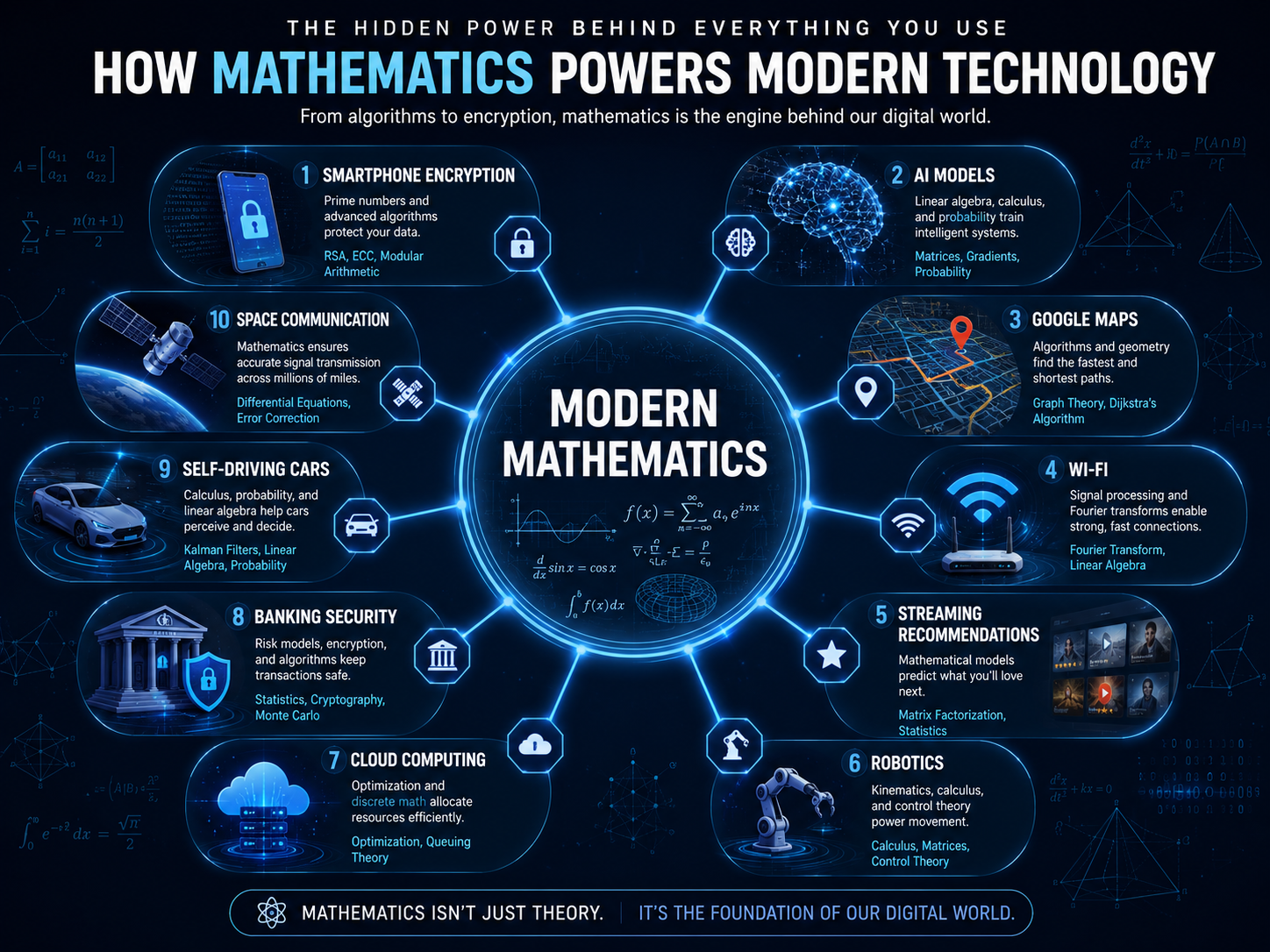
They matter because they define the theoretical ceiling and floor of what computers can do — and that ceiling shifts the moment a breakthrough happens. A result that looks purely academic today can, ten or twenty years later, become the reason your encrypted messages stay private or your AI model trains twice as fast.
In practice, most of the payoff isn’t immediate. That’s honestly one of the more frustrating things about this field if you’re used to tech-industry timelines — a proof from 2020 might not touch a real product until 2035. But the direction of influence is consistent: cryptography, AI training efficiency, network optimization, and error-correcting codes all trace back to results that once looked like abstract curiosities. If you’re wondering how all this abstract math eventually touches your job security, it’s worth reading our breakdown of which skills AI is already replacing in 2026 — a lot of it traces back to exactly this kind of foundational research.
A few areas where this field’s fingerprints show up constantly:
- Artificial intelligence and machine learning
- Post-quantum cryptography
- Quantum computing
- Network and logistics optimization
- Cloud infrastructure and data centers
- Error-correcting codes for wireless and satellite communication
Global spending on AI technologies is projected to exceed $630 billion by 2028 — Source: IDC, 2025. That kind of growth puts real pressure on the underlying math — faster algorithms and better complexity bounds directly translate into cheaper, more efficient AI systems, not just theoretical bragging rights.
The Ten Advances in Mathematics and Theoretical Computer Science
1. Progress on the Cap Set Problem
The cap set problem asks how large a subset of a grid can get before you’re forced to include three points that form a straight line. In 2016, Jordan Ellenberg and others used something called the “polynomial method” to slash the previous upper bounds, cracking a problem that had resisted classical combinatorics for decades. What’s notable is that the technique itself turned out to be reusable — researchers have since applied variations of it to other extremal problems in additive combinatorics. That’s the sign of a genuinely good proof technique: it doesn’t just solve one puzzle, it hands you a new tool.
2. The Resolution of MIP* = RE
In 2020, a team of computer scientists proved that MIP* equals RE — a fairly dense complexity-theory statement that, as a side effect, resolved the Connes embedding problem in operator algebra, a question mathematicians had been chewing on since the 1970s. What makes this one worth knowing about is the crossover: a proof rooted in quantum computing and complexity theory settled a pure math conjecture that had nothing to do with computers on the surface. That kind of cross-field payoff doesn’t happen often, and when it does, it tends to open up new research directions on both sides. You can read the original preprint on arXiv, where the authors lay out the full complexity-theoretic proof.
3. Faster Matrix Multiplication Algorithms
Matrix multiplication is one of those unglamorous operations that quietly runs underneath computer graphics, physics simulations, and — increasingly — every neural network you’ve ever used. Researchers have kept chipping away at the theoretical exponent for how fast matrix multiplication can go, building on the older Coppersmith-Winograd approach with new algebraic tricks. It’s worth being honest here: these improvements are mostly theoretical for now. The practical speedups you’d actually notice in a training run haven’t caught up yet, and some of these algorithms are only faster for matrices so enormous they’re not realistic to build in hardware today. Still, the trend line matters for where computation is headed.
4. AlphaDev’s New Sorting and Hashing Algorithms
In 2023, DeepMind’s AlphaDev used reinforcement learning to find faster sorting algorithms for short sequences — and these weren’t just academic curiosities, they got merged into the LLVM standard library, meaning they’re running in real software today. This one stuck with a lot of engineers I’ve talked to because it flips the usual script: instead of humans hand-tuning instruction ordering, a search algorithm found micro-optimizations that decades of manual work had missed. It’s a small, concrete example of AI contributing directly to core computer science infrastructure rather than just generating text or images.
5. Improved Approximation for the Traveling Salesman Problem
The Traveling Salesman Problem asks for the shortest route that visits every point on a list and returns to the start — deceptively simple to state, brutally hard to solve exactly at scale. In 2020, researchers Karlin, Klein, and Oveis Gharan improved on the Christofides algorithm, which had stood as the best-known approximation for over 40 years. That’s the kind of result that doesn’t make headlines outside academic circles, but for anyone working in logistics or routing software, a better approximation ratio on TSP is a genuinely big deal — it’s the theoretical backbone behind delivery routing, airline scheduling, and network design.
6. Explicit Constructions of Ramsey Graphs
Ramsey theory studies the point at which order has to emerge from sufficiently large or complex systems — the classic informal version is that among any six people at a party, three either all know each other or all don’t. In 2023, mathematicians found new explicit constructions of Ramsey graphs that improved bounds without relying on the usual non-constructive probabilistic arguments. That distinction matters more than it sounds: an existence proof tells you a structure exists somewhere, but an explicit construction actually hands you the structure — which is far more useful if you’re trying to build an algorithm around it.
7. New Bounds on Prime Gaps
Yitang Zhang’s 2013 proof that infinitely many prime pairs exist within a bounded gap was one of the more surprising breakthroughs in recent number theory — surprising partly because Zhang was a relatively unknown lecturer at the time, not an established star in the field. Since then, James Maynard and others have kept shrinking that bound using refined sieve methods. This is a good example of how progress in pure math often isn’t one dramatic leap — it’s a long chain of incremental tightening, where each new paper trims the bound a little further using techniques the last paper introduced.
8. Progress Toward P vs NP Through Circuit Lower Bounds
P vs NP is still unsolved — nobody’s cracking that headline anytime soon, and it’s worth being upfront about that. But researchers have made real progress on related circuit complexity questions, including new lower-bound techniques for restricted computational models. Ryan Williams’ work connecting circuit lower bounds to algorithm design gave the field new angles to attack the broader question indirectly. It’s a bit like chipping away at the foundation of a locked door instead of the lock itself — you’re not through yet, but you understand the structure a lot better than you did before.
9. High-Dimensional Sphere Packing and Coding Theory
Sphere packing asks how densely you can arrange spheres in a given space — trivial in three dimensions (stack oranges at the grocery store), fiendishly hard once you’re working in 50, 100, or even a thousand dimensions. Those extra dimensions aren’t physical; they represent mathematical properties used in coding theory and digital communication. Researchers keep pushing on this because better packing arrangements translate into stronger error-correcting codes, which show up in everything from Wi-Fi to deep-space communication. NASA, for instance, leans heavily on sophisticated error-correcting codes to pull usable signal out of spacecraft transmissions from millions of kilometers away — a small efficiency gain in the underlying math can meaningfully cut transmission errors.
High-dimensional sphere packing seeks the densest possible arrangement of spheres in many dimensions and has direct applications in coding theory and information transmission.
10. The Closest Vector Problem and Post-Quantum Cryptography
The Closest Vector Problem asks you to find the nearest lattice point to a given target — a problem that’s considered computationally hard and, as a result, forms the security backbone for several post-quantum cryptographic systems. As quantum computers edge closer to being practically disruptive, today’s encryption methods (particularly ones based on factoring large numbers) start looking shakier. Lattice-based cryptography, built on problems like CVP, is one of the strongest current candidates for holding up against quantum attacks, which is exactly why NIST has been pushing standardization efforts in this space. NIST’s own post-quantum cryptography standardization project page tracks exactly which lattice-based algorithms are being finalized as official standards.
The Closest Vector Problem is a fundamental lattice problem whose computational hardness underpins much of today’s post-quantum cryptography research.
Governments and technology companies worldwide are actively transitioning toward post-quantum cryptographic standards following NIST’s standardization efforts — Source: NIST, 2024.
How Do These Fields Actually Intersect?
None of these ten advances live in isolation, and that’s honestly the more interesting story than any single result. Complexity theory constantly borrows tools from combinatorics and algebra — you can see that directly in both the cap set and Ramsey graph results above. Machine learning theory, meanwhile, increasingly leans on classical complexity results to explain why certain training methods work, since empirical results alone (“it just works”) don’t satisfy anyone trying to build the next generation of models on solid ground.
A useful mental model: pure math generates the raw tools (proof techniques, structural theorems), theoretical computer science figures out how to compute with them efficiently, and applied fields — cryptography, AI, networking — eventually absorb whatever survives that filtering process. It’s slow, and a lot of promising theory never makes the jump to application. But when it does, the payoff tends to be foundational rather than incremental.
What Role Does AI Play in Modern Mathematical Discovery?
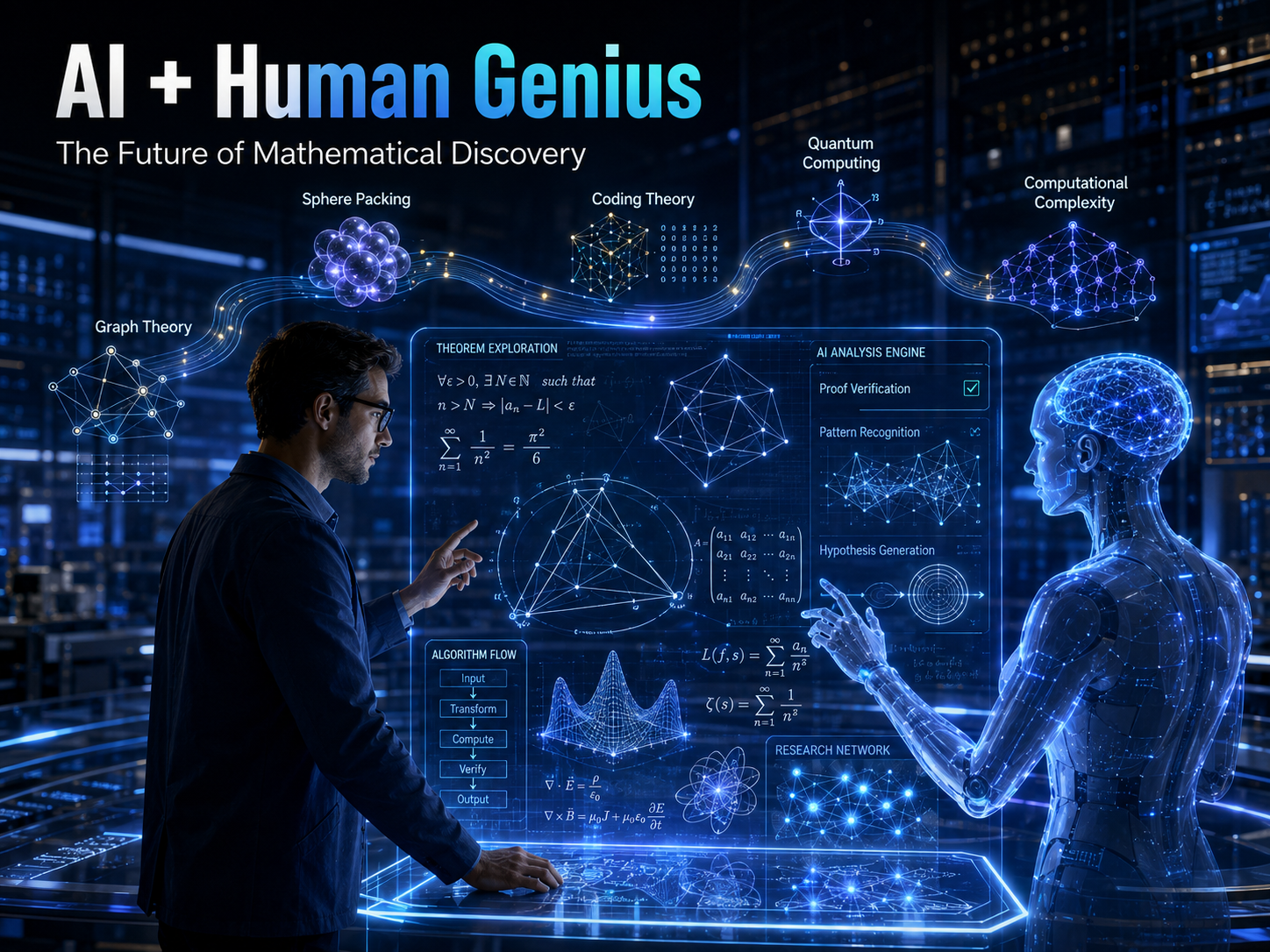
AI is increasingly showing up as a research collaborator rather than a replacement for mathematicians, and it’s worth separating hype from reality here. In 2021, DeepMind researchers worked with mathematicians to use machine learning for spotting new patterns in knot theory and representation theory — patterns that human mathematicians then formalized into actual, rigorous proofs. The AI didn’t prove anything on its own; it surfaced unexpected structure in enormous datasets that a human might never have noticed manually, and mathematicians took it from there.
This process involves training models to surface unexpected patterns in mathematical objects, which mathematicians then formalize into rigorous proofs.
Formal proof verification is the other piece of this puzzle, and it’s less talked about but arguably more important for trust in the field. Tools like Lean let mathematicians encode a proof into a formal language that software can check step-by-step, rather than relying purely on human reviewers to catch every logical gap. For proofs running hundreds of pages — which is not unusual in modern research — that kind of machine-checked verification is a real safeguard, not a nice-to-have.
Around 80% of organizations are expected to use AI in some form by 2026, which is part of why foundational mathematical research keeps getting more attention rather than less — Source: Gartner, 2025. That said, I’d push back gently on the narrative that AI is “solving math” independently. From what I’ve seen in how these collaborations are actually described by the researchers involved, the human role — intuition, framing the right question, and rigorous verification — hasn’t gone anywhere. AI is accelerating a process, not replacing the people running it. That’s really the throughline worth remembering — AI augments expert judgment rather than replacing it, which is the same principle behind our guide to becoming AI-proof in your career.
Tools and Resources for Following This Field Yourself
You don’t need a university login to keep up with this stuff, which surprises a lot of people. arXiv.org is where nearly all of these results appear first, often months before formal peer review wraps up — it’s free, searchable, and where researchers themselves post their own preprints. STOC and FOCS proceedings cover peer-reviewed theoretical computer science specifically, while the International Congress of Mathematicians (ICM) rounds up the biggest pure math results roughly every four years. Quanta Magazine does a genuinely good job translating this stuff for a general audience without dumbing it down to the point of being wrong, which is a harder balance to strike than it sounds.
| Resource | Best For | Cost |
|---|---|---|
| arXiv.org | Preprints across mathematics and computer science | Free |
| STOC / FOCS Proceedings | Peer-reviewed computer science theory papers | Free / Institutional |
| Quanta Magazine | Accessible science journalism | Free |
| ICM Proceedings | Major mathematics research published every four years | Free |
| Lean Proof Assistant | Hands-on formal proof verification and theorem proving | Free |
What’s Next for Mathematics and Theoretical Computer Science?
The near-term trajectory looks like deeper collaboration between researchers and AI tools rather than AI operating solo — and a handful of open problems still loom large. P vs NP remains the big one, with circuit lower-bound techniques currently the most promising indirect path forward. Post-quantum cryptography standardization will keep pushing lattice problems like CVP further into the spotlight as organizations actually migrate their systems. And formal verification tools are likely to become standard practice for major proofs, not just a novelty a handful of labs experiment with.
If any of this sparked your curiosity, a few concrete starting points: pick up the fundamentals of discrete mathematics and algorithms if you haven’t already, poke around arXiv for papers in an area that interests you (coding theory and cryptography tend to be the most immediately relatable), and try the Lean proof assistant if you want a hands-on feel for formal verification. Following a couple of researchers on social media whose work you enjoy is honestly one of the easier ways to catch new results before they filter into mainstream coverage.
Conclusion
These ten advances in mathematics and theoretical computer science show a field that’s anything but stagnant — from a computer science proof settling a decades-old question in operator algebra, to an AI system finding sorting algorithms that are now running in production software. Some of these results will stay abstract for years before touching anything you’d recognize as a product. Others, like the lattice problems behind post-quantum cryptography, are already shaping decisions companies and governments are making right now.
What ties all ten together is a simple pattern worth remembering: today’s “purely theoretical” result is often tomorrow’s essential infrastructure. If you want a genuinely useful lens for following AI, cybersecurity, or computing more broadly, keeping half an eye on this field isn’t a bad habit to build.
FAQs
FAQ 1: What is the most significant recent advance in theoretical computer science?
There’s no single “most important” answer here since it depends on your field of interest, but the resolution of MIP* = RE stands out because it connected quantum computing, complexity theory, and a pure math conjecture that had been open since the 1970s in a single proof.
FAQ 2: Why should a non-mathematician care about advances like these?
Because a surprising number of technologies you use daily — encryption, navigation apps, AI training, wireless networks — trace back to mathematical theory that looked purely academic when it was first discovered. Public-key cryptography is the textbook example of this delay between discovery and application.
FAQ 3: Is AI actually proving new mathematical theorems on its own?
Not independently, no. Current AI-assisted research, like DeepMind’s work on knot theory and representation theory, involves models surfacing patterns in data that human mathematicians then verify and formalize into rigorous proofs. Peer review and human verification remain essential.
FAQ 4: How does the Closest Vector Problem relate to everyday cybersecurity?
It’s the hardness of the Closest Vector Problem that underpins several lattice-based encryption schemes currently being standardized by NIST as candidates for post-quantum cryptography — the encryption methods expected to resist attacks from future quantum computers.
FAQ 5: Has P vs NP been solved?
No, P vs NP remains unsolved and is one of the seven Millennium Prize Problems. That said, researchers have made steady progress on related circuit complexity questions that indirectly inform how the broader problem might eventually be approached.
FAQ 6: What’s the easiest way to start following this field without a math degree?
Quanta Magazine and arXiv.org are the two most accessible starting points — Quanta translates results for a general audience, while arXiv lets you read the original preprints directly, often well before formal publication.
Written by Evan Turner: Evan Turner is a technology and science content writer covering innovation, digital trends, and emerging technologies. His work focuses on explaining complex scientific and technological developments in a clear, accessible way, helping readers better understand how new ideas and research influence computing, artificial intelligence, and the broader technology landscape.
Reviewed by: Editorial Review Team & Science and Technology Content Specialists.
Disclaimer: This article is based on publicly available research papers, academic publications, conference proceedings, official announcements, and other reliable sources available at the time of publication. Scientific research, theoretical models, and technology developments continue to evolve as new discoveries and peer-reviewed findings emerge. This article is intended for informational and educational purposes only and should not be considered a substitute for original academic literature or professional research. Readers are encouraged to consult the referenced publications and official sources for the most current and detailed information. This content was initially drafted with AI assistance and has been carefully reviewed, edited, refined, and fact-checked by human editors to ensure accuracy, clarity, originality, and editorial quality.