
By Ethan Parker | Technology Content Writer
Summarize this blog post with: ChatGPT | Perplexity | Claude | Grok
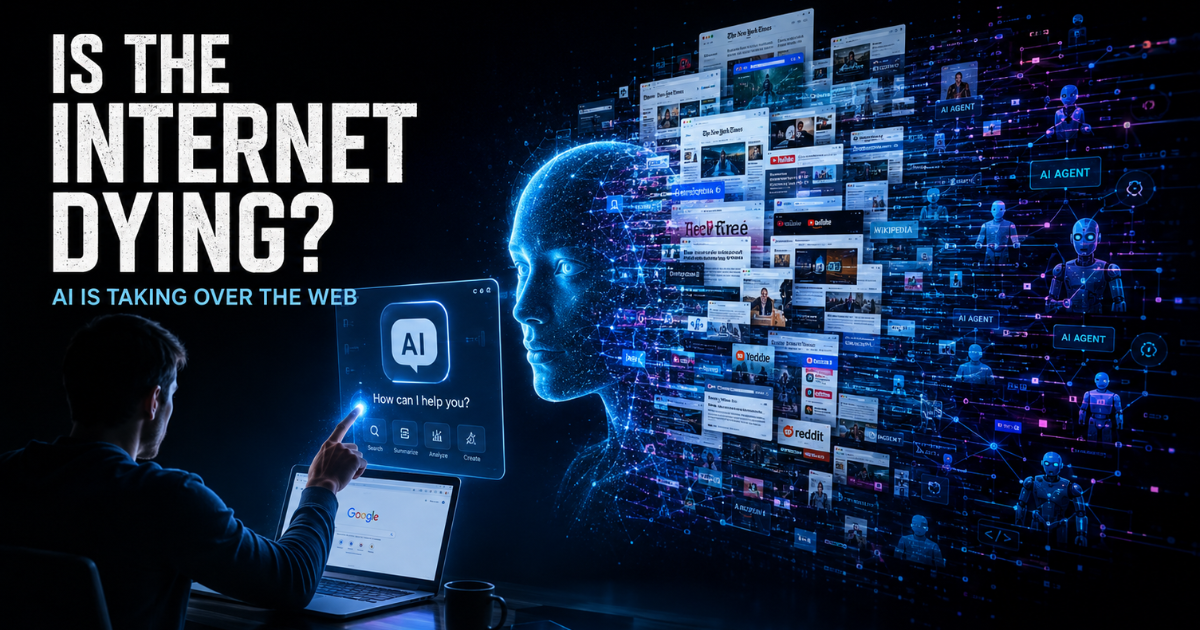
You’ve probably noticed it already: you ask a question, and instead of scrolling through ten blue links, you just… get an answer. No clicking, no comparing tabs, no visiting the actual website that did the work. That convenience feels great in the moment, but it’s quietly reshaping the entire internet — who creates content, who gets paid for it, and whether you’re even interacting with a human at all anymore.
I’ve spent a good chunk of the last two years watching this shift happen in real time, both as someone who writes content for a living and as someone who, like everyone else, has started asking ChatGPT things I used to Google. And honestly, the data backs up what a lot of us have been feeling anecdotally: the internet is becoming a post-human internet, where AI systems increasingly sit between people and the information they’re looking for. This isn’t a distant, sci-fi scenario — it’s already showing up in traffic reports, publisher revenue statements, and even in how many of us talk to machines instead of people during an average day.
Key Takeaways
- A post-human internet describes a web where AI systems handle a growing share of discovery, content creation, and interaction that people used to do directly — not one where humans have disappeared, but one where machines increasingly sit between people and information.
- Zero-click search is now the norm rather than the exception: about 60% of searches globally end without a click to any website, rising to roughly 77% on mobile — Source: Click Vision, 2026.
- Publisher referral traffic has taken a real, measurable hit, with US organic search referrals from Google down 38% year-over-year and some major outlets losing more than 80% of their organic traffic — Source: Reuters Institute for the Study of Journalism, 2026.
- AI-generated content is flooding parts of the web, feeding concerns tied to the “dead internet theory,” though this is a narrower issue than the broader post-human internet shift.
- AI agents differ from traditional crawlers because they can pursue multi-step goals — searching, comparing, and even completing tasks — rather than just indexing pages, and AI user-action crawling grew more than 15x in 2025 — Source: Cloudflare Radar, 2025 Year in Review.
- Chatbots are replacing routine, low-stakes human interactions like basic customer service faster than they’re replacing deeper human relationships, since complex or sensitive conversations still tend to route to people.
- Adapting to this shift means diversifying beyond search traffic, structuring content for AI citation, and doubling down on original expertise and first-hand insight that AI summaries can’t easily replicate.
What Does “Post-Human Internet” Actually Mean?
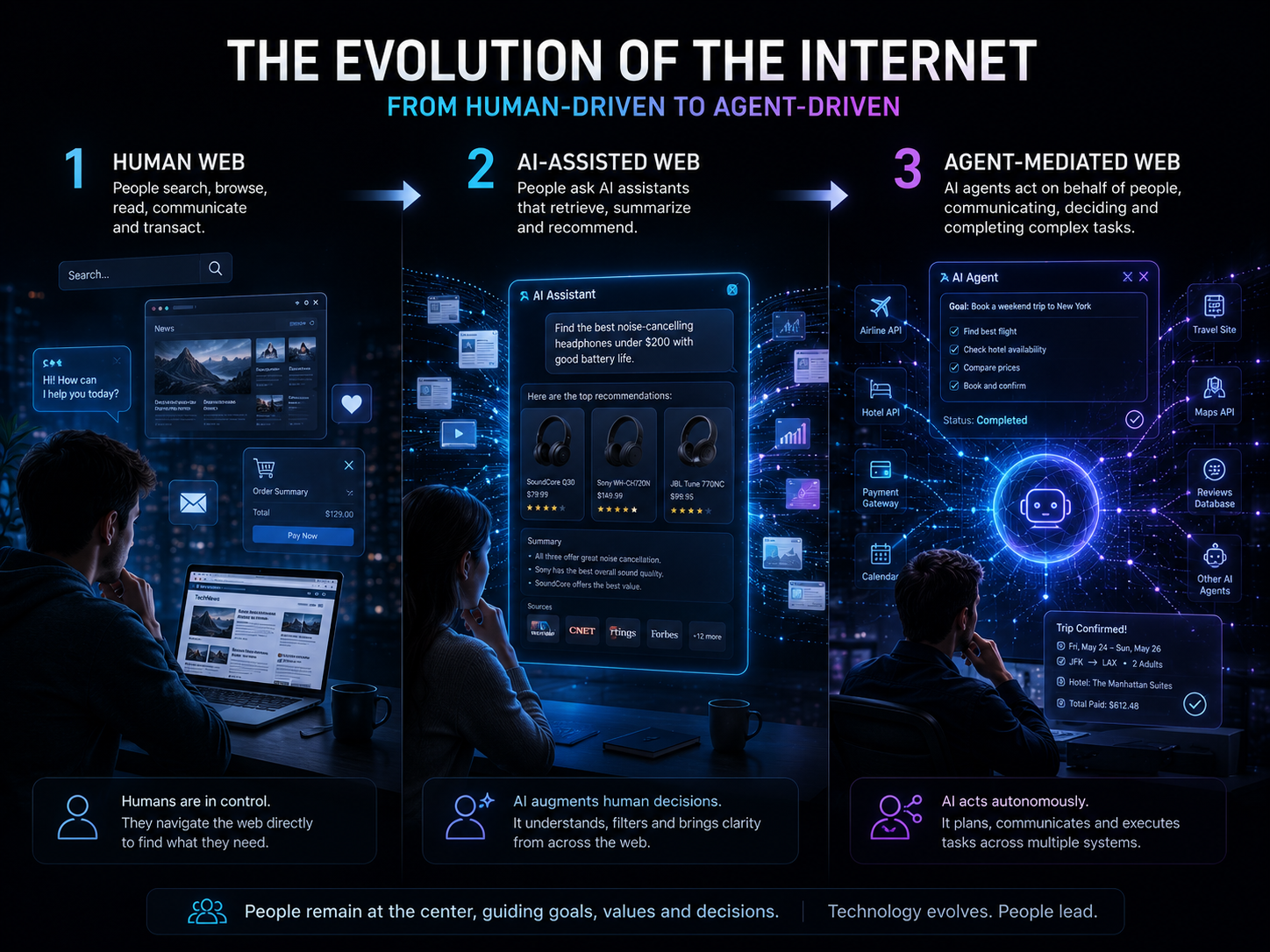
A post-human internet is a web where AI systems — chatbots, AI search summaries, and increasingly autonomous agents — handle a growing share of the discovery, content creation, and even decision-making that people used to do themselves. It doesn’t mean humans have vanished. It means the layer between you and the raw information has changed from “a website written by a person” to “a machine that read that website and is now talking to you about it.”
Think about how you used to plan a trip. You’d Google a destination, open five tabs, check a few blogs, compare hotel sites, maybe read some Reddit threads for the unfiltered opinion. That process forced you to touch a lot of human-created content along the way. Now you can just ask an AI assistant to compare three cities, summarize the pros and cons, and recommend a hotel — and the underlying websites become raw material the AI processed rather than places you actually visited.
Here’s the thing that makes this different from past internet shifts: it’s not just about search. It’s discovery (how you find information), content creation (who or what wrote it), and interaction (who or what you’re actually talking to) all moving away from direct human involvement at roughly the same time. That’s a bigger structural change than, say, the shift from desktop to mobile.
Why This Shift Actually Matters
This matters because the entire economic model of the open web — publishers write content, people click on it, ads or subscriptions pay the bills — depends on humans actually visiting websites. When AI answers the question before anyone gets there, that model starts to crack.
The numbers here are pretty stark. Global publisher referral traffic from Google dropped by roughly a third in 2025, with US organic search referrals down 38% year-over-year — Source: Reuters Institute for the Study of Journalism, 2026. That’s not a rounding error; that’s a third of the traffic that used to fund newsrooms, blogs, and independent sites simply not showing up anymore.
And some individual publishers have been hit even harder than that average suggests. Business Insider’s organic search traffic reportedly fell more than 85% between June 2025 and June 2026, according to Wall Street Journal reporting on Semrush data. USA Today lost close to half its organic traffic in the same period, and CNN dropped around 25%. These aren’t scrappy niche blogs without SEO teams — these are major newsrooms with years of domain authority, and they’re still bleeding traffic.
From where I sit, the trust angle is just as important as the money angle, if not more. If AI systems are summarizing, remixing, and sometimes flattening out nuance from human-written reporting, readers lose visibility into who actually did the work — and whether anyone fact-checked it in the first place. That’s a quieter problem than a traffic graph, but it might matter more in the long run.
How Are AI Chatbots Actually Changing Search and Discovery?

AI chatbots and AI-powered search features change discovery by answering your question directly on the results page or inside a conversation, which removes the need to click through to the original source. This is usually called zero-click search, and it’s become the norm rather than the exception.
About 60% of searches globally now end without a click to any website, and that number climbs to roughly 77% on mobile — Source: Click Vision, 2026. When Google’s AI Overview shows up on a results page, click-through rates for the top organic result have reportedly dropped by more than half compared to pre-AI Overview baselines — Source: Ahrefs, 2026. In practice, I’ve seen this play out on client sites where a page that used to rank #1 for a straightforward “what is X” query keeps its position but loses most of its traffic, simply because the answer now lives in a box above the results.
Not every kind of content takes the same hit, though, and this is worth understanding if you’re trying to figure out where to focus your energy. Evergreen, purely informational content — definitions, basic explainers, generic how-tos — gets hit the hardest, because a short AI-generated summary genuinely satisfies most people’s curiosity. Breaking news, on the other hand, has actually grown as a referral category in some datasets, since AI systems generally aren’t the fastest or most reliable source for what happened an hour ago. Technical and STEM content also tends to hold up better, because readers with a real technical need usually want the full source, not a simplified summary.
| Content Type | Typical Traffic Impact | Why |
|---|---|---|
| Evergreen/informational guides | Severe decline | Fully answered inside AI summary |
| Breaking news | Growth in some cases | Requires timely, primary reporting |
| Technical/STEM content | Smaller decline | Readers still want the full source |
| Product/transactional pages | Moderate, uneven | Purchase intent still drives clicks |
Is AI-Generated Content Actually Flooding the Web?
Yes, and this connects to something people call the “dead internet theory” — the idea that a large and growing share of online content and activity is generated by bots rather than humans. The post-human internet concept is broader than that (it covers discovery and interaction too, not just content volume), but the content flood is a real and measurable part of it.
In practice, this shows up as an enormous increase in low-effort, mass-produced content: product descriptions, filler blog posts, auto-generated social comments, and SEO pages built purely to rank rather than to help anyone. I’ve reviewed sites where entire content libraries were clearly templated and AI-written with zero editorial review, and you can usually tell within a paragraph — the sentences are grammatically fine but say almost nothing.
The bigger long-term risk, honestly, is the feedback loop. If AI models increasingly train on a web that’s filling up with AI-generated text, quality and originality can degrade over successive generations — a bit like making a photocopy of a photocopy. That’s still an emerging concern rather than a settled fact, but it’s the reason a lot of SEOs and researchers are watching content provenance so closely right now.
Are AI Agents Different From Regular Bots and Crawlers, and Does It Matter?
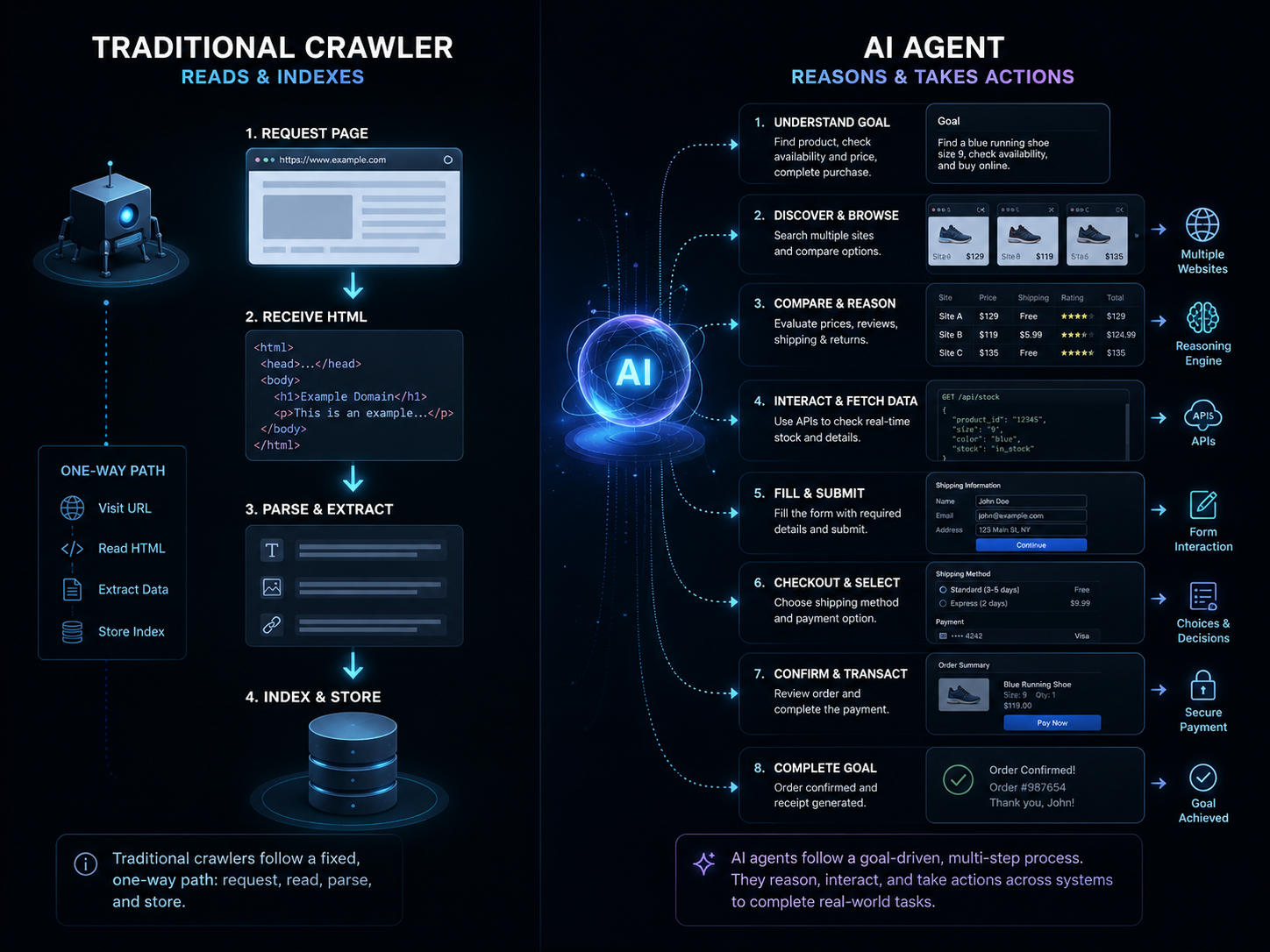
Yes — and the distinction matters more than people realize. A traditional crawler just requests and indexes a page. An AI agent can pursue a goal across multiple steps: searching, comparing, filling out a form, and moving toward an outcome, sometimes with minimal human input along the way.
A basic search crawler might discover a concert ticket page and index it. An agent, by contrast, could search several ticket platforms, compare prices and seat locations against your stated preferences, and get you most of the way toward checkout. Google has already described agentic Search capabilities along these lines — helping with things like restaurant reservations or multi-source comparisons, not just returning a list of links.
This is where the “post-human” framing starts to feel less abstract. Cloudflare reported that AI user-action crawling — bots taking action on behalf of a user, rather than just indexing — increased more than 15x during 2025, and that AI bots overall made up about 4.2% of HTML request traffic, close to Googlebot’s 4.5% — Source: Cloudflare Radar, 2025 Year in Review. That’s a meaningful chunk of total web traffic that isn’t a human clicking a mouse at all.
If you’re curious how far this agentic behavior can actually go beyond search, it’s worth reading our breakdown of what agentic AI is and how it’s already reshaping work and daily life — the same underlying shift is showing up well outside the browser.
Are Chatbots Really Replacing Human-to-Human Interaction Online?
To some degree, yes — particularly in customer service, casual conversation, and low-stakes informational exchanges. A lot of companies have shifted routine support entirely to chatbots, so a user who once typed a message to a support rep now only ever talks to a bot for anything short of an escalation. Separately, AI companion apps have grown fast, and some users genuinely treat them as a substitute for casual conversation.
That said, I’d push back a little on the idea that this substitution is total or even close to it. Complex, emotionally sensitive, or high-stakes conversations still get routed to humans, and most people I’ve talked to still prefer a real person the moment a conversation gets complicated or something goes wrong. So the honest read is that chatbots are displacing routine, low-complexity interactions faster than they’re replacing deeper human relationships — at least for now.
What Does the Data Say About How Fast This Is All Moving?
A peer-reviewed 2026 study using a difference-in-differences design across more than 161,000 matched article pairs found that AI Overview exposure reduces daily traffic to source pages by approximately 15% — Source: arXiv, 2026. That’s on the more conservative end of the estimates floating around, which range from 15% up to the 40-plus percent declines some individual publishers have reported — a reminder that averages can hide a lot of variation depending on your content type and niche.
Separately, Pew Research Center tracked browsing behavior from 900 U.S. adults and found that searches producing an AI-generated summary led to a traditional search-result click only 8% of the time, compared to 15% when no AI summary appeared. Clicks on links inside the AI summary itself happened in just 1% of visits — Source: Pew Research Center, 2025. The same study found 58% of tracked participants had at least one search that produced an AI summary during the month, and longer, more detailed queries were far more likely to trigger one.
Interestingly, this isn’t necessarily bad news for Google’s bottom line, even if it’s bad news for publishers. Google’s search revenue grew 19% year-over-year to $60.4 billion in Q1 2026 — Source: Search Engine Land, 2026. People are still searching just as much, if not more. They’re just not clicking away from Google’s own page as often, which tells you a lot about where the value is being captured versus where it used to flow.
What Tools Are Actually Driving This Shift?
A handful of tools illustrate different pieces of the post-human internet, and it’s worth knowing what each one is actually doing differently.
Google AI Overviews and AI Mode sit above traditional search results and now appear on somewhere between 18% and 30% of searches depending on the query type, absorbing clicks that used to go to publisher sites. Google has described AI Mode as designed for longer, more complex questions, with some agentic capabilities for tasks like comparing options or checking reservation availability.
ChatGPT and Perplexity work more like research assistants — you ask a question, they pull from multiple sources, and they hand you a synthesized answer with citations you may or may not click. Grok layers in real-time social data, which changes the kind of query it’s useful for compared to the others.
None of these tools are identical, and if you’re trying to optimize your own content for AI visibility, it’s worth actually testing how each one cites (or doesn’t cite) your site rather than assuming they all behave the same way. Free tools like Google Search Console still matter here — they won’t show you AI citation data directly, but they’ll tell you whether your traditional organic visibility is holding steady while your click volume drops, which is a useful diagnostic in itself.
How Should Creators and Businesses Actually Adapt?
The honest answer is that there’s no single fix, but a few strategies have held up reasonably well in practice.
First, structure your content so an AI system (or a human skimming quickly) can extract a clear answer from the first sentence of a section. Vague, meandering paragraphs get skipped by both readers and AI summarizers. Clear, standalone definitions and facts near the top of a section give you a better shot at being the source an AI system chooses to cite or quote. On a practical level, a lot of the tools reshaping how creators work day-to-day are worth knowing too — we’ve rounded up 10 AI productivity tools that actually transform your daily workflow, rather than the ones that just sound good in theory.
Second, stop treating search as your only distribution channel. Publishers who are adapting well are investing more in newsletters, communities, and direct-to-reader relationships — channels that don’t depend on any single platform’s citation behavior. That’s not a new idea, but it’s become a lot more urgent than it was three or four years ago.
Third, lean into the things AI genuinely struggles to fake: original data, first-hand testing, expert review, and a real point of view. I’ve noticed that generic “10 tips for X” content is exactly the kind of thing that gets fully absorbed into an AI summary with zero reason for anyone to click through. Content built around original research, a specific case study, or a documented test, on the other hand, tends to hold up better — there’s simply more there that a summary can’t fully replace.
What Should You Actually Do Next?
If you’re a publisher or creator, treat 2026 as the year to diversify away from pure search dependence, and start tracking AI citation frequency alongside your traditional rankings — it’s an imperfect metric right now, but it’s only going to matter more.
If you’re a regular reader, it’s worth staying a little skeptical of fluent-sounding AI answers, especially for anything involving numbers, medical information, or recent events. AI summaries are convenient, but they’re not always right, and they’re not always current. Clicking through to the original source is still a reasonable habit to keep, especially when accuracy actually matters to you.
Conclusion: So, Is the Internet Actually Becoming Post-Human?
Not entirely, and probably not ever completely — but it is becoming a lot more machine-mediated, and the shift toward a post-human internet is happening faster than most people outside the SEO and publishing world seem to realize. Traffic numbers, crawler data, and search-behavior studies all point in the same direction: AI systems are increasingly the layer between people and information, not just an occasional convenience.
The real question isn’t whether humans will disappear from the internet — they won’t. It’s how much of your own online experience will be filtered through an AI system by this time next year, and whether the people and organizations who create the content underneath all those AI answers can find a way to stay funded and visible. The creators and publishers who adapt now, by building genuine expertise and direct reader relationships rather than depending entirely on search rankings, are the ones most likely to come out the other side of this transition intact.
Frequently Asked Questions
FAQ 1: Is the “post-human internet” the same thing as the “dead internet theory”?
Not quite. The dead internet theory specifically claims that most online content and activity is bot-generated. The post-human internet is a broader idea covering how discovery, content creation, and interaction are all shifting away from direct human involvement, not just content volume.
FAQ 2: Are AI Overviews actually reducing website traffic, or is this overstated?
The data suggests it’s real, though estimates vary quite a bit by study and by content type. Independent research has found declines ranging from around 15% to over 40%, with some individual publishers reporting drops above 80% for specific content categories.
FAQ 3: Will AI chatbots eventually replace search engines completely?
Probably not entirely — search volume and Google’s own search revenue are both still growing. What’s changing is the interface: more queries get answered directly within AI tools rather than through a traditional list of links, but plenty of query types (shopping, local business searches, breaking news) still send people to websites.
FAQ 4: What’s the single most effective thing a website can do to stay visible in an AI-driven search environment?
Based on what’s held up best across the sites I’ve watched, it’s producing genuinely original content — first-hand testing, proprietary data, expert analysis — rather than generic explainer content that an AI summary can fully replicate.
FAQ 5: Are chatbots actually replacing human customer service and social interaction?
Partially. Routine, low-complexity interactions like basic customer support questions are increasingly handled by bots. Complex or emotionally sensitive conversations still tend to route to humans, and most people still prefer a person once things get complicated.
Author & Editorial Information
Written by Ethan Parker: Ethan Parker is a technology content writer covering digital trends, emerging technologies, and the evolving internet. His work focuses on explaining technology developments and digital changes in a clear, accessible way for general readers.
Reviewed by: Editorial Review Team & Technology Content Specialists.
Disclaimer: This article is based on publicly available research, industry reports, technology developments, news coverage, and other reliable sources available at the time of publication. The impact of AI chatbots, online platforms, and emerging technologies continues to evolve as new products, research, and developments emerge. Readers are encouraged to consider the broader context of the information presented and verify important details through reliable and current sources. This article is intended for informational purposes only and should not be considered professional, business, or technology advice. This content was initially drafted with AI assistance and has been carefully reviewed, edited, refined, and fact-checked by human editors to improve accuracy, clarity, originality, and editorial quality.