By Connor Mitchell | Technology and Education Content Writer
Summarize this blog post with: ChatGPT | Perplexity | Claude | Grok
You picked your major (or you’re about to) based on the usual stuff — what you’re good at, what pays well, maybe what your parents nudged you toward. Here’s the thing most students don’t realize until they’re deep into a semester: AI is quietly changing which of those old assumptions still hold up. This guide walks through what’s actually happening to different majors, what the data says, and how to adjust your path without blowing up four years of progress.
Key Takeaways
- AI’s influence on college major choices describes how automation and generative AI are reshaping students’ perception of a degree’s career value — and a striking number of students are already acting on it.
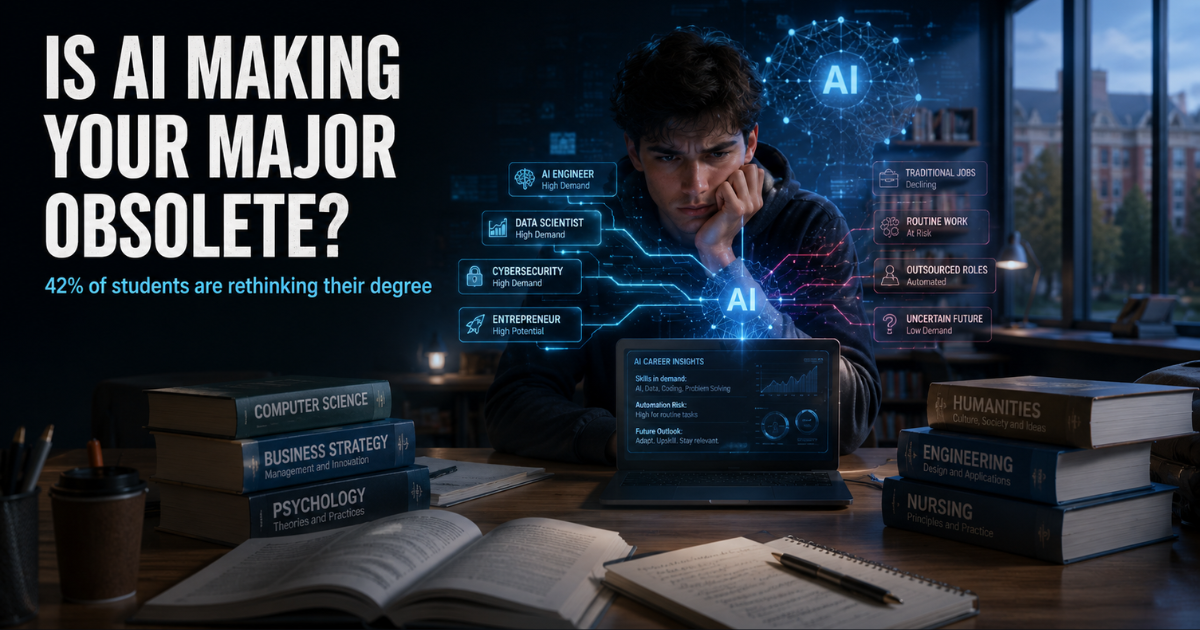
- A recent Gallup survey found that 42% of bachelor’s degree students had thought seriously about switching majors because of AI, and 16% had already done so — Source: Gallup, 2026.
- Exposure to AI varies by task, not by entire major, so a degree isn’t automatically “safe” or “doomed” just because of its name.
- Employers increasingly expect baseline AI fluency across fields, not just from computer science graduates.
- Switching majors is rarely the first or best move — adding AI literacy, a data certificate, or relevant coursework often solves the same problem with far less disruption.
- Career resilience comes from combining domain expertise with adaptable, AI-aware skills, not from finding one bulletproof major.
- Students who make small, informed adjustments early avoid the far more expensive scramble of switching majors — or careers — later.
What Is AI’s Influence on College Major Choices?
AI’s influence on college major choices is the shift in how students evaluate a degree’s career value, driven by automation risk, new AI-related job opportunities, and changing employer expectations. It’s not an abstract trend anymore — it’s showing up directly in enrollment decisions.
In Gallup’s 2026 survey conducted with the Lumina Foundation, 42% of bachelor’s degree students said they’d thought at least a fair amount about changing their major because of AI, and that number jumped to 56% among associate degree students — Source: Gallup, 2026. You can read the full breakdown of student attitudes in Gallup’s original report, College Students Weigh AI’s Impact on Majors and Careers. Even more notably, 16% of students overall said they’d already changed their major or field of study for this exact reason, with 13% of bachelor’s students reporting the same. That’s not a fringe worry — that’s a meaningful chunk of a graduating class rethinking their plans mid-degree.
From what I’ve seen covering this space, the anxiety is understandable but often misdirected. Students hear “AI is coming for jobs” and immediately start Googling which majors are “safe.” In practice, that question is usually the wrong one to ask, and we’ll get into why shortly.
This isn’t confined to STEM departments, either. Business schools, communications programs, and even humanities departments are quietly rewriting course requirements to reflect what employers now expect from graduates walking in the door.
Why Does This Matter Right Now?
It matters now because tuition keeps climbing while the payoff for any given major keeps shifting underneath students’ feet. That combination — rising cost, moving target — is exactly what fuels the anxiety Gallup picked up in its data.
Job postings are part of the signal here. Employers are increasingly listing AI tool proficiency as a baseline expectation rather than a specialized skill reserved for tech roles. A marketing coordinator posting today might list comfort with AI writing or design tools right alongside the usual creative requirements — something that would have looked strange five years ago.
There’s also a generational piece to this. Plenty of current students grew up watching automation headlines cycle through the news, and Gallup found that 14% of bachelor’s students and 13% of associate degree students said preparing for AI was actually a factor in why they enrolled in college at all — Source: Gallup, 2026. That’s a meaningful shift in motivation, not just anxiety.
Colleges are responding, too, and honestly faster than they typically move on curriculum. Universities are adding AI minors, standalone certificates, and cross-disciplinary electives at a pace that outstrips how they handled past technology shifts like the rise of the internet or mobile computing.
Which College Majors Are Most at Risk from AI?
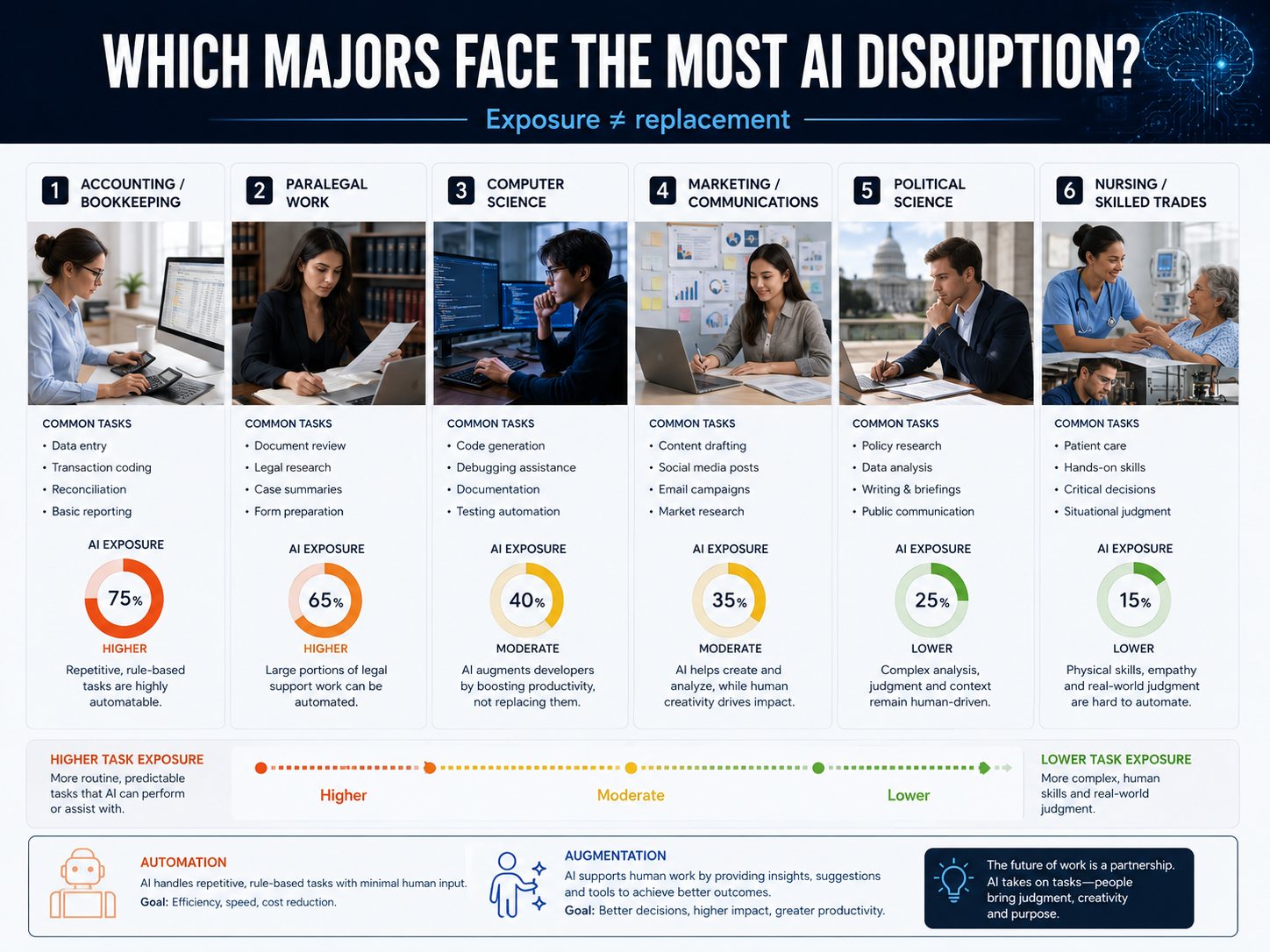
Majors tied to routine, predictable, rules-based work tend to carry more near-term automation exposure than majors built around judgment, creativity, or interpersonal trust. That’s the pattern researchers keep finding, though the details matter more than the headline.
A Federal Reserve analysis found relatively high predicted generative-AI exposure in fields like mathematics and computer science, with engineering and technology fields showing particularly high exposure tied to image-generation tools. Accounting and political science/government also showed up among majors with notable exposure to language-model-based tasks — Source: Federal Reserve, 2025. That last one tends to surprise people, since accounting doesn’t usually top anyone’s “at risk from AI” list.
Here’s the important nuance, though: high exposure doesn’t automatically mean job loss. The Fed’s own analysis is careful to note that higher exposure could mean automation in some cases and augmentation — AI making a worker faster, not obsolete — in others. It genuinely depends on how the work is structured.
| Major or Field | AI Exposure Level | What This Actually Means |
|---|---|---|
| Basic accounting/bookkeeping | High | Routine reconciliation and standard reporting tasks are increasingly AI-assisted |
| Entry-level paralegal work | High | Standardized document review and drafting is a strong fit for current AI tools |
| Computer science | High (but nuanced) | Coding assistance is widespread, but system design and judgment remain human-led |
| Marketing/communications | Medium | Content generation is AI-assisted, but strategy and audience insight aren’t |
| Political science/government | Medium-High | Language-heavy research and drafting tasks show notable exposure |
| Nursing/allied health | Low | Hands-on judgment and patient trust remain firmly human territory |
| Skilled trades | Low | Physical, situational problem-solving resists automation |
For a closer look at which specific skills are already being automated across industries, check out our breakdown of what AI is already replacing in 2026 — and what’s still safe.
Separate research from Jianqi Huang and C. Y. Kelvin Yuen found that in areas with higher local AI labor demand, students were reallocating toward AI-adjacent majors like computer science and engineering, alongside relative declines in some education and humanities programs — Source: Huang & Yuen, 2026. Worth noting: that’s a correlation observed in enrollment patterns, not a claim that those declining fields have less inherent value.
Which Majors Are Becoming More Valuable Because of AI?
Majors that pair domain expertise with human judgment, physical presence, or interpersonal trust are actually gaining ground, not losing it. This is the flip side of the exposure conversation that tends to get less attention than it deserves.
Nursing, clinical psychology, and skilled trades depend on hands-on judgment and human trust that current AI simply can’t replicate. A nurse practitioner’s diagnostic reasoning combined with bedside communication isn’t something a language model can do independently, no matter how good the underlying model gets.
At the same time, majors that train students to direct AI rather than compete with it are seeing real demand growth. Data science, applied statistics, and human-computer interaction programs fall into this bucket — they’re not “safe from AI,” they’re built around working with it. Hybrid programs like health informatics or business analytics are growing for the same reason: they blend a traditional field with the technical fluency employers now want.
Traditional majors haven’t lost their relevance either, in my view — they’ve just changed what makes them valuable. AI can generate an output, but organizations still need people who understand the context, judge the quality, and take responsibility when something goes wrong. A healthcare professional who understands both medicine and AI tools is generally more useful than someone who understands AI tools but has no healthcare background.
How Is AI Changing the Skills Employers Actually Expect?
Employers increasingly treat baseline AI fluency as a given, regardless of major, rather than a specialization reserved for computer science graduates. That’s a real shift from even a few years ago.
The World Economic Forum’s 2025 Future of Jobs report found that AI and big data, technological literacy, analytical thinking, creative thinking, and adaptability are all expected to become significantly more important skills through 2030 — Source: World Economic Forum, 2025. Separately, the WEF estimates that around 39% of workers’ existing skill sets will be transformed or become outdated in that same window — Source: World Economic Forum, 2025.
What that means practically: you don’t need to become a programmer to stay competitive. You need to become a fluent user of AI tools within whatever field you’re already in. Soft skills — communication, critical thinking, ethical judgment — are becoming more valuable precisely because they’re the things AI still can’t replicate well. Pairing your major with even a basic understanding of relevant AI tools can meaningfully strengthen your resume without adding a single semester to your timeline.
Should You Actually Switch Your Major Because of AI?
For most students, switching majors entirely is not the right response to AI anxiety, and it’s often not the most effective one either. Career resilience tends to come from combining domain knowledge with AI literacy and adaptable skills, not from chasing whatever major currently looks “safest.”
Take a psychology major who adds a data analysis certificate — that combination opens the door to UX research, a genuinely growing field that values both human insight and technical skill. That’s a much smaller lift than restarting a degree from scratch, and it preserves the years already invested.
That said, a switch can make sense in specific situations — if your current major is narrowly built around tasks AI already handles well, and there’s no realistic path to add adjacent skills within your existing program. Before making that call, it’s worth sitting down with an academic advisor and mapping out concrete alternatives rather than making the decision out of pure anxiety. A useful way to frame that conversation: ask which specific tasks in your target career are automatable versus which require judgment your degree is training you for.
Here’s a quick comparison framework worth running through before deciding:
| Question | Current Major |
Alternative Major |
AI-Adjacent Option |
|---|---|---|---|
| Do you actually enjoy the subject? | — | — | — |
| What careers does it realistically support? | — | — | — |
| How exposed are those careers to automation? | — | — | — |
| What AI skills would complement it? | — | — | — |
| Can you build a portfolio in this field? | — | — | — |
Filling that out honestly tends to be more useful than any “top 10 AI-proof majors” listicle floating around online.
What Does an “AI-Proof” Career Path Actually Look Like?
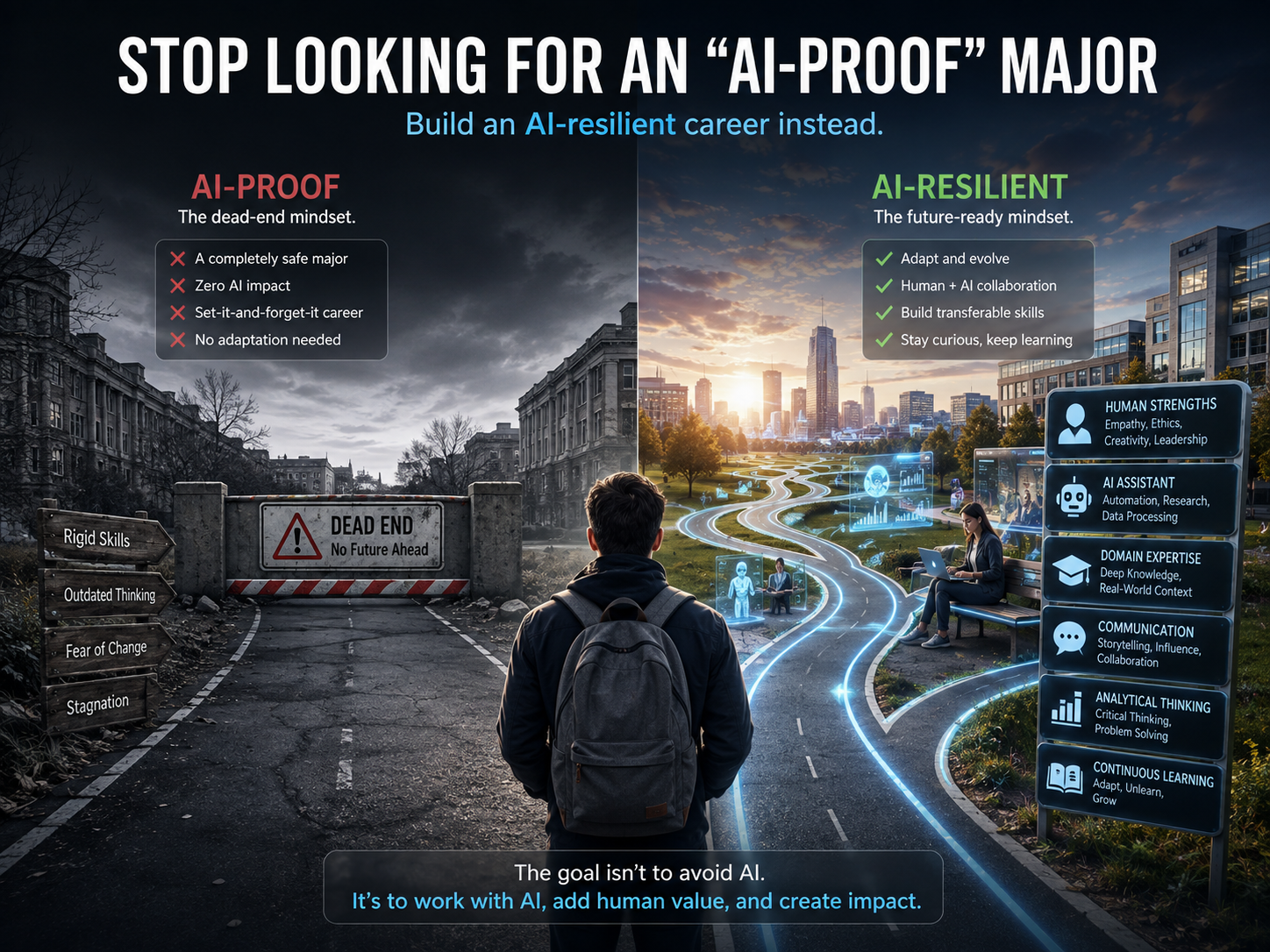
Honestly, there’s no such thing as a truly AI-proof major — the more accurate term is AI-resilient, meaning a career path built to adapt as the technology keeps evolving. It’s a subtle distinction, but it changes how you should be thinking about this.
If you want a deeper breakdown of what this actually looks like in practice, our guide on how to become “AI-proof” in your career in 2026 walks through realistic steps rather than vague advice.
An AI-resilient path typically combines a field rooted in human judgment, physical presence, or interpersonal trust with enough technical fluency to work alongside AI tools rather than get sidelined by them. A physical therapy major who picks up basic health-informatics knowledge, for example, builds a genuinely durable combination — the clinical judgment stays human, while the technical layer keeps them current.
No career is entirely immune to disruption, and anyone promising otherwise is overselling it. The goal isn’t finding an escape hatch from technological change — it’s building a skill set flexible enough to keep pace with it.
How Can Students Add AI Literacy Without Switching Majors?
Adding AI literacy usually means layering coursework in data analysis, prompt design, or applied machine learning onto an existing major rather than restarting a degree. Most universities have caught up on this front faster than you’d expect.
According to AP News reporting from 2026, colleges are seeing rising interest in AI and computer science coursework from students well outside traditional tech majors — including students studying psychology, music, and biology, who are adding relevant electives without switching their primary field. A history major, for instance, could realistically add a four-course data analytics certificate without pushing back graduation at all.
Beyond formal coursework, students can build this literacy independently — free online courses, workshops, and hands-on practice with widely available AI tools all count. A practical starter toolkit worth building over a semester or two includes: a general AI assistant for research and drafting, a coding-focused AI tool if your field touches technical work, a spreadsheet or data-analysis workflow, and at least one field-specific AI application relevant to your major.
One caveat worth being upfront about: AI-generated information can be inaccurate, incomplete, or subtly biased. Using these tools well requires verification skills and enough subject knowledge to catch when something’s off. The strongest students aren’t the ones producing the longest AI-generated output — they’re the ones who know when to trust it and when not to.
What Tools Can Help You Evaluate Your Major’s Future Viability?
Several publicly available resources let students check how AI is likely to affect their field before making a major decision, rather than relying on gut feeling or headlines. Government and academic labor-market databases publish occupational outlook data broken down by automation exposure, which is a solid starting point.
Beyond that, university career centers increasingly track how specific majors translate into real hiring outcomes, and several free platforms let you compare AI-exposure scores across occupations. Paid career-planning tools sometimes offer more granular AI-specific scoring, but they’re a nice-to-have rather than a necessity — you can get a genuinely useful picture with free resources alone.
What Should You Actually Do in Your First Two Years?
The first two years of college are the best window to build AI literacy without touching your core major requirements, since general education electives give you room to experiment. Use one or two of those elective slots on a data or AI-adjacent course, even if it’s outside your primary field.
Beyond coursework, seek out informational interviews with people actually working in your target field — they’ll tell you far more about how AI is changing day-to-day work than any survey will. Building internship experience early, even in smaller or less competitive roles, gives you a firsthand look at how employers are actually integrating these tools rather than how headlines describe it.
A five-step plan that tends to work well:
- Map your major to real careers. Identify three to five occupations your degree realistically supports.
- Map AI exposure within those careers. Figure out which specific tasks are automatable versus judgment-heavy.
- Add one or two complementary skills. Pick AI, data, or technical skills that genuinely strengthen your major.
- Build tangible evidence. An internship, research project, or portfolio piece proves you can apply what you’ve learned.
- Reassess annually. AI capabilities and employer expectations are moving fast enough that a yearly check-in is worth the time.
Conclusion
AI isn’t eliminating the value of a college degree — it’s changing what makes one valuable, and the shift is happening faster than most students expected. Majors built around routine, predictable tasks are under real pressure, while majors combining human judgment with AI fluency are becoming more resilient, not less relevant. The Gallup data makes clear this isn’t a fringe worry: with 42% of bachelor’s students seriously considering a major change and 16% already acting on it, AI’s influence on college major choices has moved well past hypothetical. The smartest response for most students isn’t panic-switching majors — it’s layering in AI literacy, relevant certificates, or practical projects early enough that they actually matter by graduation. Treat this moment as a chance to adapt rather than a threat to dodge, and you’ll likely graduate better prepared than the students who spent four years just waiting to see what happens.
Frequently Asked Questions
FAQ 1: Is AI actually causing college students to change their majors?
Yes — Gallup’s 2026 survey found that 16% of currently enrolled students had already changed their major or field of study because of AI, with 13% of bachelor’s students specifically reporting this change.
FAQ 2: What is the safest college major in the age of AI?
There isn’t a single “safest” major — exposure depends on the specific tasks within a career, not the major’s name. Fields built around hands-on judgment, physical presence, or interpersonal trust, like nursing or skilled trades, currently show lower automation exposure than routine, rules-based fields.
FAQ 3: Should I switch from a humanities major to computer science because of AI?
Not automatically. Computer science and engineering remain in demand, but the Federal Reserve’s own analysis found notable AI exposure within math and computer science fields too — meaning even “AI-safe” majors face real change. A stronger move for most humanities students is adding AI-adjacent skills rather than switching fields entirely.
FAQ 4: How can I tell if my specific major is at risk from AI?
Break your major down into the real occupations it leads to, then break those occupations into individual tasks. Classify each task as likely automatable, augmentable by AI, or still human-led — this gives a far more accurate picture than judging an entire major at once.
FAQ 5: Do employers really expect AI skills from non-tech majors now?
Increasingly, yes. Job postings across marketing, business, and communications fields are listing AI tool proficiency as a baseline expectation rather than a specialized skill, reflecting the broader skills shift the World Economic Forum has tracked through 2030.
Author & Editorial Information
Written by Connor Mitchell: Connor Mitchell is a technology and education content writer covering digital trends, emerging technologies, and topics affecting everyday life. His work focuses on presenting technology-related developments and changing trends in a clear, accessible way for general readers.
Reviewed by: Editorial Review Team & Technology Content Specialists.
Disclaimer: This article is based on publicly available research, academic studies, industry reports, news coverage, and other reliable sources available at the time of publication. The relationship between artificial intelligence, education, career choices, and employment continues to evolve as new technologies, research, and workplace trends emerge. Individual experiences and outcomes may vary, and the information presented should not be considered academic, career, financial, or professional advice. Readers are encouraged to consult current and reliable sources when making important educational or career decisions. This content was initially drafted with AI assistance and has been carefully reviewed, edited, refined, and fact-checked by human editors to improve accuracy, clarity, originality, and editorial quality.