
By Alexander Reed, an AI automation expert with 8+ years of experience specializing in practical monetization strategies, workflow systems, and scalable digital income models.
Summarize this blog post with: ChatGPT | Perplexity | Claude | Grok
You’ve probably seen the posts. “I made $8,000 last month using AI — here’s how.” And honestly? Some of them are even true. But most skip the parts that matter — the niche they spent a year building, the existing audience, the freelance clients they already had before AI entered the picture.
Here’s the thing: making money using AI is genuinely possible in 2026. The tools are better, the demand is higher, and the barrier to entry is lower than it’s ever been. But it’s not magic. What actually works looks less like passive income and more like smart leverage — using AI to do more of what you’re already good at, faster. This guide breaks down the best ways to make money with AI right now, including what each method realistically pays, how long it takes to see results, and how to get started without wasting time on approaches that don’t pan out.
Key Takeaways
- AI is a force multiplier, not a shortcut — every realistic income method still needs a skill, niche, or audience behind it.
- Freelancers using AI tools can complete 3–5x more work in the same hours, directly increasing what they earn without burning out.
- Selling AI-generated digital products like prompt packs, templates, and niche eBooks is one of the easiest ways to make money with AI — low startup cost, no client chasing.
- AI automation services for small businesses are in massive demand right now and don’t require coding skills to deliver.
- Faceless YouTube channels built with AI are real — but they typically take 6–12 months before ad revenue kicks in.
- The fastest paths to income involve active service work (writing, consulting, automation). Passive models take longer but compound over time.
- The right method for you depends on your current skills, your weekly availability, and whether you need money now or can play a longer game.
What Does It Actually Mean to Make Money with AI?

Making money with AI means using artificial intelligence tools to increase the speed, scale, or quality of something that someone else pays for — not handing everything off to a bot and watching the cash roll in.
That distinction is worth sitting with, because a lot of the content out there blurs it badly. From what I’ve seen, people who earn well with AI fall into one of three groups. There are service providers who use AI to do their existing work faster — writers, designers, marketers, consultants. There are product builders who use AI to create things people buy — templates, tools, courses, content libraries. And there are system builders who use AI to automate workflows that generate income with less active involvement over time.
What’s common across all three? You still bring something to the table. AI amplifies what you have. If you bring a skill, it makes it faster. If you bring market knowledge, it helps you dominate a niche. If you bring nothing — honestly — it gives you nothing worth selling. That’s the part most viral posts conveniently leave out.
AI isn’t profitable on its own. You are — and AI makes you more so.
Why 2026 Is a Genuinely Good Time to Start (But the Window Is Real)
Here’s something a lot of people don’t want to hear: the best time to start was 2023. The second best time is now — but only if you move with some urgency.
AI adoption has accelerated dramatically. Over 78% of organizations globally are now actively using AI in some part of their operations — Source: McKinsey Global Survey, 2025. That’s not a trend anymore; it’s a baseline. And as more businesses adopt AI, the gap between “we want to use AI” and “we know how to actually do it” keeps getting wider. That gap is where the money is.
The realistic opportunity in 2026 isn’t in building the next foundation model. It’s in becoming the person who helps businesses and individuals use the tools that already exist — more effectively, faster, and with less friction. Is AI profitable as a business? Absolutely — if you’re solving a real problem for a specific person. Vague doesn’t pay.
The Most Realistic Ways to Make Money with AI in 2026

AI-Assisted Freelance Writing and Content Creation
Freelancing is still one of the easiest ways to make money with AI, and it’s where most beginners should start. The model is simple: you use tools like ChatGPT or Claude to handle first drafts, outlines, and research synthesis, then apply your judgment, voice, and editorial skill to turn it into something a client would actually pay for.
A freelance writer who used to produce 3 articles a week can now comfortably deliver 8–12 with the same calendar. Clients pay per piece, not per hour of your time. That math changes everything. For a breakdown of the best AI tools for freelancers, it’s worth reading before you commit to one tool.
Realistic income range: $2,000–$8,000/month for full-time intermediate writers Time to first dollar: 1–2 weeks if you already have samples Best platforms: Upwork, Contra, LinkedIn, direct outreach.
Freelancers using AI tools for writing report completing projects 3–5x faster than traditional workflows — Source: Upwork Future of Work Report, 2025.
Before you jump in, it’s also worth reading our breakdown of AI agents vs freelancers — especially if you’re positioning yourself against automation.
Selling AI-Generated Digital Products
Selling AI-generated digital products — prompt packs, Canva templates, niche eBooks, Notion systems — is one of the best ways to make money with AI for people who don’t want client work. You build it once, list it, and sell it repeatedly.
The products that actually convert well are specific. A generic “ChatGPT prompts” pack won’t move. A “150 ChatGPT prompts for real estate agents” or “AI workflow system for social media managers” — that sells, because it solves a real problem for a real person. Platforms like Gumroad and Etsy are the dominant distribution channels here.
Realistic income range: $200–$3,000/month (passive, after initial creation) Time to first dollar: 1–4 weeks.
AI Automation Services for Small Businesses
This one is underrated, and from what I’ve seen, it’s among the most profitable AI side hustle ideas available right now — especially for people without a technical background.
Small businesses are buried in repetitive tasks: email follow-ups, CRM updates, social scheduling, invoice generation, lead routing. They know these things could be automated. They don’t know how. That’s where you come in. Using tools like Zapier or Make, you can build custom automation workflows — no coding required — and charge $300–$1,500 per build, plus ongoing retainers of $150–$500/month per client.
AI automation services can reduce business operational costs by up to 30% — Source: McKinsey, 2024. Businesses know this stat. They’re motivated.
Realistic income range: $3,000–$10,000/month with 5–10 active clients Time to first dollar: 3–6 weeks.
If you want to see exactly how this plays out, read our case study on what a fully automated AI side hustle actually looks like in practice — it breaks down the tools, timeline, and real numbers.
Faceless YouTube Channels Powered by AI
Faceless YouTube channels are real. I want to be honest about this: they’re also slower than anyone on TikTok will tell you. But they work.
The production stack is straightforward — ChatGPT for scripts, ElevenLabs for voiceover, Pictory or InVideo for video assembly, Canva AI for thumbnails. You can produce a complete video without showing your face in 3–4 hours. Niches that consistently perform: personal finance, AI news, history, self-improvement, productivity. The catch is that YouTube typically requires 1,000 subscribers and 4,000 watch hours to monetize, which realistically takes 6–12 months of consistent publishing.
Over 2.7 billion users watch YouTube monthly — Source: YouTube, 2025. The audience is there. Getting to it takes patience.
Realistic income range: $0–$500/month in year one; $1,000–$5,000/month by year two.
Prompt Engineering as a Service
Prompt engineering is the practice of designing structured, optimized inputs for AI systems to produce specific, high-quality outputs — and honestly, it’s become a legitimate income stream faster than most people expected.
Businesses integrating AI into their workflows quickly realize that generic prompts produce generic results. They need someone who can build prompt libraries for their marketing team, optimize how their support bot responds, or design an AI workflow for a specific internal process. Rates run $75–$200/hour.
Realistic income range: $2,000–$6,000/month Time to first dollar: 2–4 weeks with active outreach.
Print-on-Demand with AI-Generated Designs
Print-on-demand (POD) with AI-generated designs lets you sell custom merchandise — shirts, mugs, phone cases, posters — without holding a single piece of inventory. Platforms like Printful, Redbubble, and Merch by Amazon handle everything after the sale.
Your job is designing and uploading. Tools like Midjourney and Adobe Firefly can generate commercial-quality artwork in minutes. The secret to POD success is hyper-niching. Don’t upload generic designs. Go narrow — nurses who love hiking, retired teachers, specific dog breeds, regional pride.
Realistic income range: $100–$2,000/month Time to first dollar: 2–8 weeks.
Building a No-Code AI Micro-SaaS
A micro-SaaS is a small, focused software product that solves one specific problem for one specific audience — and no-code platforms have made this genuinely buildable without a developer.
Tools like Bubble, Glide, and Softr let you create functional web apps that plug into AI APIs. You charge a subscription. Real examples people are running: AI resume analyzers, niche SEO audit tools, AI-powered meal planners, cover letter generators. Fifty users at $15/month is $750/month recurring — and that compounds as you grow.
Realistic income range: $500–$10,000+/month once the product gains traction Time to first dollar: 1–3 months.
Affiliate Marketing with AI Content Sites
This is one of the laziest ways to make money with AI — in the sense that once it’s working, it requires less active effort than most other methods. But getting it working takes real time and strategy.
The model: build a niche website, use AI to produce high-volume SEO content, embed affiliate links throughout. The AI handles drafting; you handle strategy, editing, and link placement. This is where affiliate marketing with AI content as a skill becomes valuable. Meaningful organic traffic typically takes 6–18 months to build. The upside is that a well-built site earns 24/7.
68% of marketers report increased ROI after integrating AI into their content workflows — Source: HubSpot, 2025.
Realistic income range: $0–$300/month in year one; $1,000–$5,000+/month by years two and three.
AI Tutoring, Courses, and Coaching
If you’ve already spent meaningful time learning AI tools, you’re sitting on something teachable. And people will pay for that. One-on-one coaching, group cohorts, and self-paced courses are all viable formats depending on how you like to work.
Platforms like Teachable, Maven, and Gumroad handle the logistics. Your lived experience navigating the learning curve is exactly what beginners are willing to pay for.
Realistic income range: $1,000–$8,000/month Time to first dollar: 4–8 weeks.
AI-Powered Dropshipping
AI-powered dropshipping involves using AI for product research, ad copy, customer support automation, and trend forecasting — while a supplier handles inventory and shipping. This isn’t the wild west it was in 2019, but it’s more viable than ever when AI handles the parts that used to be time-consuming.
Realistic income range: $500–$5,000/month with the right product and ad strategy Time to first dollar: 4–8 weeks.
Effort vs Reward: A Realistic Comparison
Here’s the honest breakdown across methods. This table is the one I wish existed when I was figuring out which approach to prioritize.
| Method | Time to First Dollar | Income Ceiling | Skill Required | Competition |
|---|---|---|---|---|
| AI-Assisted Freelance Writing | 1 – 2 weeks | High ($8K+/mo) | Medium | High |
| Digital Products (prompts, templates) | 1 – 4 weeks | Medium ($3K/mo) | Low | Medium |
| AI Automation Services | 3 – 6 weeks | Very High ($10K+/mo) | Medium | Low – Medium |
| Faceless YouTube | 6 – 12 months | High ($5K+/mo) | Low – Medium | High |
| Prompt Engineering Consulting | 2 – 4 weeks | High ($6K+/mo) | Medium | Low |
| Print-on-Demand (AI designs) | 2 – 8 weeks | Medium ($2K/mo) | Low | High |
| Micro-SaaS / No-Code AI Tools | 1 – 3 months | Very High ($10K+/mo) | Medium – High | Low |
| Affiliate Content Sites | 6 – 18 months | High ($5K+/mo) | Medium | High |
| Online Courses / Coaching | 4 – 8 weeks | High ($8K+/mo) | Medium | Medium |
| AI Dropshipping | 4 – 8 weeks | Medium ($5K/mo) | Medium | Medium |
What AI Tools Do You Actually Need?
Honestly, less than you think. Overspending on tools before you’ve validated an approach is one of the most consistent patterns among people who don’t end up earning.
Writing and content: ChatGPT Plus ($20/mo) or Claude Pro ($20/mo). Pick one and go deep on it before adding anything else.
Video and audio: ElevenLabs (free tier available), InVideo AI or Pictory ($29–$30/mo). These three cover nearly every faceless video production need.
Design: Canva AI (free tier available), Midjourney ($10/mo). Canva is enough for most commercial design work.
Automation: Zapier and Make both have free tiers that are sufficient to build and sell your first few client automations.
No-code builds: Bubble (free tier) or Glide ($49/mo).
The global AI software market is expected to reach $391 billion by 2025 and keep climbing — Source: Statista, 2025. These tools aren’t going anywhere. Learn them.
The Mistakes That Keep People Stuck
The most common reason people fail to earn with AI isn’t a lack of tools — it’s a lack of focus. Here’s what that actually looks like in practice.
Chasing every new tool. A new AI platform drops every week. People who hop between them never develop real depth in any one method. Pick an approach. Give it 90 days before evaluating.
Skipping the skill layer. AI amplifies skill. A freelance writer with strong editorial judgment produces AI-assisted content worth $300 an article. Someone without that judgment produces content worth nothing, regardless of the tool.
Expecting passive income in month one. Most of the passive-ish models — affiliate sites, YouTube, digital products — take months before they generate meaningful returns. That’s not a flaw. It’s how they work. Treat them like investments, not vending machines.
No niche. “I write AI content for businesses” doesn’t convert. “I write AI-assisted long-form content for B2B SaaS companies” does. Specificity builds authority. Authority builds trust. Trust builds clients.
How to Choose the Right Method for You
The right AI income method is the one most closely aligned with something you already know, can be started with tools costing under $50/month, and has a clear path to a first paying client or sale within 30 days.
Three questions to guide the decision:
What do you already know how to do? Writers go to freelancing. Designers go to POD or digital products. Teachers go to courses. Analytically-minded people go to automation or financial content.
How much time do you have each week? Under 5 hours: digital products or POD. 5–15 hours: freelancing or consulting. 15+ hours: YouTube, affiliate sites, or micro-SaaS.
Do you need income now or can you play a longer game? Need money within 30–60 days: freelancing, consulting, or digital products. Can wait: YouTube, affiliate sites, or micro-SaaS.
Your 30-Day Action Plan
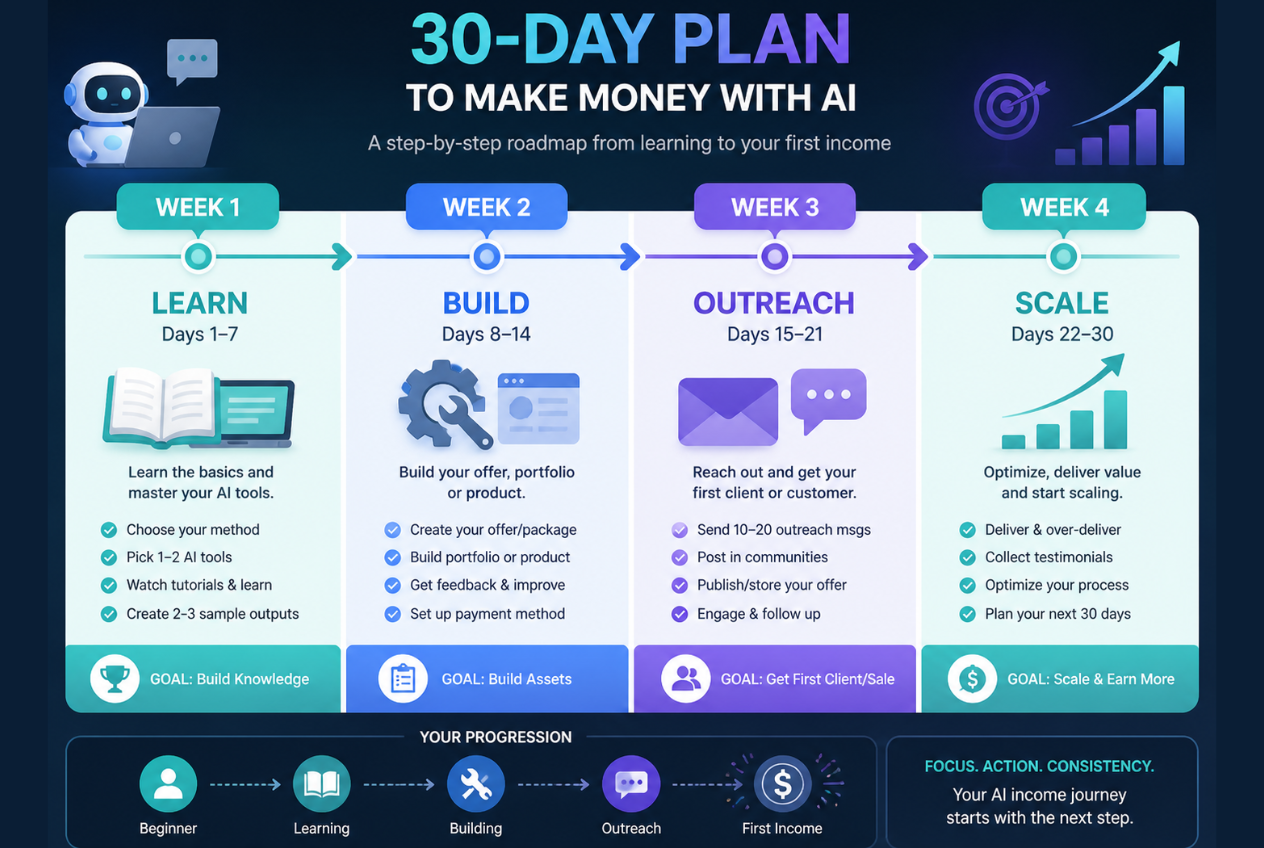
A structured 30-day plan removes the paralysis. Here’s the sequence that actually works.
Week 1 — Choose and learn. Pick one method. Subscribe to one AI tool. Spend 30–60 minutes daily learning it. Create 2–3 real test outputs.
Week 2 — Build your first deliverable. Create a portfolio piece, product listing, or service package. Get one piece of feedback from someone in your target market. Set up a way to get paid.
Week 3 — Find your first client or customer. For service methods: send 10–20 direct outreach messages on LinkedIn or Upwork. For product methods: publish your first listing and promote it in 2–3 relevant communities. For content: publish and distribute your first piece.
Week 4 — Iterate based on reality. Something got traction? Do more of it. Nothing happened? Change one variable — niche, offer, pricing, or outreach message. Don’t change all of them at once. Commit to 90 days before drawing a conclusion.
Conclusion: AI Is the Leverage. You’re Still the One Doing the Work.
The people making real, sustainable income with AI in 2026 aren’t the ones using the most tools. They’re the ones who picked a specific method, applied consistent effort, and treated AI as a multiplier — not a replacement for strategy, skill, or persistence.
The realistic ways to make money with AI are all right here. They work. They just work differently depending on who you are, what you already know, and how you like to operate. Start where your existing skills are strongest. Add AI to make those skills faster and more scalable. Then build from there.
The window to move early is still open. But it won’t be open indefinitely. The best time was two years ago. The second best time is right now.
Frequently Asked Questions
How can I use AI tools to generate passive income?
The most realistic paths to AI-based passive income are niche affiliate content sites, digital product sales (prompt packs, templates, eBooks), and faceless YouTube channels. All three require significant upfront effort — typically 3–12 months — before income becomes meaningfully passive. The key is building an asset that earns while you sleep, not just a task you complete for someone else. Affiliate sites and digital products on platforms like Gumroad or Etsy tend to be the most accessible starting points for beginners aiming for eventual passive returns.
What are the best AI platforms for freelance work?
For finding AI-related freelance work, Upwork, Fiverr, and Contra are the strongest starting points in 2026. Upwork has seen significant growth in AI-related job postings — categories like AI content writing, prompt engineering, and automation consulting have grown substantially. LinkedIn is increasingly useful for direct outreach, particularly for higher-ticket consulting work. Toptal and Expert360 are worth exploring once you have a track record. The platform matters less than your positioning — a sharp, specific service offering outperforms a generic profile on any platform.
Which AI services offer affiliate programs for earning money?
Several major AI platforms run affiliate programs worth exploring. Jasper AI, Copy.ai, and Writesonic all offer affiliate commissions in the 20–30% range on referred subscriptions. GetResponse and Systeme.io, which integrate AI features, offer recurring affiliate commissions. ElevenLabs, Pictory, and Descript also have affiliate structures for creators promoting their tools. The most effective affiliate strategy is to genuinely use the tool you’re promoting and build content around real workflows — review posts, tutorials, and comparison articles tend to convert far better than generic banner placements.
How do I start an AI-powered dropshipping business?
Starting an AI-powered dropshipping business involves four core steps: (1) use AI tools like ChatGPT or Minea to research trending products with solid margins and manageable competition; (2) set up a Shopify store and connect a supplier through DSers or AutoDS; (3) use AI to generate product descriptions, ad copy, and email sequences; and (4) run targeted ads on Meta or TikTok, using AI to analyze performance and iterate. The AI advantage in dropshipping is speed — faster product research, faster creative production, and faster data-driven decisions. Most beginners see their first sale within 4–8 weeks if they choose the right niche and invest in paid traffic.
Where can I find freelance AI writing jobs?
The best places to find freelance AI writing jobs in 2026 are Upwork (search “AI content writer” or “AI blog writing”), ProBlogger Job Board, LinkedIn Jobs, and Contra. Niche job boards like We Work Remotely and Remote.co also list content roles that increasingly require AI familiarity. Cold outreach directly to content agencies and SaaS companies remains one of the highest-converting methods — many are actively looking for writers who can blend AI efficiency with strong editorial judgment. Building a small public portfolio of AI-assisted writing samples before applying significantly improves your response rate.
Written by Alexander Reed: Alexander Reed is an AI Automation Expert with 8+ years of experience specializing in practical AI monetization strategies, workflow systems, and scalable digital income models. He’s helped hundreds of freelancers and solopreneurs build real income streams using AI tools.
Reviewed by: The Editorial Team — Our editorial process includes independent fact-checking, source verification, and review by practitioners active in the field.
Disclaimer: This article is based on practical use cases and real-world experimentation with AI tools and automation workflows. Results may vary depending on execution, niche, and market conditions. AI tools, features, and pricing evolve rapidly, so readers should independently verify current details before making decisions. This content was initially drafted with AI assistance and has been carefully reviewed, refined, and fact-checked by human editors and subject matter experts to ensure accuracy, clarity, and editorial integrity.