
By Caleb Morgan | Technology and Entertainment Content Writer
Summarize this blog post with: ChatGPT | Perplexity | Claude | Grok
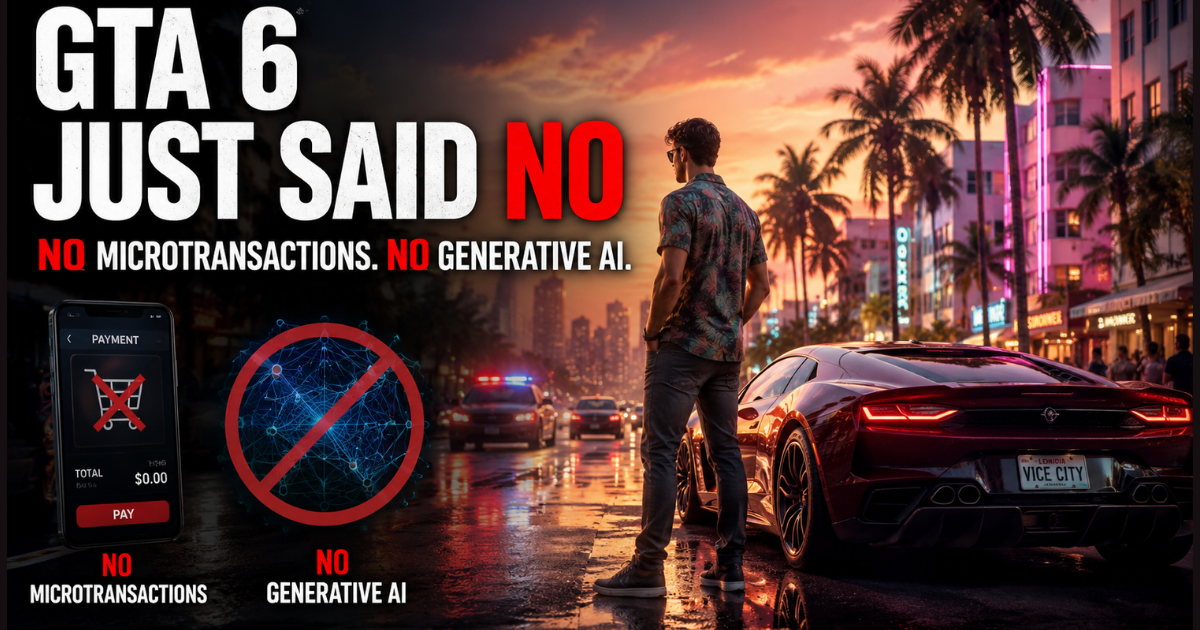
You’ve probably already seen the headlines. GTA 6 won’t have microtransactions in the single-player mode, and Rockstar says generative AI has no part in how the game was built. Sounds straightforward — except most of the coverage breezes past the nuances that actually matter here. There’s an important distinction between the single-player campaign and whatever GTA Online becomes, and a lot of people are conflating the two. In this piece, we’ll go through exactly what Rockstar confirmed, what “no generative AI” actually means in practice, and what remains genuinely unknown heading into the November 2026 launch.
Key Takeaways
- GTA 6’s single-player mode will not include microtransactions, according to Rockstar North co-studio head Rob Nelson’s reported comments — players get the full campaign experience at the purchase price.
- Generative AI was not used in GTA 6’s development, consistent with Take-Two CEO Strauss Zelnick’s earlier statement that AI has “zero part” in the game.
- “No generative AI” is not the same as “no AI” — traditional game AI still governs NPC behavior, traffic, combat logic, and simulation systems.
- GTA Online’s monetization model has not been confirmed either way — the single-player statement should not be read as a blanket promise about the online component.
- Rockstar’s approach is grounded in handcrafted development, including real-world research trips to Miami and on-the-ground styling work to inform how NPCs look and behave.
- GTA 6 launches November 19, 2026, currently confirmed for PlayStation 5 and Xbox Series X|S only.
- This announcement matters beyond GTA 6 itself — it signals how one of the industry’s biggest studios is choosing to position itself against two of modern gaming’s most contentious trends.
What Did Rockstar Actually Confirm?
Rockstar Games has confirmed that Grand Theft Auto VI’s single-player mode will contain no microtransactions, meaning players will access the complete story experience through a one-time purchase with no additional paywalled content. The studio also stated that generative AI was not used in the game’s development or content creation.
The confirmation came through Rockstar North co-studio head Rob Nelson during a reported visit by Kinda Funny Games, where he gave direct “no” answers when asked about both real-money spending inside the campaign and the use of generative AI. That directness is worth noting — these weren’t vague PR-speak responses, but concrete statements on two specific concerns.
Take-Two CEO Strauss Zelnick had previously told GameSpot that generative AI has “zero part” in GTA 6, describing AI as backward-facing while Rockstar was focused on what hadn’t previously been made possible in gaming. Nelson’s reported comments reinforce that position rather than walk it back.
Rockstar’s official GTA VI website currently lists the game for November 19, 2026, on PlayStation 5 and Xbox Series X|S — and that’s worth bookmarking as your baseline for official information rather than the flood of speculation circulating elsewhere.
Why GTA Fans Were So Worried in the First Place
Here’s the thing: the concern wasn’t irrational. GTA Online launched alongside GTA V in 2013 and quickly became one of the most aggressively monetized games in history through Shark Cards — purchasable bundles of in-game GTA$ that let players skip grinding for cash through missions. Rockstar’s decision to exclude microtransactions from GTA 6’s single-player mode is significant precisely because GTA Online generated billions in revenue through this model, raising entirely reasonable fears about where the franchise was headed.
Take-Two Interactive’s recurrent consumer spending — the earnings category that includes Shark Card revenue — contributed substantially to quarterly results year after year through the early 2020s. — Source: Take-Two Interactive Earnings Reports, 2022–2024.
From a player’s perspective, the concern was blunt: if GTA Online proved people would pay to progress faster, what would stop Rockstar from designing GTA 6’s story mode around the same principle? The history of microtransactions in AAA games doesn’t help — Star Wars Battlefront II‘s loot box backlash in 2017 and NBA 2K‘s ever-deepening VC economy showed that single-player or story-adjacent experiences were no longer automatically immune to monetization pressure.
A single-player game is supposed to work like this: you buy it, you play it, you progress. Removing real-money purchases from that loop means the campaign’s economy — earning cash through heists and missions, investing in properties, unlocking gear — stays intact as a design system rather than becoming a psychological nudge toward your credit card.
What “No Generative AI” Actually Means (and What It Doesn’t)
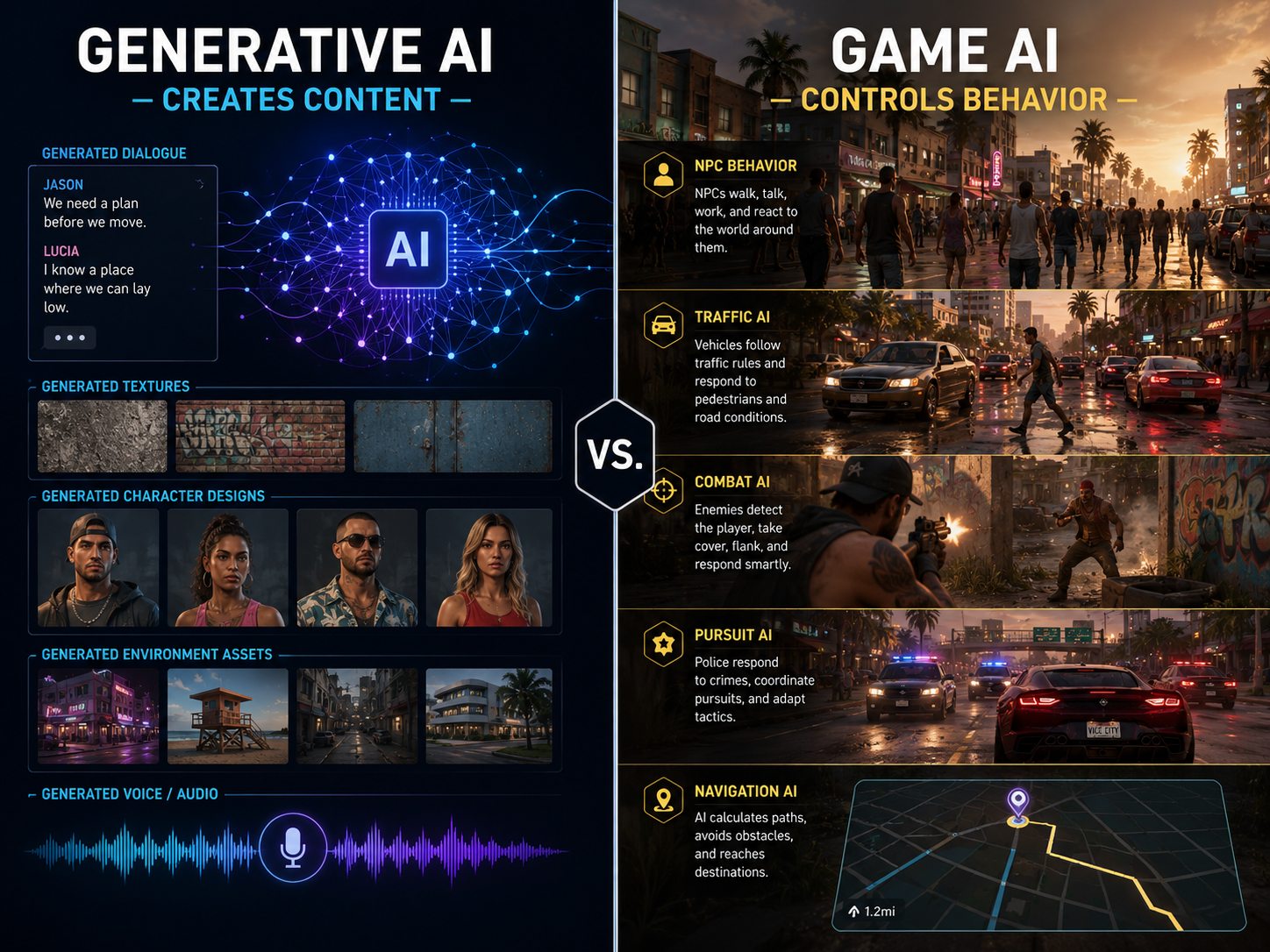
Generative AI in game development refers to machine learning models that can autonomously produce content — NPC dialogue, environmental textures, voice performances, quest scripts, even animation — without a human directly authoring each individual element. Studios including Ubisoft have publicly explored these tools, and the appeal for publishers is obvious: generative AI can reduce production costs and accelerate output at scale. For a world as detailed as GTA 6 reportedly is, the temptation to use it must have existed.
The entertainment industry beyond gaming is grappling with the same questions — Netflix recently disclosed that around 300 titles on its platform used generative AI in some capacity, which shows just how quickly the technology is spreading across creative industries and why Rockstar’s explicit refusal is notable rather than routine.
Rockstar’s public rejection of generative AI positions the studio as an outlier in an industry where major publishers have increasingly explored AI-generated NPC behavior, voice acting, and environmental content. That’s not a small position to take.
But — and this is important — “no generative AI” does not mean “no AI whatsoever.” Traditional game AI still controls how NPCs react when you steal a car, how traffic flows, how enemies respond in combat, and how the world simulation functions moment to moment. None of that is what Rockstar is ruling out. The statement is specifically about generative AI as a content creation tool, not about eliminating AI-driven gameplay systems.
Rockstar’s research-driven approach gives some texture to what “handcrafted” actually looks like in practice. Reports indicate the studio deployed a team in Miami to gather real-world environmental information, and hired a Miami stylist to inform how NPCs are dressed throughout the game. That’s a fundamentally different workflow from generating NPC wardrobes through a prompt. It’s also expensive and time-consuming in a way that signals genuine commitment to the philosophy rather than lip service. — Source: TweakTown, 2025.
Approximately 37% of game developers reported using generative AI in some capacity during 2024, up from 18% in 2022 — Source: Game Developers Conference AI in Games Survey, 2024. Rockstar is consciously stepping away from that trend.
The tension between AI-generated content and human authorship isn’t unique to game development — the same debate is playing out in creator culture, and our breakdown of AI influencers vs. human creators explores why audiences increasingly care about who — or what — is actually making the content they consume.
How GTA 6 Single-Player and GTA Online Compare
It’s worth putting the two models side by side, because they’re fundamentally different things operating under the same franchise name.
| Feature | GTA 6 Single-Player | GTA Online (GTA V) |
|---|---|---|
| Real-money purchases inside the game | No, confirmed by Rockstar | Yes — Shark Cards |
| Generative AI content | Not used | N/A (pre-generative AI launch) |
| Complete story at purchase | Yes | Ongoing updates required |
| Pay-to-progress mechanics | No | Yes — Shark Cards accelerated progression |
| GTA Online monetization | Not yet addressed | Shark Cards, in-game currency sales |
The single-player mode has always been a premium, buy-once experience — but after a decade of GTA Online’s financial success, fans had legitimate reason to wonder if that distinction would hold. Rockstar’s confirmation restores the original promise.
What it doesn’t do is tell us anything concrete about GTA Online’s future. That’s the part of this story most coverage underplays.
Will GTA Online Have Microtransactions?
Honestly? Probably some form of them — but that’s informed speculation, not confirmed fact.
While Rockstar has committed to a microtransaction-free single-player experience in GTA 6, the studio has made no equivalent commitments about GTA Online’s structure. GamesRadar noted the same gap: the single-player confirmation is real, but the online component’s business model is genuinely unknown. Take-Two has strong financial incentives to maintain recurring revenue from GTA Online — it’s been one of their most reliable income streams for over a decade. Whether that takes the form of Shark Cards again, a battle pass model, virtual currency, or something new hasn’t been revealed.
The honest version of this story is: the single-player confirmation is meaningful and worth celebrating. Extending it to “GTA Online will be free of all monetization” goes further than the evidence supports.
What Does This Mean for the GTA 6 Experience?
From a practical standpoint, a microtransaction-free single-player means the game’s pacing and economy can be designed around what’s actually fun rather than what nudges players toward spending. That’s bigger than it sounds. Games designed around microtransactions often calibrate their grind deliberately — making progression feel just slow enough that a shortcut purchase becomes tempting. Without that pressure, Rockstar can balance GTA 6’s in-game economy purely around player satisfaction.
Meanwhile, the no-generative-AI commitment means every character, line of dialogue, environment, and story beat reflects a deliberate human creative decision. That’s the philosophy that made GTA V’s story and world feel authored rather than assembled — and it’s a meaningful signal that Rockstar isn’t cutting corners on the craft of the thing.
GTA V’s modding community is also worth mentioning here. A clean, unencumbered single-player foundation has historically supported a healthier modding ecosystem — GTA V accumulated thousands of player-made experiences over more than a decade. A GTA 6 single-player built on the same principles could extend that legacy considerably.
What’s Still Unknown Before Launch
The biggest open questions all concern what comes after the campaign:
- GTA Online’s monetization structure — unconfirmed
- Whether paid single-player DLC or story expansions (think GTA IV’s The Lost and Damned) will follow launch — not ruled out
- PC launch timing — not yet confirmed by Rockstar
The confirmed facts are straightforward: GTA 6 launches November 19, 2026, on PS5 and Xbox Series X|S. Single-player has no microtransactions and no generative AI content. Everything else requires patience and a healthy skepticism toward rumor sites. For the most accurate and up-to-date information on platforms, editions, and release timing, Rockstar’s official GTA VI page remains the only source worth treating as ground truth — everything else is speculation until Rockstar says otherwise.
Conclusion
Rockstar’s confirmation isn’t just good news for one game — it’s a public statement that player trust and creative integrity are worth protecting even when the financial incentives to do otherwise are genuinely enormous. When one of the world’s most commercially successful studios turns down aggressive monetization and AI shortcuts for its flagship release, it raises an implicit standard for the rest of the industry.
For players, it means you can buy GTA 6’s story mode and trust you’re getting the complete, handcrafted experience Rockstar intended. For the industry, it means one fewer excuse to claim that microtransactions and AI-generated content are simply inevitable.
Keep the distinction between single-player and GTA Online in mind as more details emerge. Follow Rockstar’s official channels — rockstargames.com/VI — for confirmed information rather than speculation. And hold studios accountable for the promises they make before launch, not just after.
Frequently Asked Questions
FAQ 1: Does GTA 6 single-player have microtransactions?
No. Rockstar North co-studio head Rob Nelson confirmed that GTA 6’s single-player mode will not include microtransactions for cosmetics or in-game items. Players will not reach a point in the campaign where real-world money can be spent on virtual purchases.
FAQ 2: Did Rockstar use generative AI to make GTA 6?
No. Rockstar has stated that generative AI was not used in GTA 6’s development. Take-Two CEO Strauss Zelnick previously described generative AI as having “zero part” in GTA 6, and Rockstar’s latest comments are consistent with that position.
FAQ 3: Does “no generative AI” mean GTA 6 has no AI at all?
No. Traditional game AI — which governs NPC behavior, traffic systems, combat reactions, and world simulation — is a completely different technology from generative AI. Rockstar’s statement rules out AI as a content creation tool, not AI-driven gameplay systems.
FAQ 4: Will GTA Online have microtransactions?
Rockstar has not confirmed GTA Online’s monetization model. The confirmation about no microtransactions specifically covers the single-player experience. GTA Online’s business model remains an open question.
FAQ 5: Does Rockstar’s statement rule out paid DLC or story expansions?
No. The confirmation covers microtransactions within the base single-player experience. Premium story expansions — similar to GTA IV’s The Lost and Damned and The Ballad of Gay Tony — have not been specifically addressed or ruled out.
FAQ 6: Why does this announcement matter beyond GTA 6?
Because Rockstar is one of the most commercially successful studios in the world. When a studio at that scale publicly commits to no microtransactions and no generative AI in a flagship release, it sets a visible standard that other publishers have to respond to — whether they follow it or not.
Author & Editorial Information
Written by Caleb Morgan: Caleb Morgan is a technology and entertainment content writer covering digital trends, games, and emerging technologies. His work focuses on explaining news, developments, and changing trends in an accessible and straightforward way for general readers.
Reviewed by: Editorial Review Team & Technology Content Specialists.
Disclaimer: This article is based on publicly available information, official statements, news reports, company announcements, and other reliable sources available at the time of publication. Information about upcoming games, features, monetization plans, and technology can change as developers release new details or updates. Readers should refer to official announcements and current sources for the latest information. This article is intended for general informational purposes and should not be considered an official statement from the developer or publisher. This content was initially drafted with AI assistance and has been carefully reviewed, edited, refined, and fact-checked by human editors to improve accuracy, clarity, originality, and editorial quality.